The Chartered Institute of Management Accountants 2011
P3 – Performance Strategy
Performance Pillar
P3 – Performance Strategy
Friday 2 September 2011
Instructions to candidates
You are allowed three hours to answer this question paper.
You are allowed 20 minutes reading time before the examination begins
during which you should read the question paper and, if you wish, highlight
and/or make notes on the question paper. However, you will not be allowed,
under any circumstances, to begin using your computer to produce your
answer or to use your calculator during the reading time.
You are strongly advised to carefully read ALL the question requirements
before attempting the question concerned (that is all parts and/or sub–
questions).
ALL answers must be submitted electronically, using the single Word and
Excel files provided. Answers written on the question paper and note paper
will not be submitted for marking.
You should show all workings as marks are available for the method you use.
The pre–seen case study material is included in this question paper on pages
2 to 9. The unseen case study material, specific to this examination, is
provided on pages 10 and 11.
Answer the compulsory question in Section A on page 13. This page is
detachable for ease of reference
Answer TWO of the three questions in Section B on pages 16 to 21.
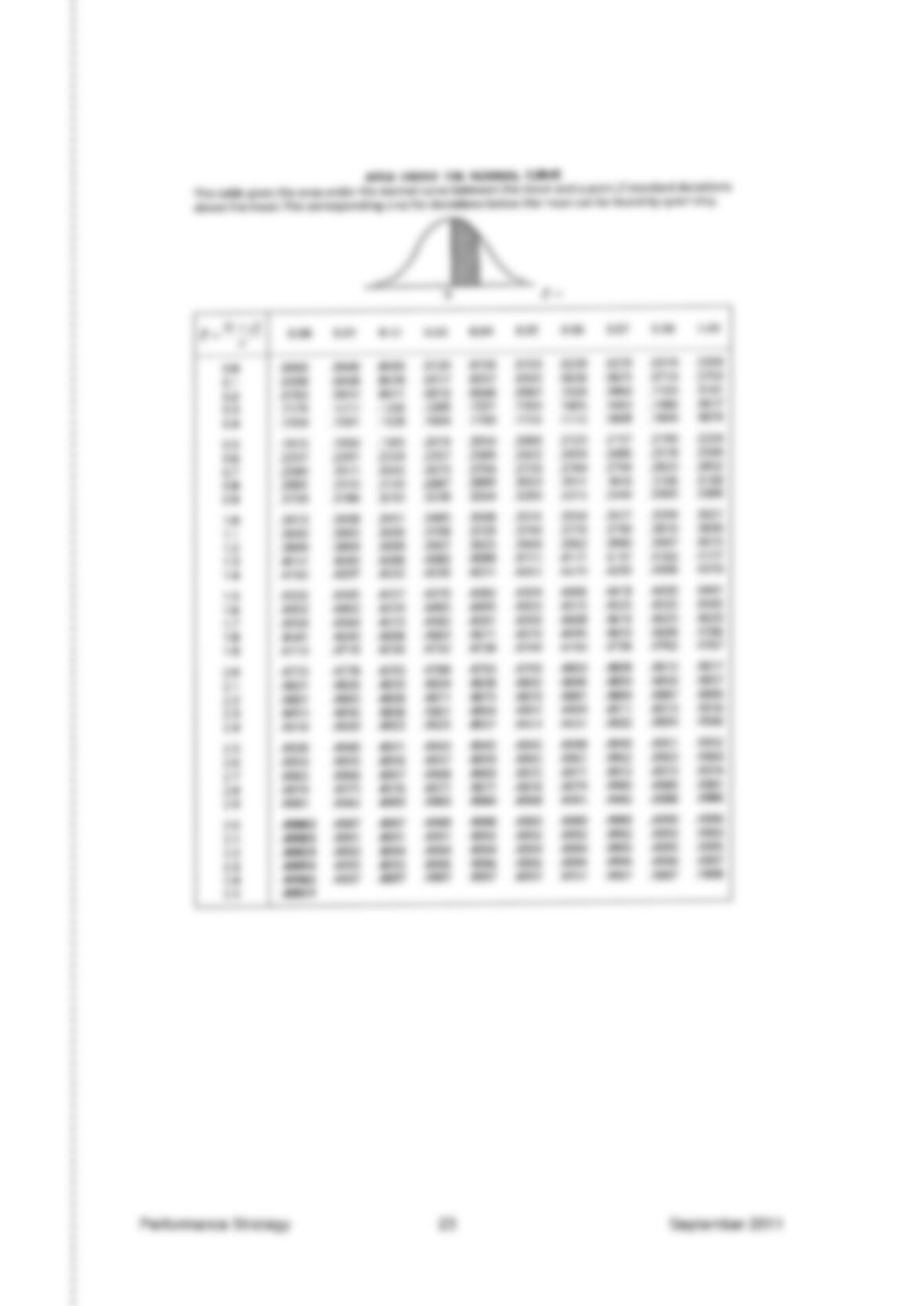
Maths tables and formulae are provided on pages 23 to 26.
The list of verbs as published in the syllabus is given for reference on page
27.
Your computer will contain two blank files – a Word and an Excel file.
Please ensure that you check that the file names for these two documents
correspond with your candidate number.
TURN OVER
September 2011
2
Performance Strategy
F plc
Pre–seen case study
Introduction
F plc is a food manufacturer based in the United Kingdom. It generates its revenue from three
divisions named the Meals, Snacks and Desserts divisions. Each division specialises in the
production of different types of food and operates from its own factory located on three
different sites in England. F plc’s head office is located in a remote part of England and is
about equidistant from each of the company’s three divisions.
Currently, F plc has a total employment establishment of about 10,000 full–time equivalent
employees, about 97% of whom are employed in its three divisions. It is constantly running
with about 700 full–time vacancies, mostly in the Desserts Division. This vacancy factor in the
Desserts Division impedes its productivity.
The company was founded over 150 years ago by an entrepreneurial farmer who saw the
opportunity to expand his farming business by vertically integrating into food production.
Instead of selling his crops on the open market, he established a mill and produced flour.
From this, it was a natural progression to diversify into producing other crops which were then
processed into different ingredients for food products.
The company grew steadily and it became clear at the beginning of the 20th Century that
increased production facilities were needed. It was at this point that the company built its first
factory which at the time was a state of the art manufacturing facility. As demand continued to
grow during the 20th Century, the company required additional manufacturing facilities and
made a public offering of shares in 1960 to finance this expansion. The public offer was
successful and F Limited was established. The original family’s holding in the company fell to
25% at this point. Although a second factory was opened with the capital that had been
raised, F Limited continued to manage the company on a centralised basis.
The next phase of development came in the late 1980’s when F Limited became F plc. After
this, F plc had a successful rights issue which raised sufficient capital to enable a third factory
to be built. It was at this point that the divisionalised and de–centralised structure was
established. Prior to this, the company managed its factories directly from its head office. The
family shareholding fell to 20% at this point, with one family member holding 10% of the
shares and family trusts holding the other 10%.
The environment in which F plc trades is dynamic, particularly with regard to the growth of
legislation relating to food hygiene and production methods. F plc now exports many of its
products as well as obtaining ingredients from foreign producers, which means that F plc
must observe legislative requirements and food standard protocols in different countries.
Mission statement
F plc’s mission statement, which was set in the year 2000, is as follows:
“F plc is committed to continually seek ways to increase its return to investors by expanding
its share of both its domestic and overseas markets. It will achieve this by sourcing high
quality ingredients, using efficient processes and maintaining the highest standards of
hygiene in its production methods and paying fair prices for the goods and services it uses.”
Performance Strategy
3
September 2011
Strategic aims
The strategic aims are set in order to enable F plc to meet the obligations contained in its
mission statement. F plc aims to:
(i) increase profitability of each of its divisions through increased market share in both
domestic and overseas markets
(ii) source high quality ingredients to enhance product attractiveness
(iii) ensure that its factories adhere to the highest standards of food hygiene which
guarantee the quality of its products
(iv) strive to be at the forefront in food manufacturing techniques by being innovative
and increasing efficiency of production with least waste.
Corporate Social Responsibility
F plc takes Corporate Social Responsibility (CSR) seriously. The post of Environmental
Effects Manager was created two years ago and a qualified environmental scientist was
appointed to it. The Environmental Effects Manager reports directly to the Director of
Operations. The role of the Environmental Effects Manager is to develop initiatives to reduce
environmental impacts, capture data on the environmental effects of divisional and head
office operations and report to the Board of Directors on the progress towards the
achievement of F plc’s CSR targets. An extract from F plc’s internal CSR report for 2010 is
shown in Appendix 1. F plc does not publish its CSR report externally.
Last year, F plc received criticism in the national press in England and in other countries for
exploiting some of its suppliers in Africa by paying low prices for ingredients. This resulted in
an extensive public relations campaign by F plc to counter these accusations. It established a
programme to channel funds to support farmers in Africa via payments made through African
government agencies. The programme, which is managed through F plc’s head office,
received initial financing from F plc itself and is now widening its remit to draw funding from
other sources including public funding from the European Union.
The Board of Directors
The Board of Directors comprises five executive and five non–executive members all of whom
are British. No member of the Board is from an ethnic minority.
The Chairman is a senior non–executive director and a retired Chief Executive of a major
quoted retail clothing company based in England. He received a knighthood two years ago for
services to industry.
The Chief Executive is 52 years old and was Director of Operations at F plc before taking up
his current post three years ago.
The Finance Director is 49 years old and a qualified CIMA accountant. He has experience in
a variety of manufacturing and retail organisations.
The Director of Operations is 65 years old and is a member of the original family which
founded the business. He has been employed by F plc for all of his working life. He took up
his current post three years ago following the promotion of the previous post holder to the role
of Chief Executive.
The Marketing Director is 43 years old and has held various positions in sales and marketing
for different organisations before being appointed to the Board. He came to the attention of
the Chief Executive when he was instrumental in a successful initiative to market a new
shopping complex in the city in which F plc’s head office is based. At the time, the Marketing
Director was the Chief Marketing Officer for the local government authority in the area.
The Director of Human Resources, the only female member of the Board, is 38 years old and
holds a recognised HR professional qualification. Last year she was presented with a national
award which recognised her achievements in the development of human resource
management practices.
September 2011
4
Performance Strategy
In addition there are four other non–executive directors on the Board. Two of them previously
worked in senior positions alongside the Chairman when he was Chief Executive of the retail
clothing company. One of them was the clothing company’s finance director, but is now
retired and the other was its marketing director but is now the sales and marketing director for
a pharmaceutical company. One of the other non–executive directors is a practising lawyer
and the other is a sports personality of national renown and a personal friend of the
Chairman.
The Divisional General Managers, responsible for each of the three divisions, are not
members of F plc’s board. The Divisions are organised along traditional functional lines. Each
division is managed by a Divisional Board which is headed by a Divisional General Manager.
Each Divisional Board comprises the posts of Divisional Operations Manager, Divisional
Accountant, Divisional Marketing Manager and Divisional Human Resources Manager. Each
division undertakes its own marketing and human resource management. The divisional
accountants are responsible for the management accounting functions within their divisions.
Each member of the divisional boards is directly accountable to the Divisional General
Manager but have professional accountability to the relevant functional F plc executive board
members.
Financial position and borrowing facilities
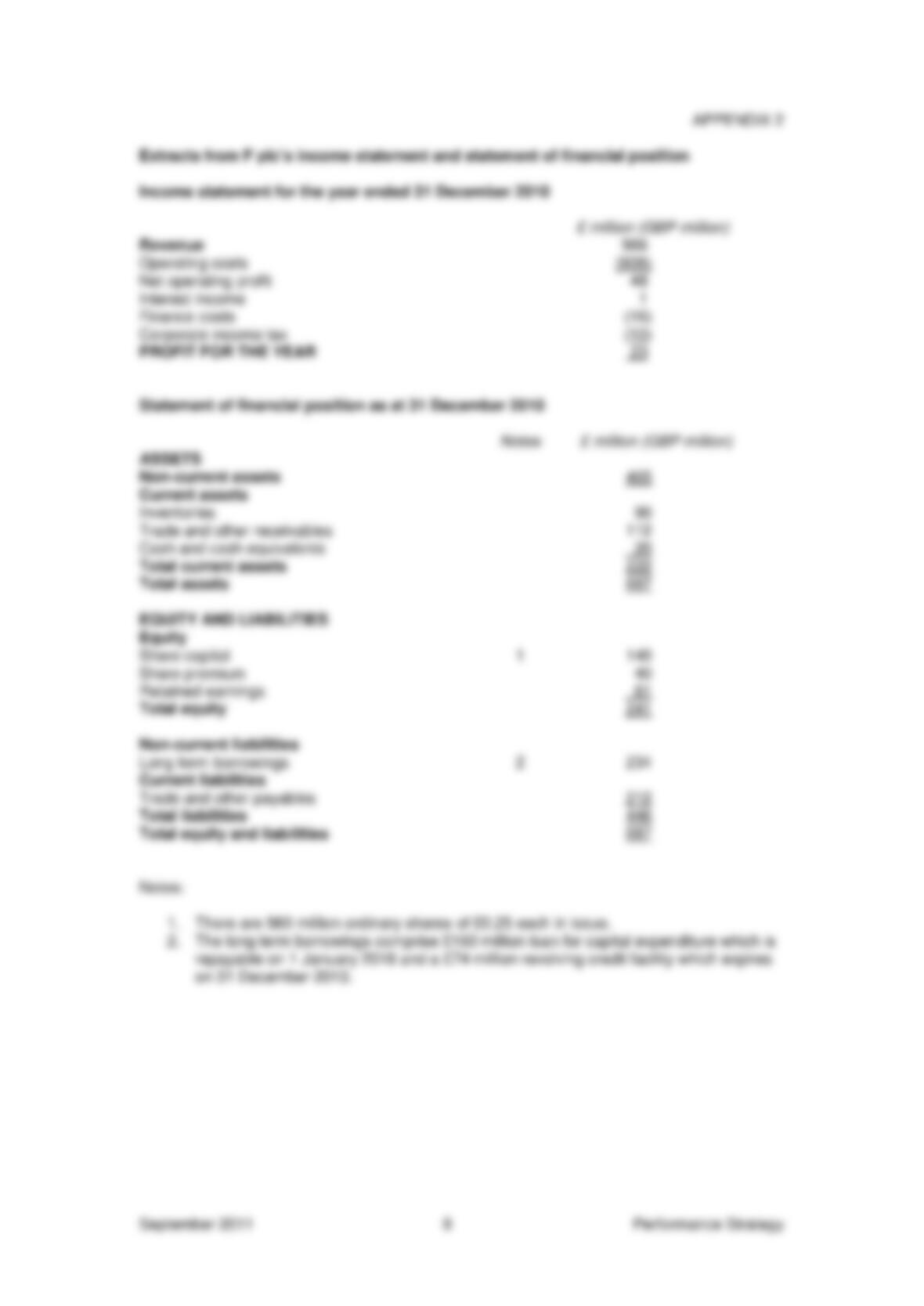
Extracts from F plc’s financial statements for the year ended 31 December 2010 are shown in
Appendix 2.
F plc’s long term borrowings are made up of a £160 million bank loan for capital expenditure
and a £74 million revolving credit facility (RCF).
The bank loan is secured on F plc’s assets and is repayable on 1 January 2018.
The RCF allows F plc to borrow, make repayments and then re–borrow over the term of the
agreement. This provides F plc with flexibility because it can continue to obtain loans as long
as it remains at or below £80 million, being the total amount agreed for this facility. The RCF
expires on 31 December 2013.
Planning process
The planning process employed by F plc is one which can be described as adhering to
classical rational principles. This has been the method of planning used for many years and
culminates in the production of a five year forecast. The annual budget cycle feeds in to the
strategic plan which is then updated on an annual basis. All F plc’s revenue is derived through
the operations of the three divisions. The only income generated by F plc’s head office is from
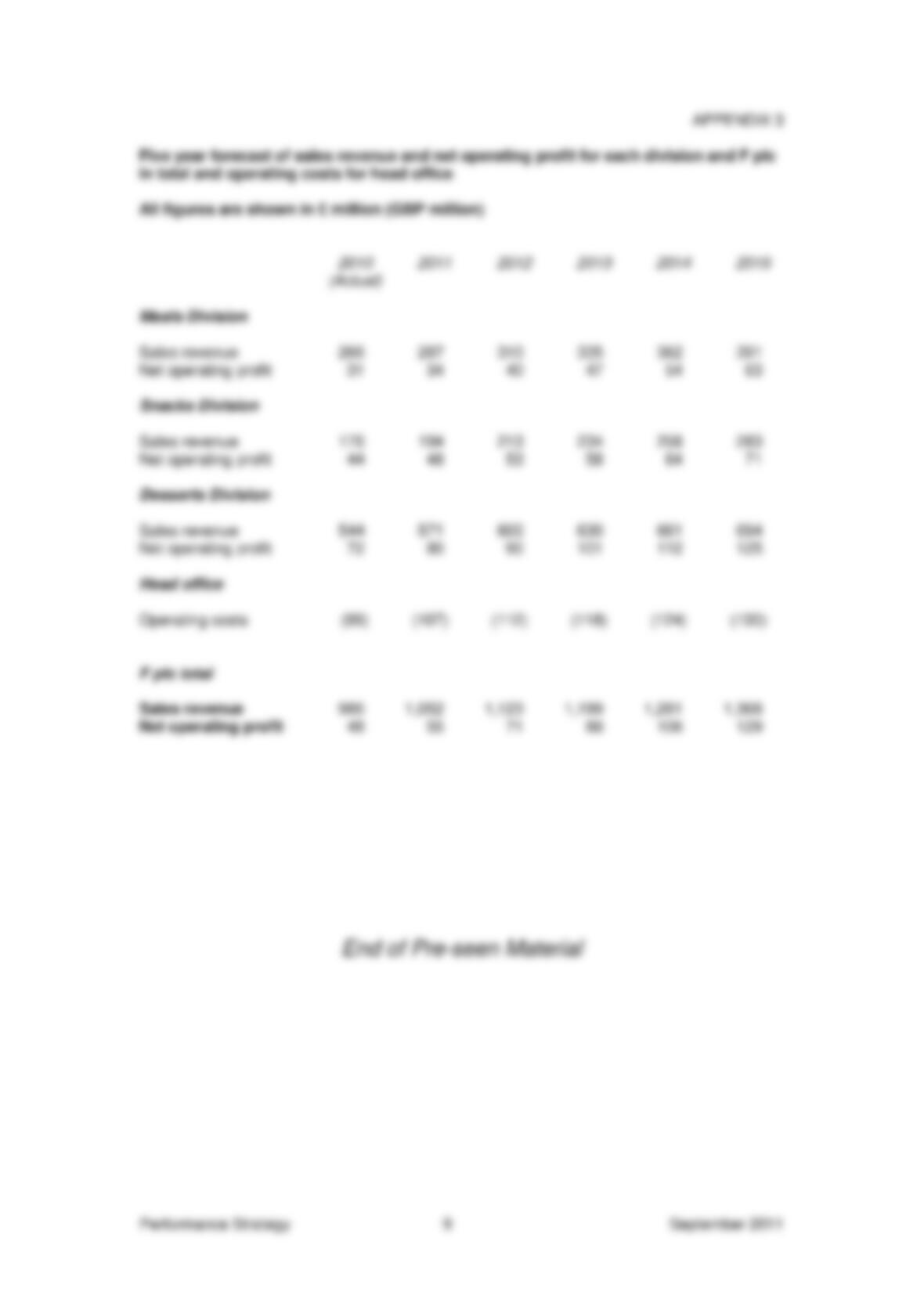
investments. The five year forecast for sales revenue and net operating profit for each division
and F plc in total, after deduction of head office operating costs, is shown in Appendix 3. This
shows that F plc is seeking to increase its sales revenue and net operating profit over the five
year plan period.
Competition within the industry
F plc is one of the largest food production companies in England. It had an overall share of
about 6% of its home market in 2010. Its nearest competitors held 5% and 7% market share
respectively in 2010. The products in the industry have varying product life cycles.
Competition is intense and there is a high failure rate for new products. Usually, new products
require significant marketing support particularly if a new brand is being established.
Organisational culture within each division
Different cultures have emerged within each division.
Meals Division:
In the Meals Division, each function operates with little direct interference from the Divisional
Board members. The approach is to allow each function to operate with as little control as
possible being exercised by the Divisional Board.
Performance Strategy
5
September 2011
Snacks Division:
In the Snacks Division, the emphasis of the Divisional Board is on product research and
development and marketing. The Snacks Divisional Board expects its divisional marketing
staff to undertake market research into customer tastes and preferences and then for
products which satisfy these to be developed by its divisional research staff.
Desserts Division:
In the Desserts Division, the finance function is the dominant force. The finance functions in
the other two divisions exert less influence over operations than is the case in the Desserts
Division. It is not unusual for the Divisional Accountant in the Desserts Division to have
confrontational meetings with managers of other functions. Such confrontation is particularly
evident in the monthly meetings between the Divisional Accountant and the Divisional
Marketing staff. It is clear that within the Desserts Division, the Divisional General Manager, a
food technologist by profession, and the Divisional Accountant, formerly an auditor with a
local government authority, maintain strict control over the operation of the division.
Further details relating to the three divisions are as follows:
Meals Division
The Meals division is located in the South of England. It specialises in manufacturing frozen
meals, which are designed to be easy for consumers to quickly heat up and serve. The meals
are sold to supermarkets and other retail outlets. Some are manufactured under F plc’s own
brand and others are manufactured under supermarkets’ own labels. The division is also
increasing its sales to welfare organisations which support elderly and infirm people. These
organisations purchase simple frozen meals in bulk which they then heat up to provide a hot
meal each day to those people in their care. In 2010, the Meals Division earned 14% of its
revenue from outside the United Kingdom.
One of the Meals Division’s most profitable products is a steak pie that is flavoured with
special gravy that was developed by one of F plc’s founding family members in the early part
of the 20th Century. F plc’s competitors cannot copy this gravy because the ingredients have
to be combined in a very precise manner and then cooked in a particular way. The recipe for
this gravy is known only to F plc’s Director of Operations and the manager of the pie factory.
Two of the Meals Division’s products are currently subject to investigation by the Food
Standards Authority of a European country. Please see Appendix 1 under the heading “Food
labelling” for more information on this.
Snacks Division
The Snacks Division, located in the East of England, mainly manufactures confectionery such
as packet savouries and chocolate bars. Its main customers are supermarkets and retail
shops. It has a growing market in continental Europe and in 2010 the division earned 19% of
its revenue from non–United Kingdom sales. Many of its products are F plc’s own brands,
although, similarly with the Meals Division, it supplies products to supermarkets under their
own label.
The Snacks Division successfully launched a new premium brand of chocolate bars in the UK
in 2010.
Desserts Division
The Desserts Division is located in the North of England where road, rail and air links are not
well developed. This has resulted in high transportation costs for goods into and out of the
factory. Originally, this location was chosen because the lease terms for the factory were very
competitive but in recent times the local taxes placed on the factory have become expensive.
There is some limited room for expansion on the site the factory occupies but the local
government authority has repeatedly rejected the expansion plans when the Division has
sought the necessary planning permission to put its plans into action. This has caused the
Divisional Board to consider whether it should move its entire operation to another part of
England where its expansion plans may be more easily accomplished.
September 2011
6
Performance Strategy
The Division has experienced technical and managerial staff shortages. The workforce of the
Division has an establishment of 4,700 full–time equivalent employees. Despite there being a
ready supply of manual labour for production work, the Desserts division runs with an
average of 385 full–time vacancies at any one time.
The Division’s products range from cold desserts, particularly ice cream, which can be eaten
directly from the packaging, to those which require some preparation by the final purchaser
before the product can be consumed. The Divisional Marketing Department has been
investigating the possibility of negotiating ‘Freezer deals’ by which the Desserts Division
would supply ice cream freezers to independent retailers which sell the Division’s ice cream
products. An independent retailer is a shop or outlet that is not part of a larger chain. This is
in order to investigate the possibility of increasing the Division’s share of the ice cream market
sold by independent retailers.
The Division’s sales increase in the periods which lead up to national and international festive
periods such as Christmas and Chinese New Year. The Division is constantly researching
new markets in an effort to increase its foreign earnings. Revenue from outside the United
Kingdom in 2010 represented 23% of the Division’s total revenue.
Inventory control and IT systems
There have been a number of problems across all three divisions in respect of inventory
control. Poor inventory control has led to high levels of wastage and obsolete inventory being
carried. This has been particularly problematic in respect of perishable ingredients. In the
case of the Desserts Division, the Divisional Accountant has estimated that 5% of the
Division’s potential revenue has been lost as a result of not being able to satisfy customer
orders on time, due to poor inventory control.
F plc operates a standard information management system across all the Divisions and at
Head Office. The Information Technology in use has been unreliable due to technical
malfunctions since the information management system was installed in 2001. Monthly
management accounts, provided by each division to head office are often late, sometimes not
being made available for up to three weeks into the subsequent month.
Internal audit
Until now, F plc’s Internal Audit function, which is based at Head Office, has tended to
concentrate its efforts on reviewing activities in the Meals and Snacks divisions as they each
produce lower revenues and net operating profits in absolute terms compared with the
Desserts division. The Internal Audit function’s approach of applying a “light touch” to the
Desserts Division is also in recognition of the influence exerted by the Divisional Finance
function over the Division’s operational activities.
Strategic development
The Board of Directors is now midway through its strategic planning cycle and is considering
how the company should move forward. There is a proposal to build and operate a factory in
West Africa to reduce air kilometres being flown in supplying the Meals Division with fresh
vegetables. It is intended that the African factory will freeze the vegetables and then transport
them to the Meals Division’s factory in England by refrigerated ship.
APPENDIX 1
Extracts from F plc’s internal Corporate Social Responsibility report for the year ended
31 December 2010.
This report was produced by the Environmental Effects Manager and presented to the
Board of F plc in February 2011.
Fair trading
In accordance with its mission statement, F plc is committed to paying a fair price for the
ingredients it uses in its products, particularly to farmers in the less developed economies of
the world.
Waste reduction and recycling
F plc set a target for the financial year 2010 that waste of ingredients should be cut by 2%,
measured by weight, from the 2009 levels. The actual ingredient waste was 2.5% lower in
2010 than in 2009 as measured by weight.
A target was also set for F plc to recycle 90% of its used packaging in the year 2010. It was
recorded that 85% of packaging in 2010 was actually recycled.
Food labelling
Legal requirements demand accuracy in food labelling, in respect of ingredients, product
description and cooking instructions in many countries. F plc employs a Compliance Manager
to ensure that relevant labelling laws in each country, with which the company trades, are
adhered to. A target is set for F plc to justify 100% of its claims in food labelling. Two products