tho75109_case21_C240-C250.indd C-240 12/18/18 10:49 AM
TJX Companies: Its Strategy in
Off-Price Home Accessories
and Apparel Retailing
David L. Turnipseed
University of South Alabama
In February 2018, TJX Companies, Inc., the world’s
largest off-price home accessories and apparel
retailer, completed 42 years of operations with sev–
eral enviable milestones: the company had edged up to
number 85 on the Fortune 500, surpassed $35 billion
in sales, and opened its 4,000th store, guided by a
highly effective global strategy. Sales had grown over
eight percent and comparable store sales increased 2
percent in fiscal year 2018. In the company’s 42-year
history, it had experienced an annual decline in
comparable store sales in only one year. The strong
earnings trend enabled TJX to increase its per share
dividends for fiscal 2019 by 20 percent, which made
21 consecutive years of dividend increases.
Ernie Herrman, the President and CEO of TJX,
looked back at his first year in charge of the huge, inter–
national off-price retailer with great satisfaction. As
the TJX Companies moved into fiscal 2019, President
Herrman pondered how to keep the company on the
same upward trajectory. Although the TJX Companies
had one small chain that was primarily e-commerce,
and its brick-and-mortar chains had e-commerce capa–
bilities, in a world ostensibly focused on e-commerce,
TJX had been very successful concentrating on its
brick-and-mortar chains. Given TJX’s steadily increas–
ing sales and profits in its present structure, should
the company divert part of its attention and resources,
and attempt to boost its internet sales? Also, given
the outstanding sales growth driven by opening new
stores worldwide, should the company stay the course,
or would concentration on certain geographical loca–
tions produce more sales and profits?
TJX: AN OVERVIEW
TJX traced its origin to the Feldberg cousins who
opened their Zayre (Yiddish for “very good”) dis-
count store in Hyannis, Massachusetts in 1956. Over
the years, Zayre purchased a women’s clothing chain,
opened Chadwick’s of Boston, launched a mem-
bership warehouse club, and a home improvement
chain. The first T.J. Maxx opened in Auburn, MA
in 1977, offering off-price upscale family apparel.
In 1987, the Zayre’s off-price chains were organized
as the TJX Companies, Inc., which were operated
as a subsidiary of Zayre. Also in 1987, TJX had an
IPO, with Zayre retaining 83 percent ownership. In
1989, Zayre divested its warehouse club division, and
acquired minority ownership in TJX companies that
had been publically traded. Zayre merged with TJX
and then adopted the name of its former subsidiary.
In 1990, TJX acquired Winners Apparel Ltd, a
Canadian chain similar to T.J. Maxx, and this chain
became Canada’s largest off-price stores. Two years later,
in 1992, HomeGoods, offering home fashions from
around the world, was launched in the United States.
TJX ventured overseas in 1994 and opened T.K. Maxx
in the United Kingdom (UK) and Ireland. Over time,
T.K. Maxx became the only major brick-and-mortar off-
price retailer of home fashions and apparel in Europe.
In 1995, TJX acquired the 496 store Marshalls chain,
which was the second largest off-price retailer of brand-
name family apparel in the United States.
CASE 21
Copyright ©2018 by David L. Turnipseed. All rights reserved.
Final PDF to printer

tho75109_case21_C240-C250.indd C-241 12/18/18 10:49 AM
CAsE 21 TJX Companies: It’s Strategy in Off-Price Home Accessories and Apparel Retailing C-241
TJX launched an off-price concept, named A.J.
Wright, in 1998, which was similar to Marshalls
and T.J. Maxx. A.J. Wright targeted moderate-
income families. In 2001, TJX opened HomeSense
in Canada, which was the first off-price home fash-
ion chain in Canada. HomeSense was similar to
HomeGoods in the United States and offered a wide
selection of off-price home fashions. TJX acquired
Bob’s Stores in 2003, which was a value-oriented,
casual family apparel and footwear retailer, located
in the Northeastern United States. In 2007, T.K.
Maxx opened stores in Germany, introducing the off-
price concept to that country.
In 2008, TJX sold Bob’s Stores to private
equity firms and opened the first HomeSense
stores in the UK. The expansion into Europe con–
tinued in 2009 when T.K. Maxx opened stores
in Poland. Also in 2009, T.K. Maxx launched its
e-commerce site, tkmaxx.com in the UK. TJX con–
solidated its A.J. Wright division, converting 91
stores to Marshalls, HomeGoods, or T.J. Maxx.
Marshalls was launched in Canada in 2011 and
in 2012 TJX acquired a U.S. off-price Internet
retailer, Sierra Trading Post. T.J. Maxx launched
its e-commerce site, tjmaxx.com, in 2013. The fol–
lowing year, Sierra Trading Post opened two brick–
and-mortar stores to bring its off-price outdoor
apparel to more consumers.
TJX continued its international expansion in
2015, acquiring an Australian off-price retail chain,
Trade Secret, and opening stores in Austria and
the Netherlands under the T.K. Maxx brand. The
Australian Trade Secret stores were converted to
T.K. Maxx stores in 2017. HomeSense expanded
into Europe and opened stores in Ireland. Moving
into fiscal year 2019, TJX had over 4,000 stores in
nine countries— the United States, The Netherlands,
United Kingdom, Germany, Republic of Ireland,
Austria, Poland, Australia, and Canada.
TJX’s sTRATEGIC VIsION AND
MANAGEMENT FOCUs
TJX’s mission was:
Our mission is to deliver great value to our custom-
ers every day. We do this by offering a rapidly changing
assortment of quality, fashionable, brand name, and
designer merchandise generally 20 percent to 60 percent
below full-price retailers’ (including department, specialty,
and major online retailers) regular prices on comparable
merchandise.1
TJX management believed that the company
had one of the most flexible business models in the
world, and that the great flexibility had enabled the
company to succeed through the many economic
and retail situations over the years. There were no
walls between departments in TJX stores—stores
could expand and contract merchandise areas for fast
response to market trends and changes in customer
preferences. TJX had rapid inventory turnover, which
enabled the company to buy close to need, having
visibility into current fashion and pricing trends. The
company sourced its merchandise from around the
world from a group of over 20,000 vendors in over
100 countries. TJX was an industry leader in innova-
tion: the company relentlessly tested new ideas, try-
ing to find the current fashions and top brands, and
leveraging information from their global worldwide
purchasing network. Also, the company was finan-
cially strong, which gave it the ability to invest in the
growth of its business. These key success factors gave
TJX management confidence in the company’s abil-
ity to achieve corporate goals for global growth.
TJX’s management was focused on increasing
market share, while simultaneously delivering profit-
able stock growth to its shareholders. Management
had several initiatives underway in 2018 to attract
consumers to the TJX stores and grow its customer
base in the United States and internationally. TJX
expected total sales and comparable store sales
growth in fiscal year 2019 similar to prior years.
TJX’s management believed that their pursuit of
their goals for global growth would be sustained by
the company’s major strengths:
• World-class buying organization
• Global supply chain and distribution network
• Leveraging the global presence
• One of the most flexible retail business models in
the world
The company’s earnings per share estimates
reflected the significant benefit from U.S. tax reform
as well as continued increases in wages and expected
investments to support company growth. President
Herrman and his management team were passionate
about surpassing corporate goals.
Final PDF to printer
tho75109_case21_C240-C250.indd C-242 12/18/18 10:49 AM
C-242 PART 2 Cases in Crafting and Executing Strategy
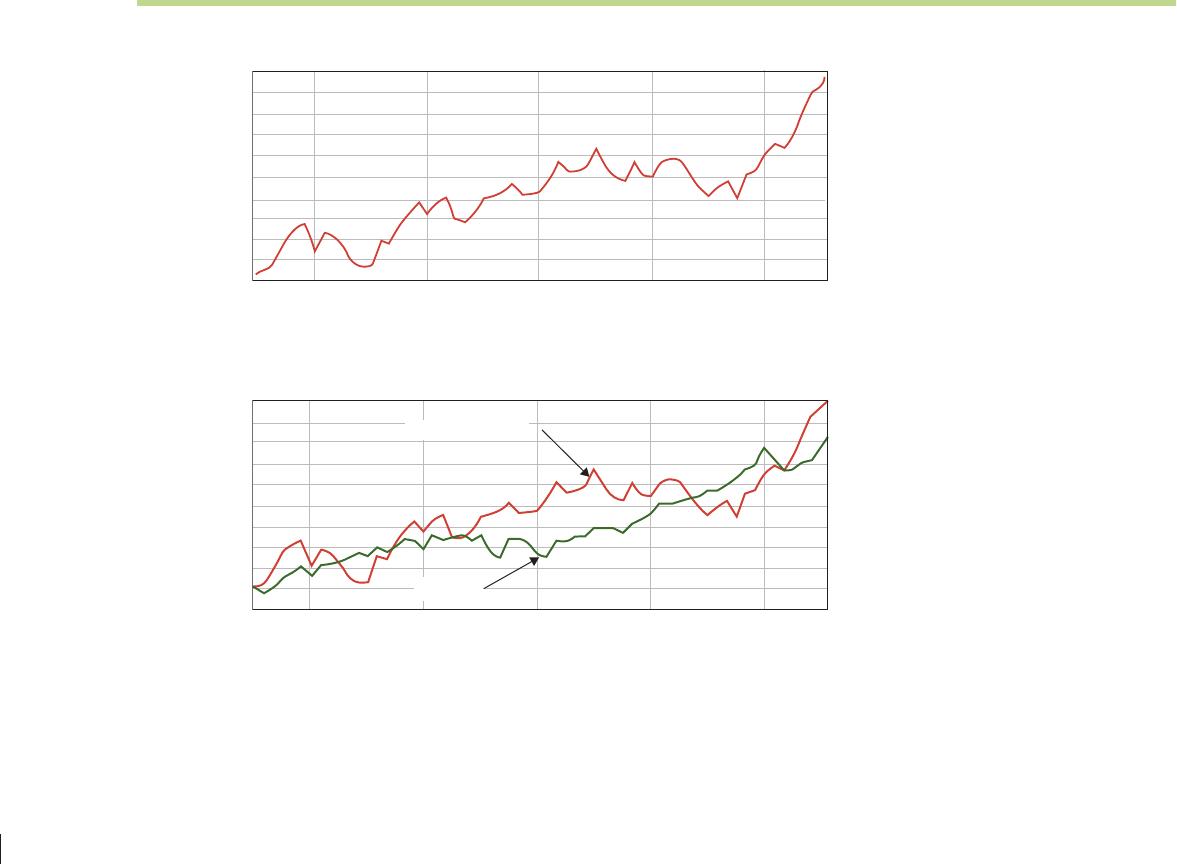
EXHIBIT 1 Monthly Performance of TJX Companies’ stock Price, July 2013–July 2018
˜°
(a) Trend in TJX’s Common Stock Price
Year
˜˛ ˜˝ ˜˙ ˜ˆ
Stock price
˛ˇ
˛˛
˝ˇ
˝˛
˙ˇ
˙˛
ˆˇ
ˆ˛
˘ˇ
˘˛
$˜ˇˇ
(b) Performance of TJX’s Stock Price versus the S&P ˛ˇˇ Index
Year
˜° ˜˛ ˜˝ ˜˙ ˜ˆ
Percent change
(July 2013 = ˇ)
+˘ˇ%
+ˆˇ%
+˙ˇ%
+˝ˇ%
+˛ˇ%
+°ˇ%
+30%
+20%
+˜ˇ%
+ˇ%
–˜ˇ%
TJX’s Stock price
S&P ˛ˇˇ
Source: Bigcharts.com
TJM’s sTOCK PERFORMANCE
TJX had its IPO on August 4, 1989, and the stock
began a steady uptrend of growth that continued into
mid-2018. Stock prices from July 2013 to July 2018
are shown in Exhibit 1.
TJX stock showed significant strength: a $10,000
investment in TJX at $16.15 on July 14, 2008, would
have returned 573.71 percent and yielded an ending
investment of $67,351.07, at $95.36 on July 11, 2018,
10 years later (assuming dividend reinvestment).
Following a very strong fourth quarter, with
24 percent stock price growth, TJX announced a divi-
dend increase of 25 percent ($.39) and announced
plans to repurchase $2.5 to 3.0 billion of TJX stock.
The stock reached its historic high of $96.82 on
June 20, 2018.
TJX BUsINEssEs
TJX operated four primary business segments,
Marmaxx and HomeGoods (U.S.), TJX Canada,
TJX International, and one Internet retailer, Sierra
Trading Post. The company believed that it had the
opportunity to expand their retail chains around the
world by increasing their store base of 4,000 by more
than 2,000 stores, or about 50 percent, to 6,100 stores
long term. This reflected the potential the company
saw with its existing chains in the current countries
alone. In 2018, TJX planned an increase of approxi-
mately 240 new stores, about 6 percent store growth.
U.S. Segments
Marmaxx The T.J. Maxx and Marshalls chains
(“Marmaxx”) were collectively the largest off-price
Final PDF to printer
CAsE 21 TJX Companies: It’s Strategy in Off-Price Home Accessories and Apparel Retailing C-243
growth ahead for the division. Marmaxx’s continued
comparable store sales and traffic increases in many
different retail and economic environments gave TJX
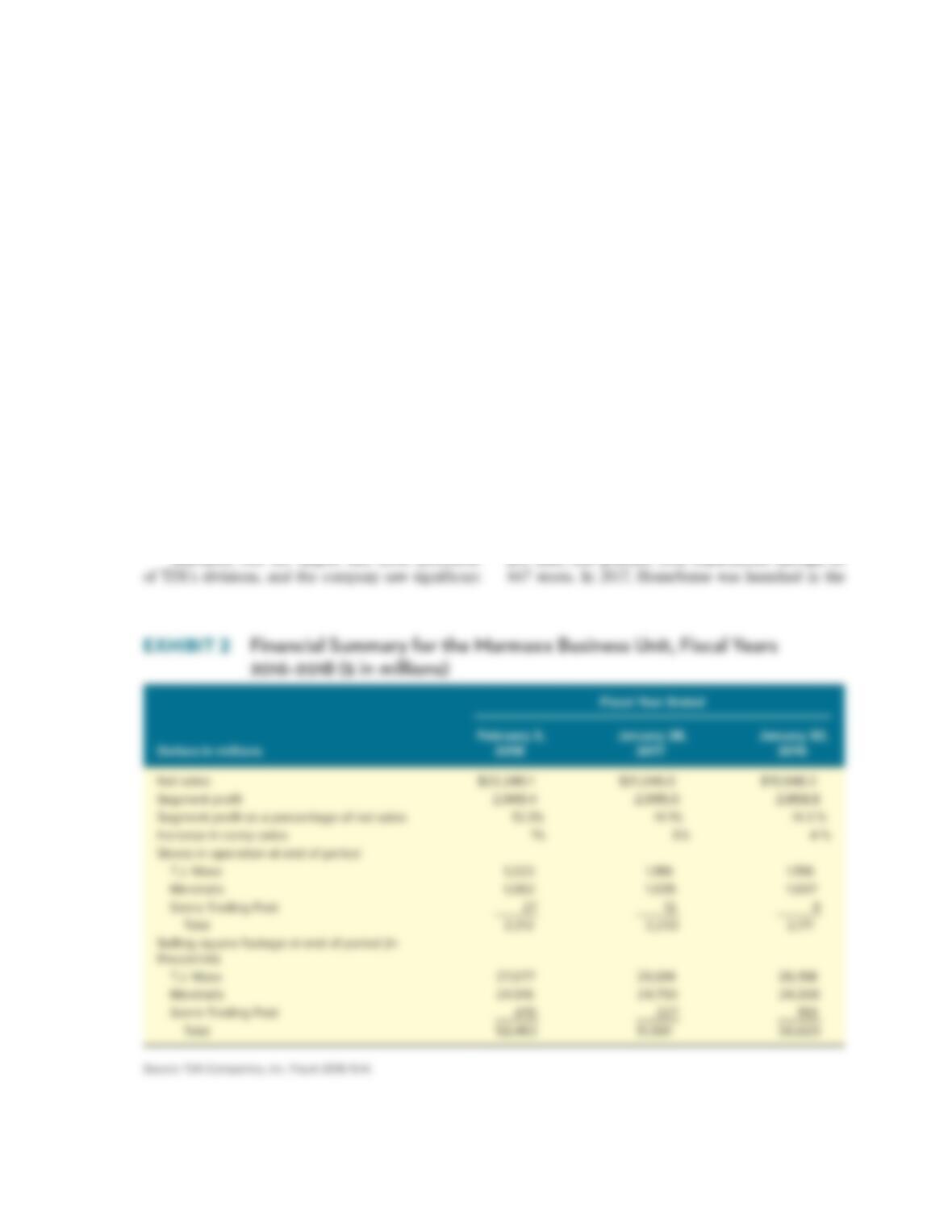
confidence in the division’s continued growth (see
Exhibit 2). Also, new stores continued to reach their
targets and, overall, to generate attractive returns.
Marmaxx had a 1 percent comparable store sales
increase in 2017, which met the low end of the com-
pany’s expectations, despite a significant negative
impact of severe weather during the year. Marmaxx
was focused on driving customer traffic and com-
parable sales increases, and had a long-term target
of 3,000 stores that reflected TJX’s determination
and perceived ability to further penetrate existing
U.S. markets.
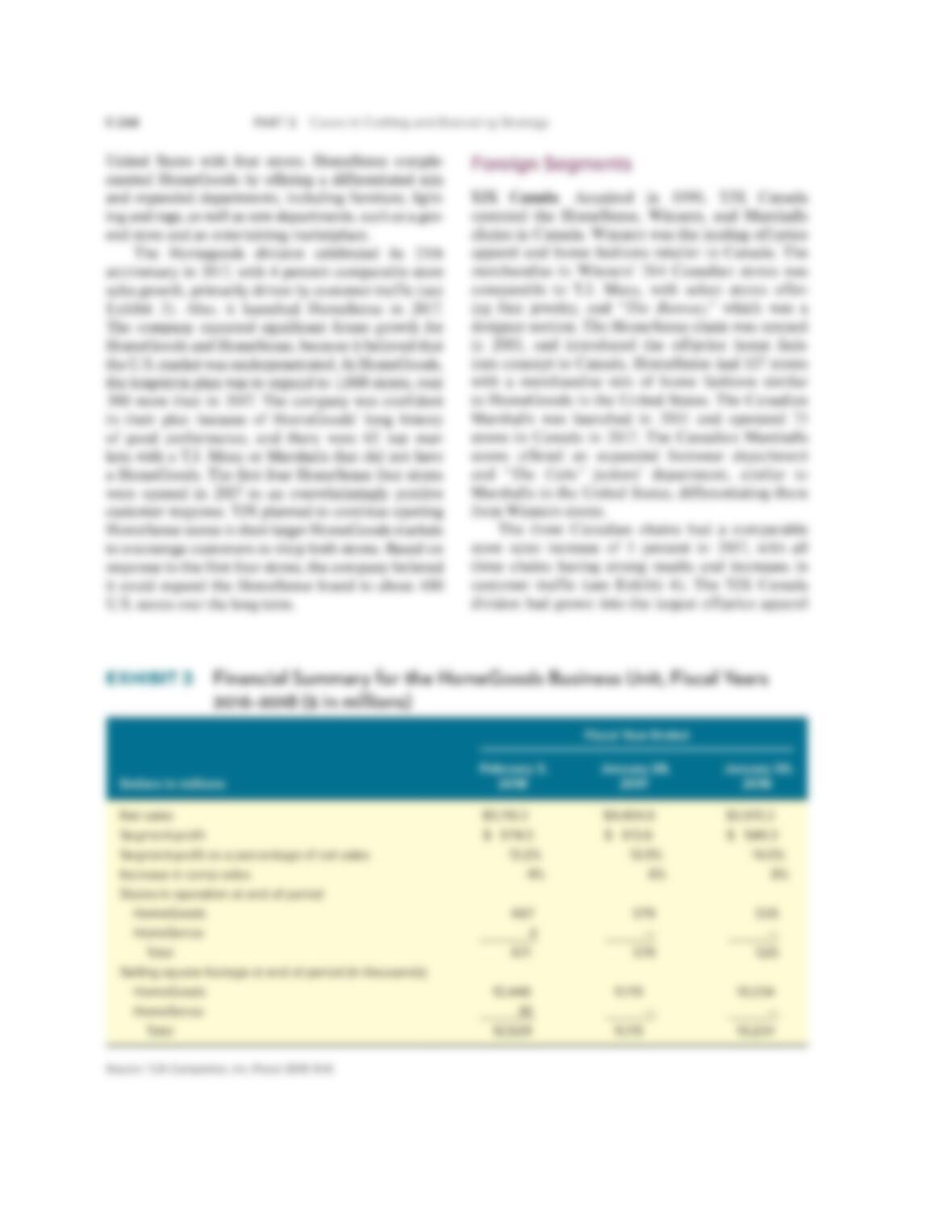
HomeGoods The HomeGoods segment was intro–
duced in 1992, and became the leading off-price home
fashions retailer in the United States. HomeGoods
offered an extensive assortment of home fashions,
including furniture, rugs, lighting, decorative acces–
sories, tabletop and cookware, as well as expanded
retailers in the United States, with a total of 2,285
stores. T.J. Maxx was founded in 1976 and Marmaxx
acquired Marshalls in 1995. Both chains sold family
apparel, home fashions (e.g., home basics, accent
furniture, lamps, rugs, etc.), and other merchan–
dise. The primary difference between T.J. Maxx and
Marshalls was their product assortment: a larger
assortment of fine jewelry and accessories and a
designer section called The Runway at T.J. Maxx,
and a full line of footwear, a broader men’s offer–
ing, and a juniors’ department named The Cube at
Marshalls. The intent of the differentiated shopping
experience at the two stores was to encourage cus–
tomers to shop both chains. T.J. Maxx’s e-commerce
website, tjmaxx.com, was launched in 2013.
Sierra Trading Post Sierra Trading Post was an off-
price Internet retailer of brand name, quality outdoor
gear, family apparel and footwear, sporting goods,
and home fashions. Sierra Trading Post launched its
e-commerce site, sierratradingpost.com, in 1998 and
operated 27 retail stores in the United States.
Final PDF to printer