– 472 –
Amazon.com, Inc.: Driving Disruptive
Change in the U.S. Grocery Market
Overview
This case is about Amazon’s attempts to disrupt the U.S. grocery retail industry. Amazon had been chasing
the grocery market since 2007 with the launch of its online grocery delivery service, AmazonFresh. But
it had been unable to crack the market successfully. Finally, Amazon’s CEO, Jeff Bezos (Bezos), realized
that he could not win the grocery game by being online alone. In 2017, the e-tailer started experimenting with
physical grocery retail by launching the Amazon Go store (cashier-less convenience store) and AmazonFresh
Pick-Up services (grocery pickup). To further its brick-and-mortar ambitions and accelerate its growth in the
U.S. retail sector, Amazon acquired retail organic chain Whole Foods in June 2017. With this acquisition,
Amazon became a full force brick-and-mortar grocery retail operator, with more than 450 stores, most of them
in premium urban locations in the U.S.
As Amazon entered into the $800 billion U.S. grocery market, Bezos and his team nevertheless faced a number
of challenges including: growing competition, the low margin nature of grocery retailing, logistical complexities,
bringing digital conveniences to the in-store grocery experience, and turning around Whole Foods. The stakes
were high for Amazon in the grocery retail industry. Could Amazon manage its bricks-and-mortar operations
well and upset other traditional grocery retailers? Could the e-commerce giant change where and how customers
shopped for groceries? Would Amazon’s rivals in the grocery retail industry remain content with their positions,
or could they be expected to retaliate in some way? Could Amazon disrupt the U.S. grocery retail industry the
way it had upended bookstores?
Suggestions for Using the Case
This is a high-interest case because of both Amazon’s and Whole Foods Markets’ ubiquity and brand recognition,
and is one that will certainly trigger lively classroom discussion. Students should be very interested in discussing
the Amazon case, perhaps even in tandem with the Amazon case, particularly given the current dynamic changes
in industry leadership in both online and bricks-and-mortar retailing.
This case provides a unique opportunity for students to discuss Amazon’s attempts to strengthen its competitive
position via its sudden acquisition of Whole Foods Markets in June 2017, and is ideally paired with Chapter
6. Students should develop an appreciation of how and when companies need to deploy offensive or defensive
* This teaching note reflects the thinking and analysis of Professor Armand Gilinsky, Sonoma State University. We are most grateful
for his insight, analysis and contributions to how the case can be taught successfully.
case 16 teaching note
*
Case 16 Teaching Note Amazon.com, Inc.: Driving Disruptive Change in the U.S. Grocery Market
473
strategic moves, as well as the impact of those moves in terms of changes in industry structure. Students can
tangentially consider the strategic risks and benefits to expanding a company’s horizontal scope via acquisitions.
This case is also of use in tandem with coverage of the diversification tests in Chapter 8 (industry attractiveness,
cost-of-entry, and better-off or “synergy” test). The case contains suffcient financial and operating and some
competitor information for students to evaluate. The case is meant to illustrate the following concepts and
frameworks and provide students with ample opportunities to use the tools of analysis:
Perform an analysis of the separate companies’ operating performance in the run-up to the acquisition,
and use the analysis of the addition of Whole Foods Markets to Amazon’s portfolio as a means
to determine the prospects for synergy between the two businesses (covered separately in Chapters 4
and 8)
Craft a strategic group map and discuss grocery retail industry rivals’ positions and their potential for
retaliation (Chapter 3)
Review strategic alternatives that could successfully deter threats to Amazon’s competitive position as
a result of rivals’ moves (Chapter 5).
Evaluate Amazon’s recent acquisition strategy (Chapter 6), and then craft future strategies that can
strengthen this company’s competitive position.
Broadening the scope of diversification by entering additional segments of the internet retailing industry
(Chapter 8)
s Enabling a portfolio of related businesses to share resources or to transfer them from business to business
at a lower cost (Chapter 8)
The case also provides students with the opportunity to make recommendations that will yield even stronger
positions given its resources and capabilities, as well as specific action steps to improve Amazon’s position in
the highly competitive grocery retail industry.
The assignment questions and teaching outline presented below reflect our thinking and suggestions about
how to conduct the class discussion and what aspects to emphasize.
To guide students in thinking about which analytical tools can be used to prepare the Amazon.com, Inc.: Driving
Disruptive Change in the U.S. Grocery Industry case for class discussion, we strongly recommend (1) providing
class members with a set of study questions and (2) insisting that they prepare good notes/answers to these
questions.
Video for Use with the Amazon.com, Inc.: Driving Disruptive Change in the U.S. Grocery
Market case. There is a 4:33-minute 2018 YouTube video entitled “Amazon Turns Groceries into Gold” that
you can show in class or have students view on their own. The video is located at https://www.youtube.com/
watch?v=CJzlXqrP0Eo
This case is suitable for both written and oral presentations, and because of its broad scope, works well as for a
midterm (or as a review for a final examination) writing exercise. Our recommended assignment questions are
as follows:
As part of your internship requirements with Amazon, you have been asked to prepare an analysis
of Amazon’s competitive position in the retail marketplace. Your report should contain 2–3 pages
of recommendations for sustaining the company’s success in bricks-and-mortar retail as well as
complementing its growing portfolio of online retail businesses, improving its financial position,
Case 16 Teaching Note Amazon.com, Inc.: Driving Disruptive Change in the U.S. Grocery Market
474
and a recommendation about potential new areas for diversification. Write an executive summary of
recommendations of no more than 2–3 pages, accompanied by supporting exhibits. These exhibits
may include an overview of Amazon’s strategy, an assessment of its resources and capabilities, and a
financial analysis.
Jeff Bezos CEO/founder of Amazon, Inc., has learned of your considerable skills in strategic analysis
and has hired you to develop a strategic plan that will enable Amazon to improve its position in the U.S.
grocery industry, continue to build a stronger financial position, and decide about future diversification
opportunities stemming from its existing core competencies. In developing your recommendations,
you should assess the retail industry. You should also assess Amazon’s competitive strength in its core
retail category and analyze its recent acquisitions and financial performance. Finally, the plan should
offer specific, actionable recommendations that will allow Amazon to further improve its position. Your
recommendations should be well supported with arguments and justifications for each recommendation.
Your report should include 4–6 pages of recommendations and whatever supporting charts, tables or
exhibits you deem useful.
Assignment Questions
1. What is competition like in the grocery retail industry? Which of the five competitive forces is strongest?
Which is or are weakest? What competitive forces seem to have the greatest effect on industry attractiveness
and the potential profitability of new entrants?
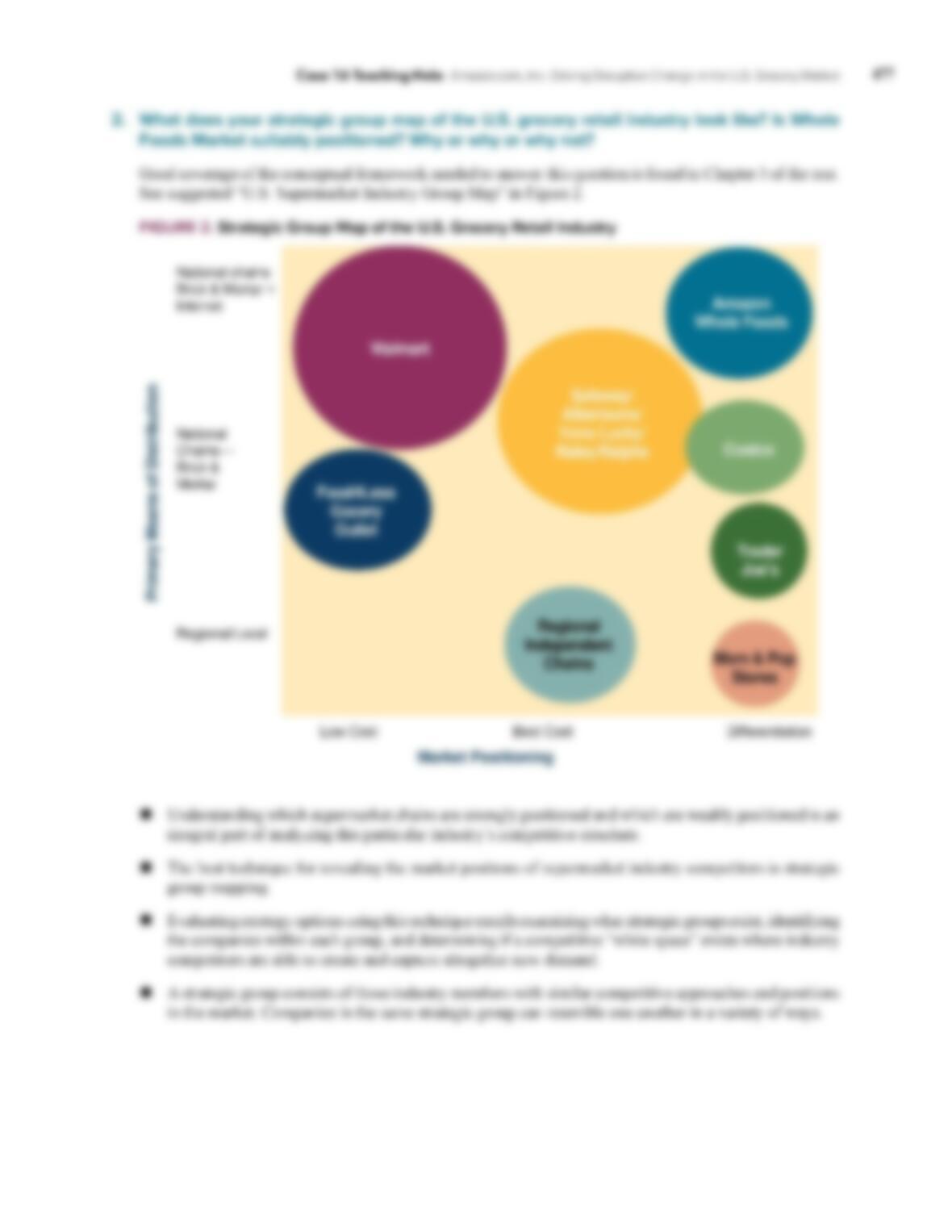
2. What does your strategic group map of the U.S. grocery retail industry look like? Is Whole Foods Market
suitably positioned? Why or why or why not?
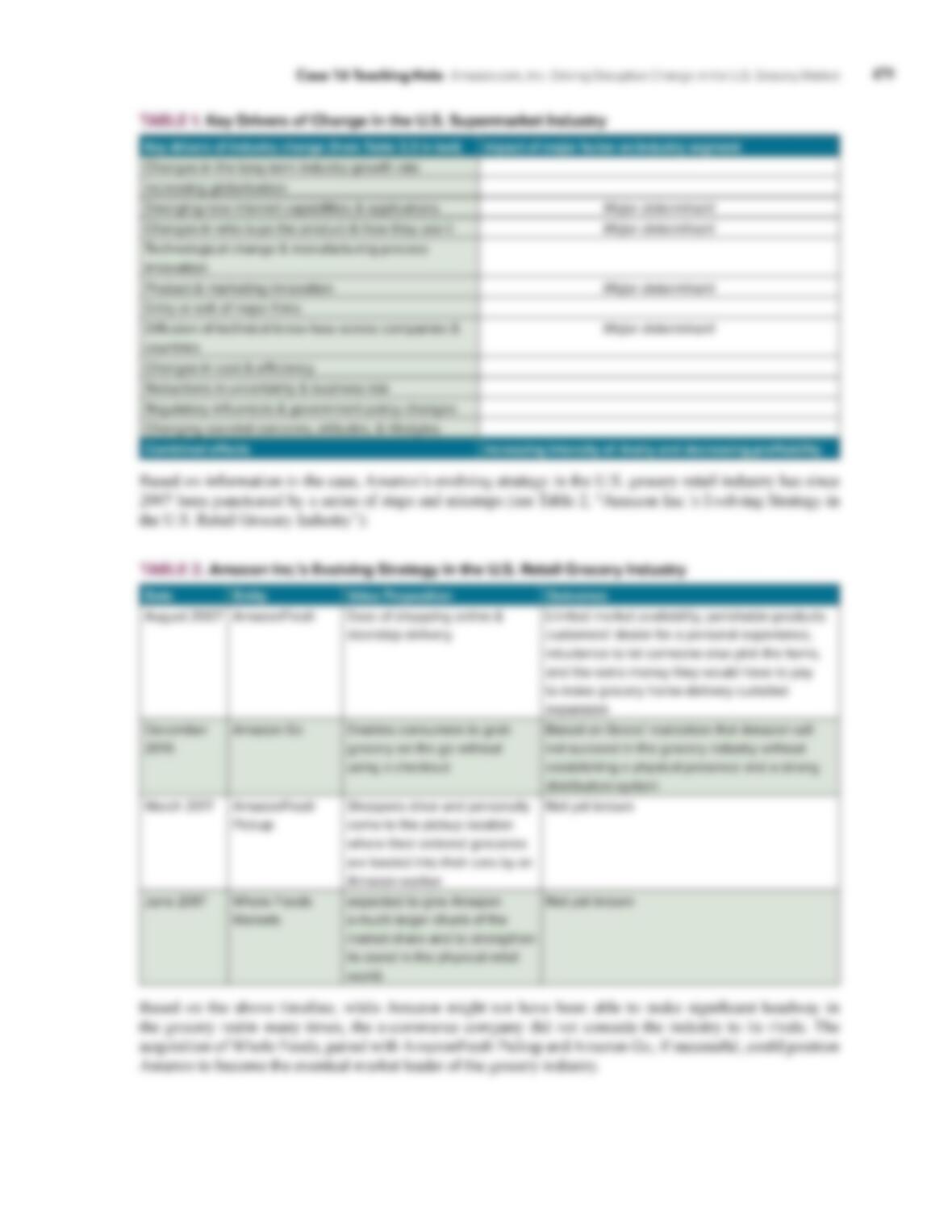
3. What do you see as the key drivers of change in the U.S. grocery retail industry? Based on these drivers,
trace Amazon, Inc.’s evolution in the U.S. retail grocery industry. Is the Amazon Inc. / Whole Foods Market
combination potentially disruptive? Why or why not?
4. What key factors may determine the success of the Amazon, Inc. combination with Whole Foods Market?
5. What recommendations would you make to Jeff Bezos, CEO and founder of Amazon, Inc. to improve Whole
Foods Markets’ competitiveness in the market while mitigating any current and future risks?

Case 16 Teaching Note Amazon.com, Inc.: Driving Disruptive Change in the U.S. Grocery Market
475
Teaching Outline and Analysis
1. What is competition like in the grocery retail industry? Which of the five competitive forces
is strongest? Which is or are weakest? What competitive forces seem to have the greatest
eect on industry attractiveness and the potential profitability of new entrants?
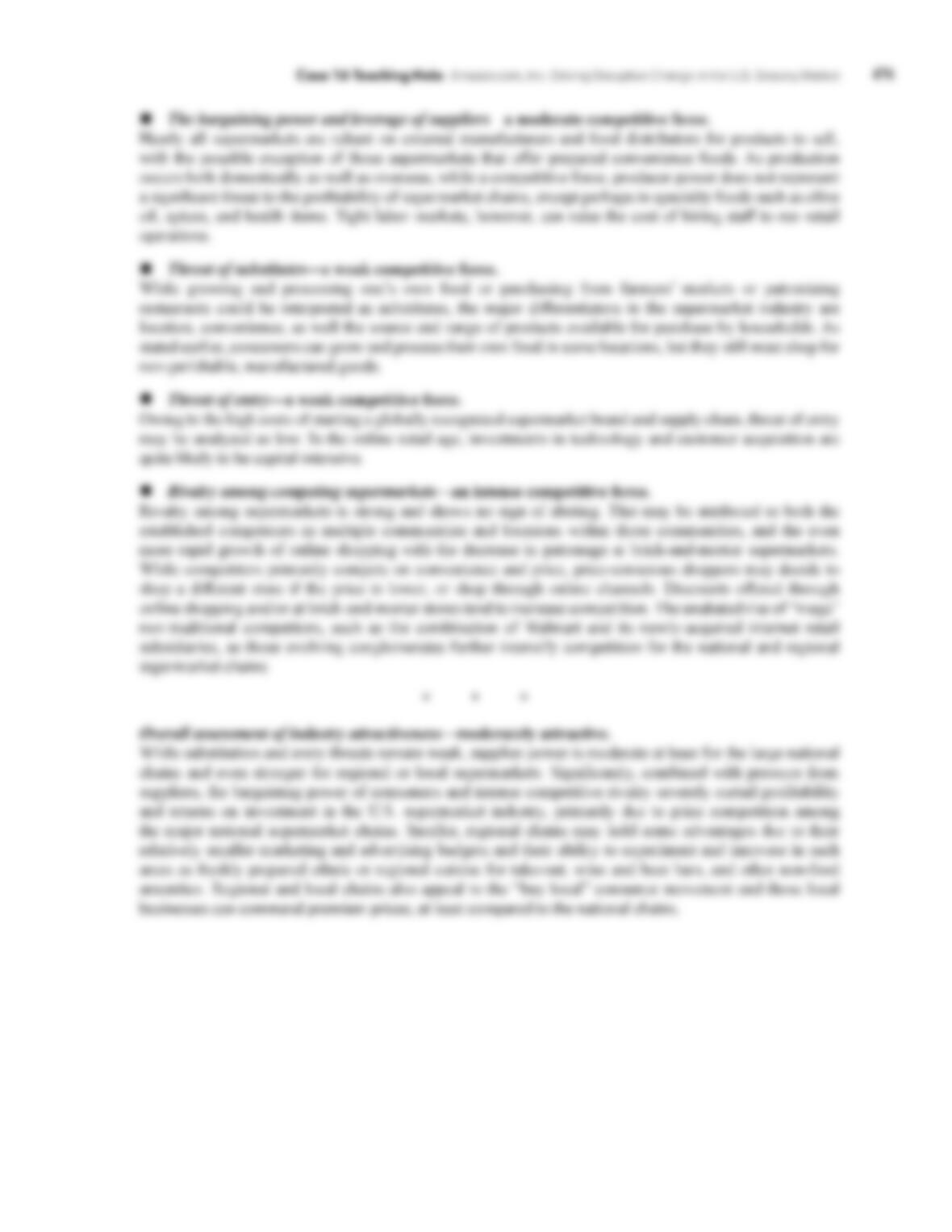
Students should be able to demonstrate their mastery of the material in Chapter 5, and come up with the
information used to create Figure 1, “Five Forces Model for the U.S. Supermarket Industry.”
FIGURE 1. The Five Forces Model for the U.S. Retail Grocery Industry
Bargaining
Suppliers
have
Customers
have
Threat
of New Entrants
Direct: Low
Indirect: High
Rivalry among
Competitors
Bargaining
Direct-High:
Safeway, Lucky’s,
Whole Foods,