Chan Chung
Carbon Tax Policy in China and Other Parallel Policies Suggested
TECON 460
Professor William McGuire

Chung 2
Introduction
Seriousness of Chinese environmental pollution has been numerously reported
through all sorts of media around us since few decades ago. According to the World Health
Organization (WHO), the concentrations of air pollutants in China have exceeded the
recommended global standards. However, we are not very well informed about how the
Chinese government has been setting up the measures against the pollution and what kinds of
benefits or harms would be given as it takes the measures. According to the Reuters, China
has decided to declare war on its pollution as it published several policies and ideas which
were aimed at addressing environmental issues last year, 2014 (Martina & Reklev, 2014). The
new plans under Premier Li Keqiang are expected to be an epoch-making contribution in
changing China’s loose environmental tax into well-systemized levies on major polluters.
However, the vice environment minister, Zhu Guangyao, said the efforts to diminishing
pollution in China will get in the way of implementing carbon dioxide emission tax (Chen &
Reklev, 2014). The importance of carbon tax policy has been decreased since last year as the
Premier Li declared war upon pollutions in China and as the policy became in doubt due to
the problem of air pollution being unmanageably serious. Henceforth, the government of
China has been considering abolition of the carbon tax policy, as Australia under a new
conservative government is currently trying. The emission tax policy has been increasingly
controversial over regions not only of China but also of the world during the past decades.
Through this research paper, I would like to briefly introduce why environmental pollution of
China became notorious and why the government is not pursuing implementation of carbon
dioxide emission tax policy anymore, but trying to follow Premier Li Keqiang’s new policy.
Also I will present some proposals of how the Chinese government should deal with carbon
tax policy and furthermore, environmental pollution issues.
Chung 3
Background
China until the late nineteenth century was relatively underdeveloped compared to
the western countries and Japan but it had various resources over the vast land area. For these
reasons, the West and Japan took over China and this time was the starting point of Chinese
industrialization. Due to fairly late industrialization, abundant but cheap labor resources and
very few environmental levies, China had to profoundly rely on heavy industries built during
the Japanese occupation to catch up the economies of western countries and Japan. During
the Reform era, since 1978 until now, Chinese government has been putting lots of effort on
restoring damaged economic infrastructures from the Socialist era and building up the
bottom-heavy economy. Through all of these processes, the government had to focus on
developing national economy rather than protecting its environment. However, since past few
decades ago, Chinese government started to consider its ecological problems and publish
various policies and plans for environmental protection to prevent increasing carbon
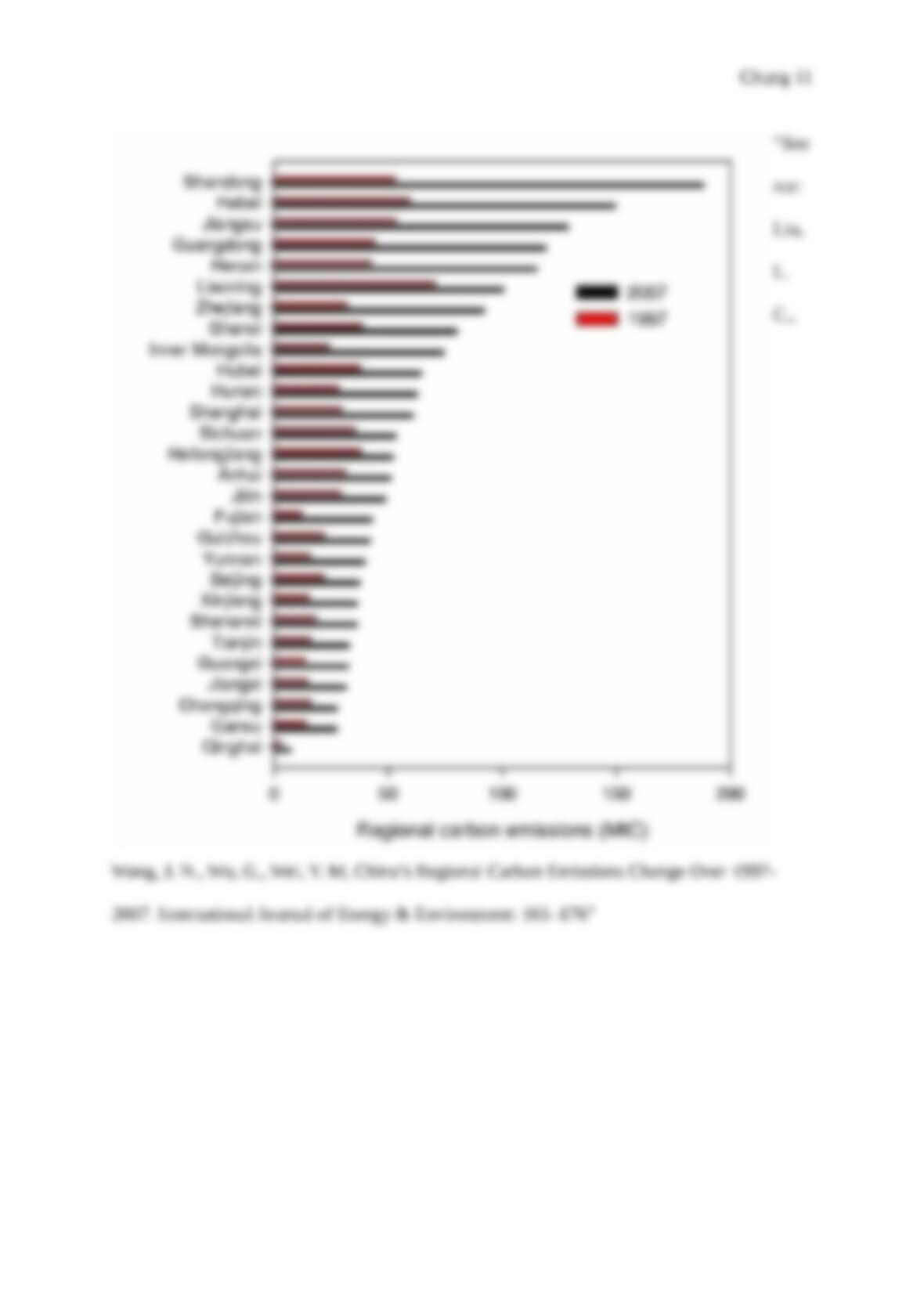
emissions through various cities in China. (See the appendix.) Although the all-out efforts
might have been contributing towards a better surrounding, it seems quite a struggle for
China because of its heavily polluting industries and uncooperative local governments. They
demand a policy that works in accordance to their current environmental situation.
In March 2014, the Chinese ministry of environment declared that carbon dioxide
emission tax policy will be no longer implemented but instead they will exercise Premier Li’s
policy which includes full-blown tax targeting on the source of air pollution and eliminating
outdated industrial plants and energy producers will be weighted. At this point, the carbon tax
policy has been gradually controversial among politicians not only of China but also of the
world. The premier of China had come up with a few strategies addressing the environmental
problems in China starting from agricultural pollution to the contaminated water source in
Chung 4
bits and parts of China. Premier Li had turned his words of promise into action by declaring
an estimated budget of 2 trillion Yuan (approximately 330 billion US dollars) to tackle the
severe pollution of water resources that acts as the most important element for agriculture and
for the consumption of the people in China. By doing so, they will be able to improve the
average quality of the surroundings. “He also stated that China is aiming for a conversion of
333,300 hectares of farmland to forest and grassland to fight desertification and recover
wetlands that they have previously encountered.” (Martina & Reklev, 2014)
Proposal
First of all, I do not clearly understand why the vice environment minister referred
that Australian government has been trying to abolish the carbon tax policy. “Zhu also
referred to the fact that Australia, under a new conservative government, is trying to abolish