1
Vrije Universiteit Amsterdam
Knowledge
Management
Capturing knowledge despite high staff turnover
Mike Baas, 2510808 – Alexander Leutscher, 2506267 – Achraf Ben Moussa,
2507206 – Stijn Wolff, 2511454
-12-2013
Table of contents
Introduction…………………………………………………………………………………………………………………..……...3
Theory………………………………………………………………………………………………………………………..……..…4
Method………………………………………………………………………………………………………………….…..……..….7
Organization description………………………………………………………………………………………………………7
Research Methods…………………………………………………………………………………………..…..……..…..….7
Results………………………………………………………………………………………………………………………………....9
Discussion and Conclusion………………………………………………………………………………………………….…11
Theoretical and Practical Implications………………………………………………………………..…..……..…..…..12
Limitations and further Research…………………………………………………………………………………………….12
Bibliography………………………………………………………………………………………………………………………..14
Appendix……………………………………………………………………………………………………………………...…….15
Appendix I (Interview Guide)…………………………………………………………………………..…..……..…....15
Appendix II (Coding scheme before)……………………………………………………………..……..…..…..…...17
Appendix III (Interview 1)…………………………………………………………………………...……..…..…..…...18
Appendix IV (Interview 2)………………………………………………………………………………...…..…..……..21
Appendix V (Interview 3)……………………………………………………………………………………………..…...26
Appendix VI (Interview 4)………………………………………………………………………………...…..…..……..29
2
Introduction
It is almost common knowledge that Google is a great place to work, namely because of the great
facilities at Google’s main office in California. This facility, also referred to as the Googleplex,
includes two swimming pools, a volleyball court and a dinosaur skeleton [ CITATION 25t07 \l 1043 ].
Nonetheless Google is reported to have the fourth highest staff turnover of any Fortune 500
organization [ CITATION Vin13 \l 1043 ], which suggests that Google isn’t a good employer after all.
This high turnover might cause a lot of knowledge to be lost when employees leave the organization.
Therefore, it is important to manage this knowledge properly; so that limited or no knowledge is lost.
This process is a part of knowledge management. Essentially, knowledge management is the process
of deliberately directing efforts to manage knowledge within an organization [ CITATION His13 \l
1043 ].
Studies by Choi, Poon & Davis (2008) and Hansen et al (1999) have shown that there are
multiple ways of applying knowledge management within an organization. The strategies to applying
knowledge management they mention give organizations a framework to guide their efforts. These
studies also investigate which strategy is most successful for organizations to apply. For example,
Choi et al. (2008) have found a combination of two strategies that has the highest probability for
success.
Although many studies have shown which strategies exist and which are more successful
within organizations with an average employee turnover rate, there is little or no research in
knowledge management within organization with an above average turnover rate. It is therefore
relevant to investigate if the same concepts are valid for those organizations.
Integrand is an organization which shows these characteristics; the organization changes half
of its staff every half-year for their city boards and every year for their national board. Within
Integrand, its only employees are the board members. Because of its frequent board-changes and thus
high employee turnover and the fact that every employee only works at Integrand for one year, it is
inevitable that knowledge is lost when new staff take over. This is a problem for Integrand, because
when this knowledge is lost it needs to be regained, which costs money and time. Integrand will need
to make a significant effort to minimize the amount of knowledge that is lost, so that it can perform
efficiently. From this the following research question is formulated:
How does Integrand minimize the loss of knowledge caused by a board change?
To answer this question the knowledge management strategies and processes of the organization
Integrand are researched. These strategies and processes are investigated using interviews with key
people within the organization. For these interviews it is important to first consider the theoretical
background of knowledge management, by defining key concepts in previous research.
3
Theory
As mentioned in the introduction there are several knowledge management strategies which have been
observed within organizations. According to Hansen et al (1999) there are two strategies to
differentiate knowledge management: codification and personalization. The codification strategy is
relevant for organizations that make use of old knowledge to train their employees. The
personalization strategy is relevant for organizations that focus on creating new knowledge.
Another framework, developed by Choi, Poon & Davis (2008), argues that strategies can be
categorized within two dimensions: knowledge management focus and knowledge management
source. In their paper Choi, Poon & Davis (2008) classify the focus dimension as explicit- or tacit-
oriented. Explicit-oriented means focusing on efficiencies by codifying and reusing knowledge. Tacit-
oriented, on the other hand, means focusing on personalization by transferring knowledge via person-
to-person contact and socialization. On the source dimension a strategy can be classified as internal- or
external-oriented [ CITATION Cho08 \l 1043 ]. Here external-orientation means capturing knowledge
from outside the organization and diffusing it throughout the organization. Internal-orientation refers
to the degree of knowledge creation and distribution within the confines of the organization
[ CITATION Cho08 \l 1043 ]. In their research Choi, Poon & Davis (2008) found that those
organizations that combine explicit-external-oriented strategy with tacit-internal-oriented strategy have
the highest probability of success. It could therefore be argued that Integrand needs to combine these
two strategies to minimize knowledge loss.
For knowledge management research it is also important to clarify when a knowledge
management approach is considered to be successful. In general the successfulness of a knowledge
management approach can be described as the degree to which the objectives of that approach are met.
Davenport, De Long & Beers (1998) describe four objectives of knowledge management projects: (1)
creating knowledge repositories, (2) improving knowledge access, (3) enhancing the knowledge
environment and (4) managing knowledge as an asset. In their research Davenport, De Long & Beers
(1998) have found that all of the organizations they researched sought to achieve one or a combination
of these objectives. Although applicable to projects in their current form, for this paper the objectives
will be slightly altered to better measure successfulness of a knowledge management approach.
Successfulness of an approach will be measured in (1) the degree to which knowledge repositories
exist, (2) the degree to which knowledge is accessible, (3) the degree to which a knowledge
environment exists and (4) the degree to which knowledge is managed as an asset. With these clear
objectives it is possible to classify the degree to which Integrand’s knowledge management approach is
successful.
Diffusing and embedding tacit knowledge within an organization’s social structure is a
difficult and ambiguous process. By embedding tacit knowledge in others via social structures,
4
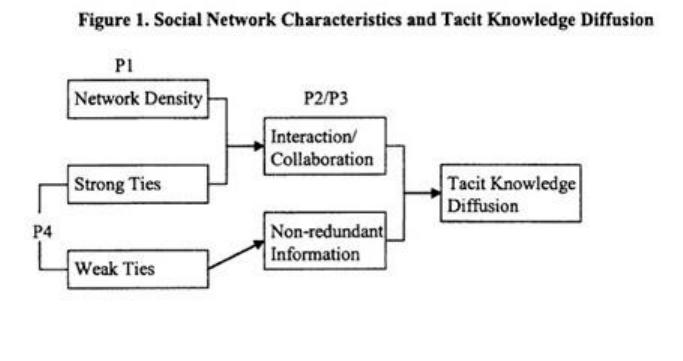
organizations retain a valuable resource, that otherwise would have been lost when employees leave
the organization.
The theory (Social Network Characteristics and Tacit Knowledge diffusion) of Droege & Hoobler
(2003) explains how the value of tacit knowledge can be protected against loss.
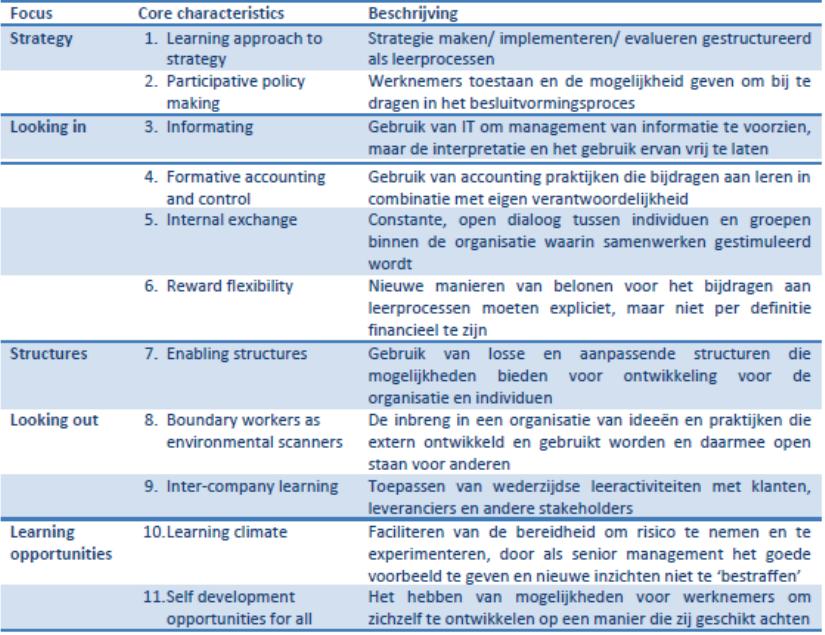
According to Hislop (2013) learning in organizations can be characterized as involving a
dynamic reciprocity between learning processes at the individual, group and organizational level. He
describes organizational learning as the embedding of individual and group level learning in
organizational structures and processes, achieved through reflecting on and modifying the norms and
values embodied in established organizational processes and structures’. Hislop (2009) also describes
two different perspectives: the propagandist perspective and the sceptic perspective. The propagandists
look at the learning organization framework as a useful tool that supports the learning of its employees
and allows them to express and utilize this learning to the advantage of the organisation through
having an organizational environment which encourages experimentation, risk taking and open
dialogue.
According to the sceptics a learning organization is an organization where socially based control
systems are used to create value alignment around the benefits to all of learning, which has the
potential to reinforce management power, and contradict the logic of emancipation embodied in the
learning organization rhetoric. Hislop (2013) diversifies the critic into three categories:
Learning and the employment relationship
Power, politics and learning
Emotions and attitudes to learning
These two views show how there is still significant debate over the concept of organizational learning
and display how complex the issue of organizational learning is. For this paper the sceptic’s point of
5
view is put forward, because it is believed that the learning organization approach hinders the dynamic
and open structure needed for a learning environment. Hence, the following statement:
Learning organization practices have a negative effect on knowledge retainment.
A disadvantage of employee turnover is the loss of organization-level tacit knowledge. Theory
of (Dress and Shaw, 2001) explains that if the employment relationship is terminated, there are costs
for the organization; including recruitment and training of new employees, decreased organizational
efficiency and decreased productivity. Another, more indirect, effect is decreased organizational social
capital; the termination disrupts established social relations which in turn can have harmful effects on
organizational performance. Organization with a high employee turnover experience the loss of
knowledge related to the termination of employment more frequently, therefore the following
proposition is formulated:
High employee turnover has a negative effect on knowledge retainment.
According to Robin Cowan (2001), who performed a four case study, knowledge that is embedded
deeply in skilled humans can be codified. Direct processes with a known and fixed goal, can easily be
translated to a list of instructions or decision rules, however, when a certain task demands pattern
recognition or generalization it becomes more difficult. Cowan (2001) also notes that environment
matters, when operating in a changing environment (e.g. changing market), skill should be deeper
codified. He also says: ‘a complex’ task in a ‘stable environment’ is likely to be easier to codify than a
‘simple’ task in a ’changing environment’. Codification ensures that knowledge is transformed in such
6
a way that it can be stored. It, therefore, prevents knowledge from being lost. From this theory the
following statement is made:
Knowledge codification has a positive effect on knowledge retainment
Method
Organization description
Integrand is a non-profit internship intermediary. Their core-business is to help academic students to
find a suitable internship and tries to fit organizations with the right candidates.
Besides offering a platform that brings students and organizations together, Integrand also organizes
career events, such as business courses and in-house days, and they offer promotion services to
organizations.
Since the founding of Integrand in 1980, the organization is run by students. They have a part-
time board in all twelve Dutch cities housing a university. These consist out of an average of 8
students and a full-time national board consisting of 6 members, who supervise the city-boards and is
responsible for the general management.
The national board is also responsible for making strategic decisions and they take care that
their strategic decisions are executed at the twelve city-boards. Strategic decisions are made in
consensus with a supervisory board. This consists of former employees who finished their studies and