1
Capsule Corporation
In a December 2013’s cold evening, Goku is travelling in his Flying Nimbus and is
evaluating all available opportunities for his personal project. He has a website dedicated to
sports and fitness which is growing and increasing its user database. However, required
maintenance costs are soaring and becoming unaffordable to him.
He is strongly considering the possibility of developing his website into an e-commerce
platform. This would require a significant and immediate initial investment but, hopefully, this
platform would generate sufficient revenue to cover all maintenance costs and to yield some
profits for himself, who would be the only shareholder.
Goku needs to identify and assess all cash flows of the project. He is willing to invest only if
the project has financial and operational viability, which should be evaluated through several
indicators such as Net Present Value, Internal Rate of Return and Payback Period. Along these
indicators, he would like to better understand the operational risks of the project and how
sensitive it is to changes in the main business drivers. Also, he is really interested in identifying
the best option for his role in the long term of Capsule Corporation, since that will have an
impact on his wealth and career. Finally, he wants to understand the value and risk of each
financing option in order to pick the one with highest added value.
Capsule
In early 2010, Goku decided to launch a website (www.capsule.dbz) where he could share
his insights about sports and fitness with whoever was interested in these topics and visited the
website. The first version was similar to a blog, since Goku was the only one writing articles
that people could read and comment. Later, given the high popularity of the articles, Goku
decided to launch a second website version with a discussion forum, so anyone could publish
an opinion and launch a discussion about any related topic. To use this forum, each user needed
to complete a registry procedure.
To develop the website to its current version, he paid 4,000€ to a web developer and has
been paying a monthly server fee of 300€ since the beginning. He also spent 2,000€ in website
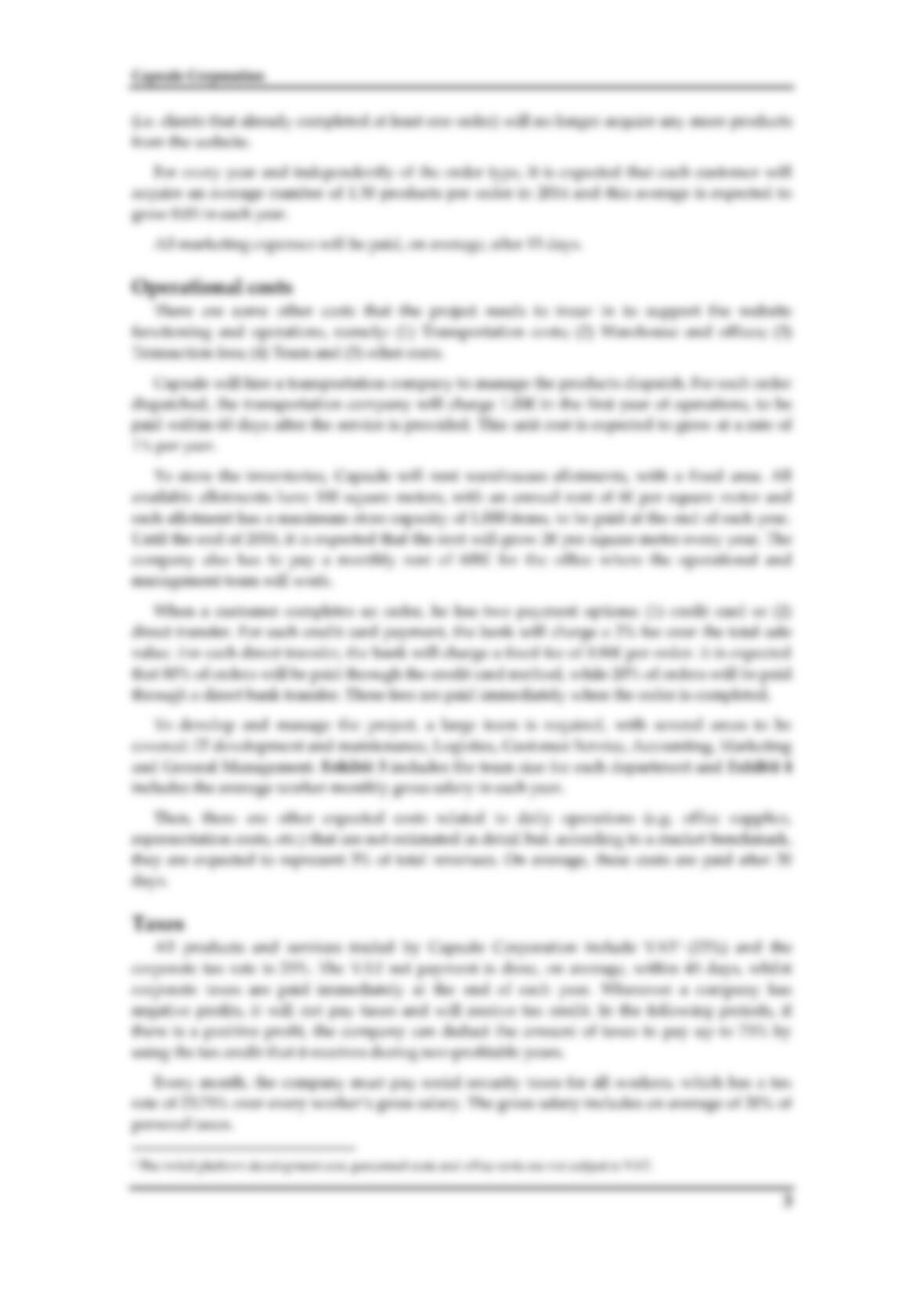
promotion in a Sports local newspaper. Currently, the forum has 10,000 active users and over
6,000 daily visits. (Exhibit 1)
Goku is not willing to invest more without return since this would make his hobby even
more expensive. Kame-Sen’nin, long-time mentor of Goku, encouraged him to take advantage
of his popularity and said that he should start selling sports and fitness equipment through his
website. He would need to create a company, called Capsule Corporation, and its revenues
would compensate all maintenance costs and generate some income for him, transforming his
hobby into a profitable business.
Finance | 2nd semester 2013/2014
Capsule Corporation
Investment needs
Capsule Corp. would require a large initial investment in the platform since its technical
capabilities are much more demanding that a simple web forum. The required investment is
1,500,000€ and it must be paid now. The platform development would be completed by the end
of 2013 and has an accounting life time of 5 years (the straight-line depreciation method is
applied, with no residual value).
Even though the immediate investment has an expected life time of 5 years, the project will
last forever as long the company invests every year in replacement developments, in a way that
net fixed assets will be kept constant throughout the first five years.
The project also requires an investment in a large product portfolio, to be sold in the website.
40% of products sold will be under consignation agreements, based on established contracts
with producers that will deliver the product every time there is a new order for those products
under consignation. Capsule will not hold this type of products in a warehouse, but there will
be an extra transportation cost of 0.25€ per product ordered, since it has to be done directly
from the producer. Besides consignation agreements, Goku has to acquire inventories in
advance, before each year starts, to cover the remaining product sales. He has to acquire stock
that can cover all ordered products from inventories for the following year plus a buffer of 10%,
to avoid out-of-stock scenarios for certain products. These extra 10% that are not expected to be
sold within one year must be taken into account for the following year. In each year, he receives
the inventories in the beginning of the year and pays immediately.
Products will be sold at an average price of 45€ in 2014, and it is expected to grow by 1€ in
each year. The margin he gets from each type of product depends on the type of product: for
consigned products he will save a gross margin of 30%, paying the remaining 70% directly to