Chap 17
1. Allocate service department costs using the direct method and the
step-down method:
– Service department: a unit in an org that is not involved directly in the
producing goods or services. However, a service department does provide a
service that enables the org’s production process to take place.
– The goal of cost allocation is to ensure that all costs incurred by the org are
assigned to its products or services.
– Cost distribution: costs in various cost pools are distributed to all
departments including service and production departments.
– Service department cost allocation: service department costs are allocated
to production departments.
– Cost application: costs are assigned to the goods or services produced by the
org.
How are service department costs charged to production
departments?
– The amount of the cost driver used by each department is measured. As each
department uses a service provider, the cost should rise proportionately
according to the amount that is used.
– The costs are allocated, or divided up, to the department that consumed the
services based on the relative amount used.
– The allocated costs eventually become a part of the overhead in a
manufacturing department (indirect cost), then a part of product’s cost. The
service centre costs become a part of the product costs when overhead is
applied, or charged, to the product.
– When the predetermined factory overhead figure is estimated, these service
department costs are included. In this way, the costs of the service departments
enter the cost of the finished product or service.
Selecting allocation bases:
– When allocating costs to departments, we want to assign a fair amount to the
department that is using the service.
– Although sometimes there is no direct cause and effect relationship bw the
cost driver and the portion of the cost assigned to the department, we still try to
look at appropriate drivers of the costs.
– Sometimes, different services will have the same, or similar, cost driving
characteristics.
– The costs of service departments are assigned to the user departments in
proportion to the benefits received by the user department.
Ex: an appropriate driver for assigning the costs of running the personnel
department might be the total number of employees in each department, bc,
more employees required would seen to cause more costs for the personnel
department. Another appropriate driver might be the number of new hires by
each department.
The costs of security or custodial services would seem to increase as the amount
of space increases, so, the square footage of the department using these services

may be an appropriate driver of the cost. Another appropriate driver might be
the number of hrs actually spent by security or custodians in each department.
Interdepartmental services:
– 1 problem that accountants face when allocating is, the one service department
might supply services to another service department, and indeed, may actually
consume some of its own services.
Ex: the power that supplies electricity to service departments, production
departments, and even consumes some of its own electricity.
a) Direct method:
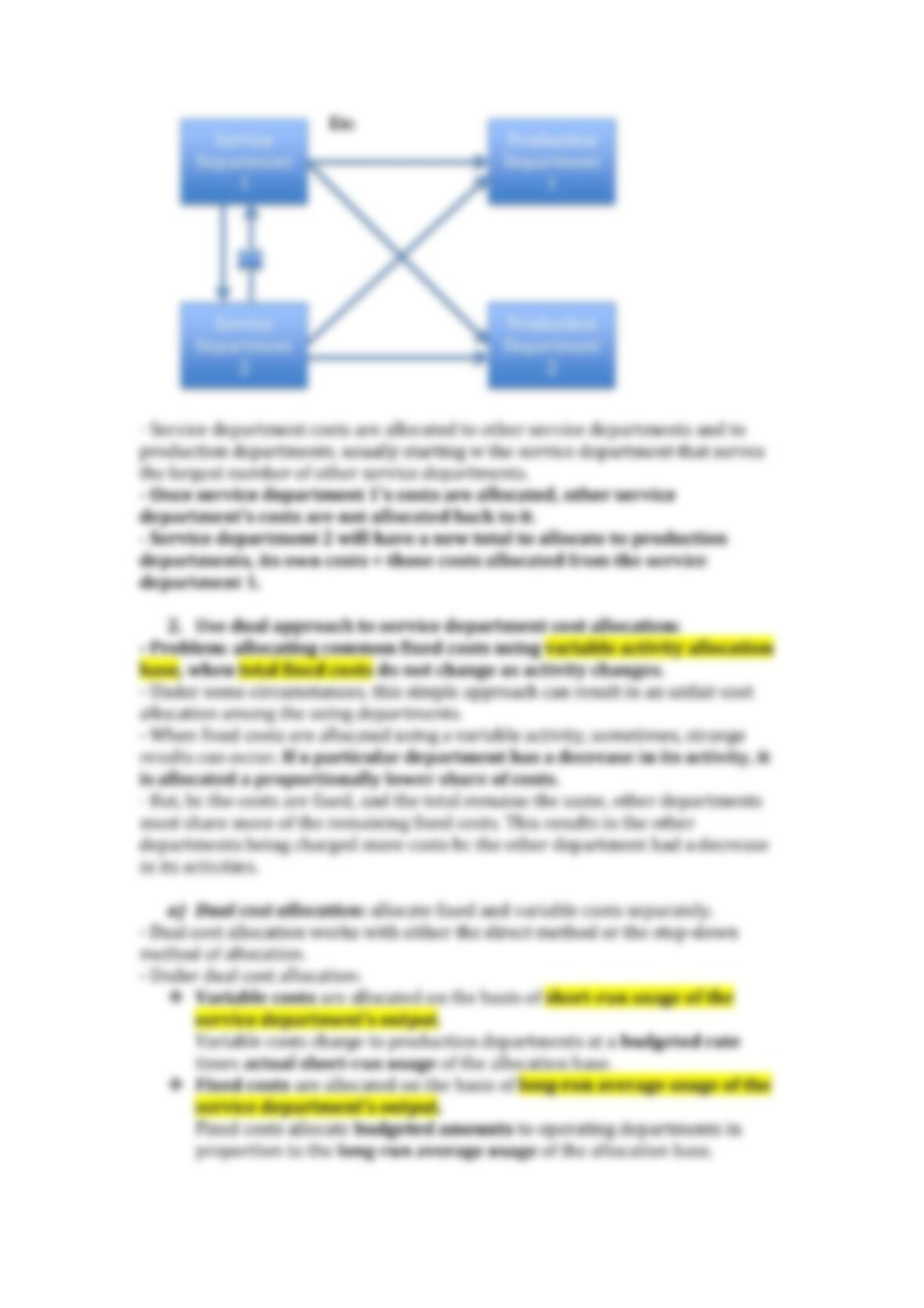
– Under the direct method, each service department’s costs are allocated
among only the production departments that consume part of the service
department’s output.
– This method ignores the fact that some service departments provide services to
other service departments. Thus, even though 1 department might provide
services to 2 other service departments, none of its costs are allocated to those
departments.
– The proportion of each service department’s costs to be allocated to each
production department is determined by the proportion of the service
department’s output consumed by each production department.
Service
Department
1
Production
Department
1
Costs of services
2
2