Can we change Mexico via citizen participation?
Jaime Nunez Saracho
A01224281
Improving Mexico’s energetic system will not only benefit our economic growth but our
social development as well. Can Mexican citizens perform constitutional actions and social
movements in order to receive the benefits that the energy sector can provide? PEMEX
(Petroleos Mexicanos) was created in 1935 by president Lazaro Cardenas after he decided
to nationalize petroleum and other energetic resources from multinational companies who
reached an agreement during Porfirio Diaz regime. Since then, presidents have opposed to
the re-privatization of petroleum defending the principle of “Petroleum should be exploit
by Mexicans, and they are the only ones who should receive benefits from it”. The issue is
that government does not have the economical resources to exploit the vast quantity of
petroleum the country poses, and only few Mexicans are receiving benefits from our
national black gold. Some experts have recommended that if PEMEX accepts private
investment Mexico’s wealth, power and importance in global affairs will increase
considerably. The ethical issue to be analyzed is how political parties have stopped reforms
that will increase PEMEX profitability, and how the labor union lead by Romero
Deschamps has kidnapped the “government owned institution”. Throughout this essay
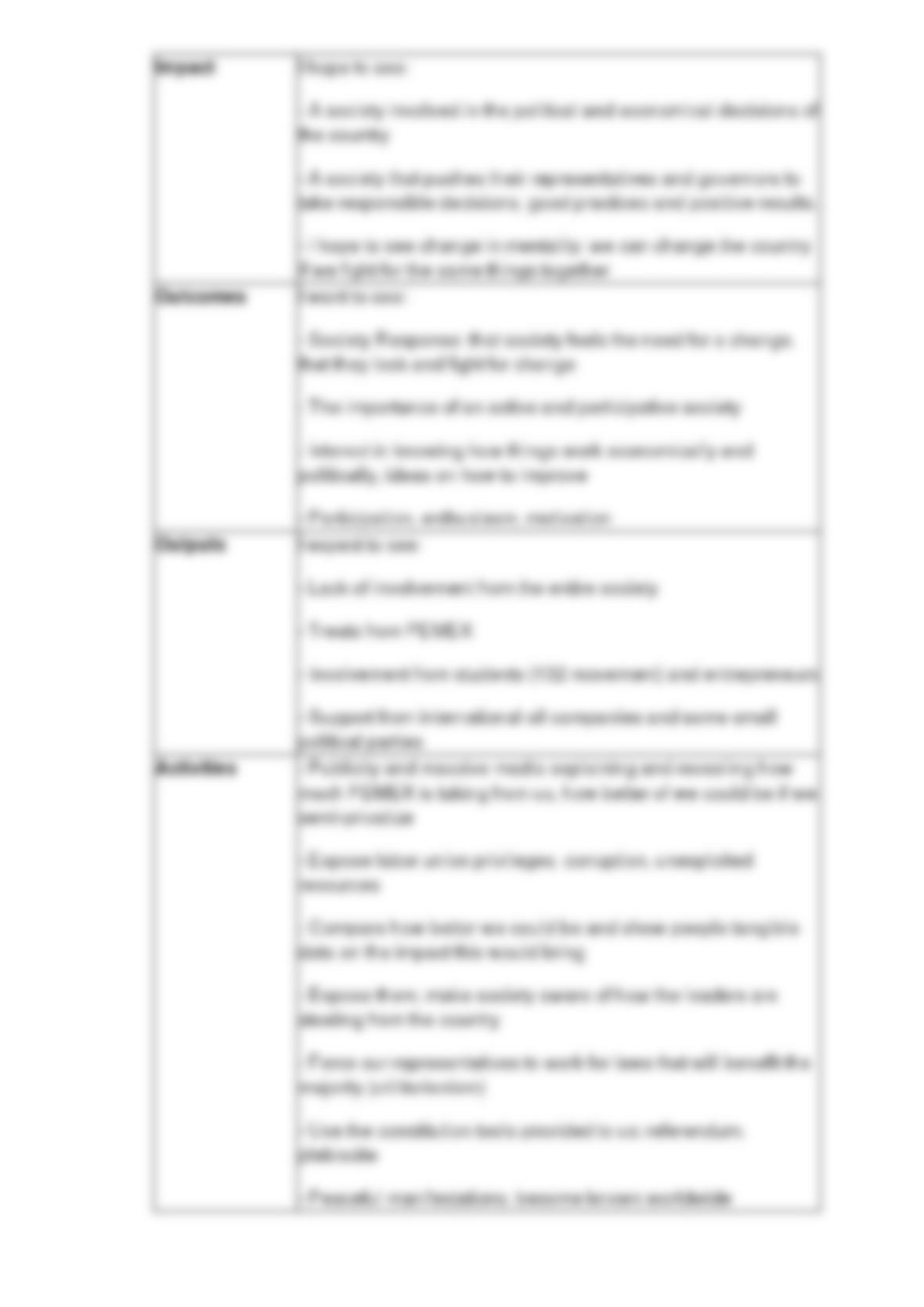
readers will observe a detailed analysis of the unethical practices and a project on how
society can influence and be key to reform the energy sector that will end up benefiting the
whole country.
Politicians and labor union leaders have performed plenty of unethical practices, many of
them consist on bribery, abuse of power and simply the violation of the social contract.
The social contract theory developed by Thomas Hobbes, John Locke and Jean-Jacques
Rousseau establishes that political authority and obligations are based on the individual
self-interests of members of society who are understood to be equal to one another.
Meaning human beings are self-interested but reasonable that’s why human beings submit
to a political authority in order to secure the most important of their interests escaping
from a state of nature. Locke uses Hobbes state of nature (in which everyone is more-less
equal and every body follows their own interests, fearing to lose everything) with the
difference that Locke argues for the right of citizens to revolt against their political leaders
and influence the democratic life of that particular society. Something Mexicans have not
used in order to manifest and fight for better practices and generate social conscience and