CHAPTER 12
THE REVENUE CYCLE: SALES AND CASH COLLECTIONS
SUGGESTED ANSWERS TO DISCUSSION QUESTIONS
12.1 Customer relationship management systems hold great promise, but their usefulness
is determined by the amount of personal data customers are willing to divulge. To
what extent do you think concerns about privacy-related issues affect the use of
CRM systems?
The basic issue concerns the willingness of consumers to divulge the kind of information
that would allow companies to personalize the sales interaction versus concerns that such
information would be misused or sold to other parties. In addition, with the growing
problem of identity theft, consumers are becoming increasingly concerned about the
safety and security of their personal information. Companies that wish to collect this data
will most likely have to demonstrate the need for this information to the consumer as well
as the company’s ability to keep this information secure.
12.2 Some products, like music and software, can be digitized. How does this affect each
of the four main activities in the revenue cycle?
Digitized products do not change the four basic business activities of the revenue cycle.
For all products, whether digitized or not, an order must be taken, the product shipped,
the customer billed, and cash collected.
The only thing that digitized products change is inventory management as products do
not need to be removed from a warehouse to be delivered. However, a copy of a product
must be shipped (usually electronically, but in some cases it may need to be burned on a
DVD and then shipped).
Ch. 12: The Revenue Cycle: Sales and Cash Collections
12.3 Many companies use accounts receivable aging schedules to project future cash
inflows and bad-debt expense. Review the information typically presented in such a
report (see Figure 12-8). Which specific metrics can be calculated from those data
that might be especially useful in providing early warning about looming cash flow
or bad-debt problems?
The accounts receivable aging report shows dollar amounts outstanding by number of
days past due by customer and by invoice. The following metrics can provide useful
early warnings about looming cash flow or bad-debt problems.
• The percentage of total accounts receivable categorized by days past due would alert
management of categories that are increasing. This could also be reported by
customer and by invoice. This way if a particular invoice was not being paid, the
company could more quickly identify the invoice, contact the customer, and
potentially resolve any problems or disputes about the particular invoice.
• Reporting by customer can help to identify chronic “slow paying” customers so that
corrective action could be taken such as offering discounts for quick payment,
changes in terms, and notifying the credit manager to restrict credit for this particular
customer.
• The company may have a threshold for each category of past due accounts either in
percentages or absolute dollars. A metric could be calculated and presented that
highlights the categories exceeding that threshold.
12.4 Table 12-1 suggests that restricting physical access to inventory is one way to reduce
the threat of theft. How can information technology help accomplish that objective?
Possibilities include:
• Electronic locks on all entrances and exits to the inventory area.
• Smart card technology where employees must scan their ID card prior to
entering/exiting the inventory area.
• Biometric access controls (fingerprint reader, face recognition software, etc.)
• Attach RFID tags to inventory items and install RFID tag scanners at each exit of the
inventory area.
• Install and monitor surveillance cameras in the inventory area.
Accounting Information Systems
12-
3
12.5 Invoiceless pricing has been adopted by some large businesses for B2B transactions.
What are the barriers, if any, to its use in B2C commerce?
Many companies are trying to incent their customers to sign up for automatic bill-pay.
The primary barrier is consumer resistance to or fear of online bill payment in general.
However, there are also problems on the seller side – particularly in regards to billing
disputes. A related issue is the threat of asset misappropriation – how easily can the seller
attempt to recover items sold to the consumer?
12.6 The use of some form of electronic “cash” that would provide the same kind of
anonymity for e-commerce that cash provides for traditional physical business
transactions has been discussed for a long time. What are the advantages and
disadvantages of electronic cash to customers? To businesses? What are some of the
accounting implications of using electronic cash?
Any form of electronic or digital cash has the same audit risks as physical cash:
susceptibility to theft and loss of an audit trail. In addition, digital “cash” also has risks
associated with the durability of the store of value – to what extent can the cash be
recovered if the storage media becomes defective?
Another issue concerns the potential loss of privacy, because the digital currency can be
“marked” in a manner that enables tracing its path through the economy.
Finally, there is the question of how to provide and maintain an adequate audit trail to
prevent unscrupulous businesses from “skimming” digital cash sales and thereby under–
reporting sales for tax purposes.

Ch. 12: The Revenue Cycle: Sales and Cash Collections
SUGGESTED ANSWERS TO THE PROBLEMS
12.1 Match the term in the left column with its definition in the right column.
1. __d__ CRM system
a. Document used to authorize reducing the balance in a customer
account
2. __g_ Open-invoice
method
b. Process of dividing customer account master file into subsets
and preparing invoices for one subset at a time
3. __a__ Credit memo
c. System that integrates EFT and EDI information
4. __h__ Credit limit
d. System that contains customer-related data organized in a
manner to facilitate customer service, sales, and retention
5. __b__ Cycle billing
e. Electronic transfer of funds
6. __c___ FEDI
f. Method of maintaining accounts receivable that generates one
payments for all sales made the previous month
7. _n__ Remittance advice
g. Method of maintaining customer accounts that generates
payments for each individual sales transaction
8. _j__ Lockbox
h. Maximum possible account balance for a customer
9. _k__ Back order
i. Electronic invoicing
10. _m__ Picking ticket
j. Post office box to which customers send payments
11. _l__ Bill of lading
k. Document used to indicate stock outs exist
l. Document used to establish responsibility for shipping goods via
a third party
m. Document that authorizes removal of merchandise from
inventory
n. Turnaround document returned by customers with payments
Accounting Information Systems
12-
5
12.2 What internal control procedure(s) would provide protection against the following
threats?
a. Theft of goods by the shipping dock workers, who claim that the inventory
shortages reflect errors in the inventory records.
Inventory clerks should count and document goods (on paper or by computer) as they
leave inventory storage. Shipping personnel should be required to count and
document receipt of goods from the finished goods storeroom to acknowledge
responsibility for custody of the goods transferred.
Counting goods when they are received and when they are sent to inventory storage
as well as when goods leave inventory storage and are sent to shipping helps maintain
control over inventory. Reconciling the two sets of counts makes it more difficult for
employees to steal inventory as it is received and shipped.
b. Posting the sales amount to the wrong customer account because a customer
account number was incorrectly keyed into the system.
If the transactions are being entered online, closed loop verification could be used.
The system could respond to the operator entering the account number by retrieving
and displaying the customer’s name for the operator to review.
If the transactions are being entered in batches, redundant data such as the first five
characters of the customer’s name could be included in each input record; after
finding a match on customer account number, the system would also verify that the
name characters match before posting the transaction.
Note that a validity check would only tell you if a valid customer number was
entered, not if the correct valid customer number was entered. Likewise, check digit
verification could tell you if the customer number existed, but not if it was the right
customer number.
c. Making a credit sale to a customer who is already four months behind in making
payments on his account.
Up–to-date credit records must be maintained to control this problem. During the
credit approval process, the credit manager should review the accounts receivable
aging schedule to identify customer’s with past-due balances to prevent additional
sales to those customers. Alternatively, the computer system could be programmed to
determine if the customer had any past due balances over a specified length of time
(such as 60 days). If not, the sale would be approved. If they had a past-due balance,
a notice could be sent to the credit manager who could review the sale and make a
decision about extending additional credit.
Ch. 12: The Revenue Cycle: Sales and Cash Collections
A credit limit check would not be sufficient, because a customer could have a balance
below the credit limit but be past due. A computer system could be programmed to
check both credit limit and past due accounts and authorize sales. Sales not passing
either the credit limit or the past due test would be sent to the credit manager for a
decision.
d. Authorizing a credit memo for a sales return when the goods were never actually
returned.
A receiving report should be required before a credit for sales returns is issued. The
system should be configured to block issuance of credit memos without the required
documentation that the goods have been returned.
e. Writing off a customer’s accounts receivable balance as uncollectible to conceal
the theft of subsequent cash payments from that customer.
The problem usually occurs because the same individual writes off accounts and
processes cash payments. Therefore, the best control procedure to prevent this
problem is to separate the function of authorizing write-offs of uncollectible accounts
from the function of handling collections on account.
f. Billing customers for the quantity ordered when the quantity shipped was
actually less due to back ordering of some items.
Shipping personnel should be required to record the actual quantity shipped on the
order document and/or enter the quantity shipped into the accounting system, in order
that bills can be prepared based upon the quantity shipped rather than the quantity
ordered. The system should be configured to generate invoices automatically based
on the quantity shipped.
g. Theft of checks by the mailroom clerk, who then endorsed the checks for deposit
into the clerk’s personal bank account.
In order to cover up this theft, the mailroom clerk has to be able to alter the accounts
receivable records. Otherwise, a customer who is subsequently notified that they are
past due will complain and provide proof that they sent in payment. Therefore, the
critical control is to segregate duties so that whoever opens the mail does not have the
ability to maintain customer accounts.
If accounts receivable updates the records based on a cash receipts pre-list instead of
the actual checks, the mailroom clerk could conceivably lap payments. To prevent
this, the cash receipts pre-list could be compared to the checks before the list is sent
to accounts receivable. The checks should not be sent to accounts receivable as the
accounts receivable clerk could perform the lapping.
Accounting Information Systems
Other deterrents used to deter theft of checks by the mailroom clerk include having
two people open the mail, using video cameras to tape the check opening process, and
utilizing a bank lockbox.
h. Theft of funds by the cashier, who cashed several checks from customers.
In order to cover up this theft, the cashier has to be able to alter the accounts
receivable records. Otherwise, a customer who is subsequently notified that they are
past due will complain and provide proof that they sent in payment. Therefore, the
critical control is to segregate the duties of handling cash and making deposits from
the maintenance of accounts receivable records.
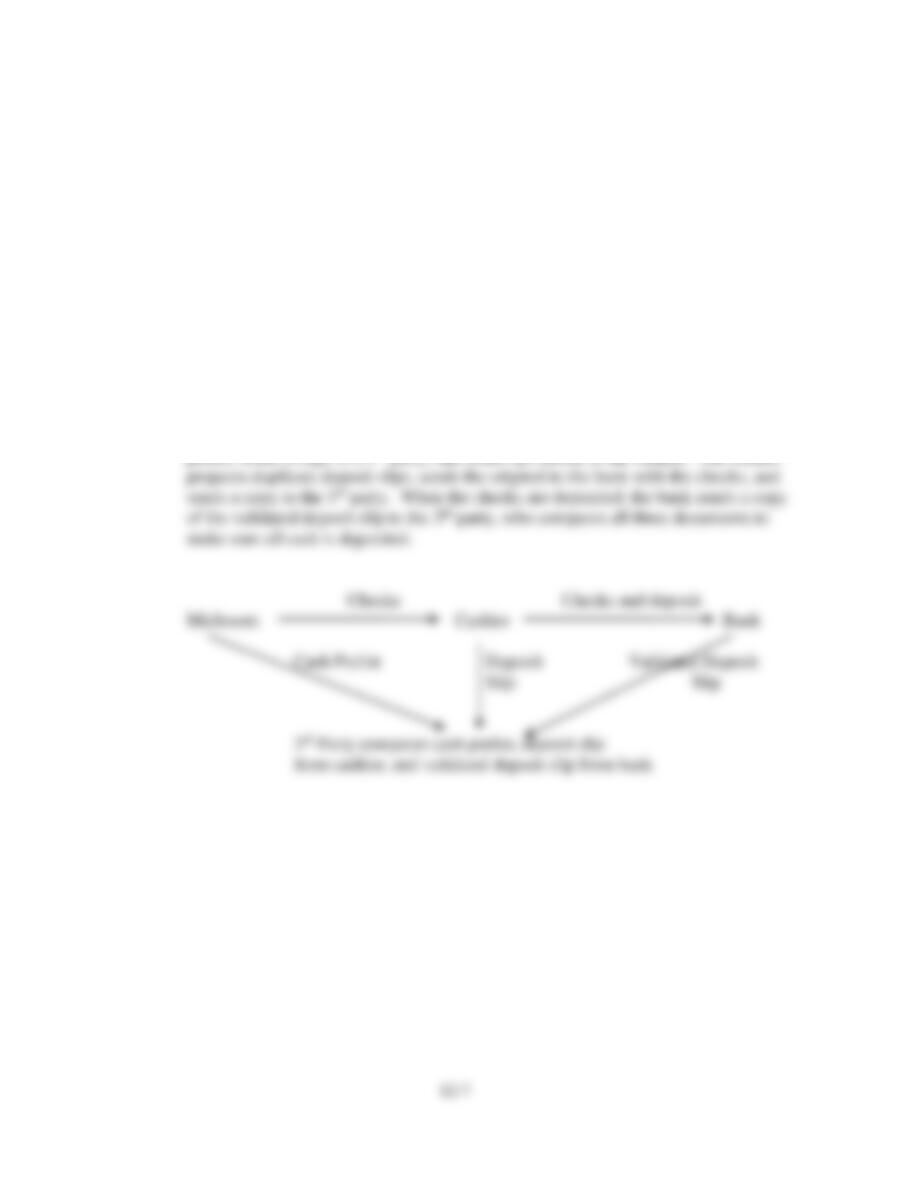
One way to control cash receipts is shown below. The mailroom creates a cash