Copyright © 2016 Pearson Canada Inc.
6
GOVERNMENT ACTIONS
IN MARKETS
L e c t u r e N o t e s
Government Actions in Markets
• Government intervention in markets—using price controls, taxes, production quotas and subsidies, and
making products illegal—can affect the price and quantity in those markets.
• Government intervention affects the efficiency of markets and can lead to the creation of deadweight losses.
I. A Housing Market with a Rent Ceiling
• A price ceiling is a government regulation that makes it illegal to charge a price higher than a specified
level. When a price ceiling is applied to a housing market it is called a rent ceiling.
• A rent ceiling set above the equilibrium rent has no effect on the market.
• A rent ceiling set below the equilibrium rent creates a housing shortage, increased search activity, and
a black market.
A Housing Shortage
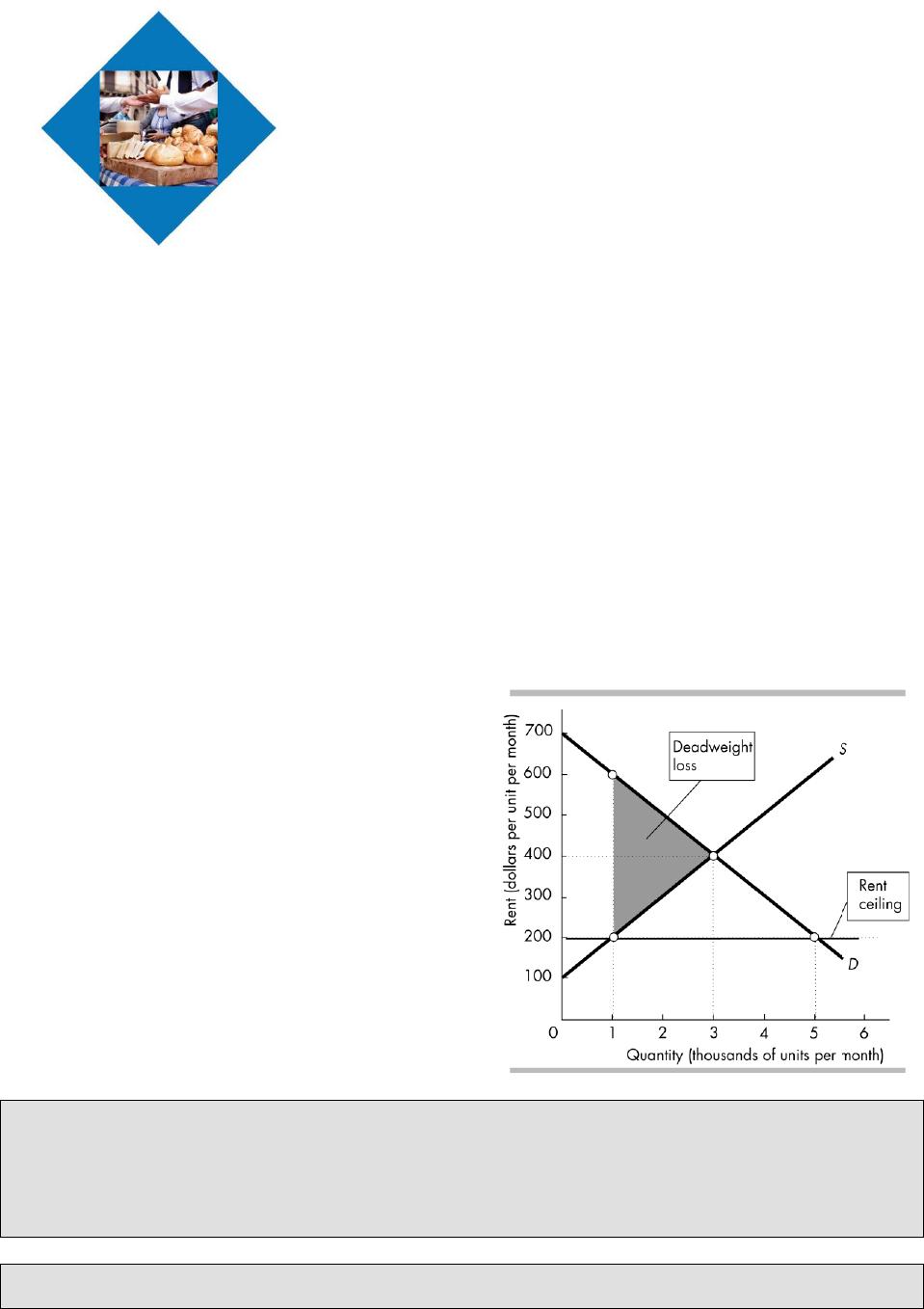
• If the government imposes a rent ceiling below the
equilibrium rent, then a shortage results. In the
figure the equilibrium rent is $400 per month and
the equilibrium quantity of units rented is 3,000. If
the government imposes a rent ceiling of $200 per
month, a shortage results. The quantity demanded
at that price is 5,000 and the quantity supplied is
1,000. There is a shortage of 4,000 apartments per
month.
• Rent ceilings lead to inefficiency. In a competitive
market, the equilibrium quantity is the same as the
efficient quantity. In a housing market with a rent
ceiling, the quantity of units available is less than
the equilibrium quantity and so is less than the
efficient quantity. The market underproduces, and
there is a deadweight loss, as shown in the figure as
the darkened triangular area.
How is the “shortage” calculated? In looking at the effects of a price ceiling, some of you may sometimes focus
only on the change in the quantity supplied relative to equilibrium instead of looking at the entire difference between
the quantity demanded and quantity supplied. The shortage is measured by the difference between the quantity
demanded and the quantity supplied, NOT simply by the difference between the original equilibrium quantity and
the new quantity supplied.
Housing Markets and Rent Ceilings: Time and the elasticity of supply. Recall the different influences on the

2 CHAPTER 6
supply elasticity of the firm from Chapter 4 and note that how the passage of time allows sellers to fully respond to
changes in their environment. It is likely that supply is more elastic in the long run for many goods and services. In
the long run, apartment owners are more likely to change the number of apartments they offer in response to a price
ceiling than in the short run. If apartment owners are restricted in the rents they can offer, the quantity of available
apartments may not decrease immediately. Eventually, however, apartment owners may find that alternative uses for
their property (as a strip mall or a storage facility, for example) become more profitable.
Increased Search Activity
• Search activity is the time spent looking for someone with whom to do business. Search activity is
costly and increases the opportunity cost of a given product or service. A rent ceiling (or a price ceiling)
that creates a shortage increases search activity.
A Black Market
• A black market is an illegal market in which the price exceeds the legally-imposed price ceiling. In a
black market, illegal arrangements are made between renters and landlords—often at effective rental rates
that are higher than would be the case in an unregulated market.
• The level of black market rent depends on how tightly the rent ceiling is enforced. When the rent ceiling is
strictly enforced, black market rent will be closer to the maximum that consumers are willing to pay, which
in the figure is $600 per month.
Are Rent Ceilings Fair?
• Blocking voluntary exchange is unfair.
• Rent ceilings are fair if they help the poor and disadvantaged. Some other allocative mechanism, such as a
conflicts with the stated goals of those who promote rent ceilings as a means to create affordable housing. Rent
ceilings lead to a shortage, which means landlords have more ability to discriminate against renters who have a
addition, there is less incentive for landlords to make needed electrical or plumbing repairs, or perform maintenance
on appliances. Builders have less incentive to build new housing units so that in the long run, the stock of available
housing will not grow with the population, making the shortage worse.