1
Chapter 5: valuation of financial securities
1. In this chapter, you will learn how to value a financial product using the knowledge you learned
from last chapter, time value of money.
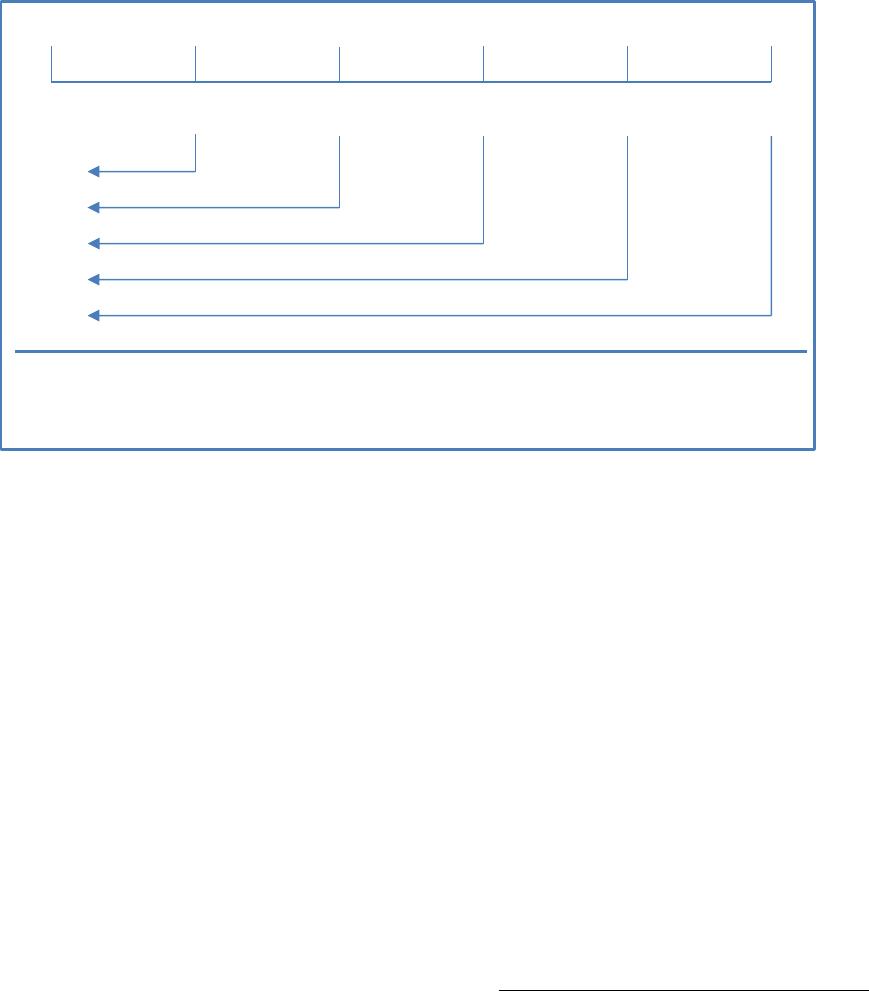
2. The value of any financial product is nothing more than the present value of all its future cash
flows. Let’s assume that a financial product generates the following cash flows:
Apparently, to calculate the value of the above financial product, we will need:
a. All future cash flows.
b. The discount rate.
c. Know how to calculate the PV of future cash flows we learned this in last chapter.
Section I – Bonds
1. What is a bond? Bond is a loan contract between investors and the borrower, which could be a
corporation, the federal government or a local government.
a. A bond is like a CD, except that a CD is issued by a bank, a bond is issued by a
government or a company.
2. Basic bond features:
a. Issuer: the borrower
b. Par (face) value: the value printed on the face of the bond, the amount of money you’re
going to be paid back when the bond matures.
• Treasury bills are in $100;
• Most bonds have par value of $1,000. If not specified, assume $1,000 par value.
c. Coupon, coupon rate and coupon frequency:
• Coupon: fixed amount of interest you’re going to receive at fixed time intervals.
0
1
2
3
4
5
CF1
CF2
CF3
CF4
CF5
PV
PV
PV
PV
PV
𝑃𝑉𝑠=𝑣𝑎𝑙𝑢𝑒 ሺ𝑝𝑟𝑖𝑐𝑒ሻ𝑜𝑓 𝑡ℎ𝑒 𝑝𝑟𝑜𝑑𝑢𝑐𝑡

2
• Coupon rate: this rate, together with payment frequency, determines how
much interest (coupon) you get paid.
• Coupon frequency: how often you get paid. Most corporate bonds make coupon
payments semiannually.
𝑃𝑀𝑇= 𝑃𝑎𝑟∗𝑐𝑜𝑢𝑝𝑜𝑛%
# 𝑜𝑓 𝑝𝑎𝑦𝑚𝑒𝑛𝑡𝑠 𝑝𝑒𝑟 𝑦𝑒𝑎𝑟
d. Maturity date: date when the bond matures (the contract ends) and you get paid the
face value, plus the last coupon payment.
• Treasury bills have 4-week, 13-week and 26-week maturities.
• Treasury notes have 1 to 10-year maturities.
• Treasury bonds have 30-year maturities.
• Corporate bonds have varying maturities, but usually longer than 1 year at the
time of issuance.
e. (Implied) rate of return, Yield to Maturity (YTM): this is your true rate of return. YTM is
usually not the same as the coupon rate, unless the bond is selling at par value. The
reason is that by selling the bond above or below par value, some percentages can be
added to or deducted from the coupon rate (which has already been printed on the
bond certificate) to reflect the up-to-date rate of return on the bond.
Example_of_Bond
f. Follow these steps to find specific bonds:
• FINRA.org → For Investors → Tools and Calculators → FINRA Market Data
Center (under Investor Tools) → Bonds (middle of the left column) → Search
(3rd button on the sub-ribbon) → type the company’s name in the “Issuer Name”
box for a quick search or → Click “Show” after “Advanced Search” for more
detailed screening
• You may also click here. You still need to click the “Search” button.
3. Bond types:
a. Depending who’s the issuer:
• Treasury bond: bill, note and bond
• Corporate bond
• Municipal bond
b. Depending on whether coupon payments will be made
• Zero-coupon (pure discount) bond: treasury bill
➢ How do investors make money when a bond doesn’t pay interests?
• Coupon bond
c. Depending on the whether the bond can be called (here “call” means buy back before
maturity)
• Callable bond
• Un-callable bond
d. Depending on whether the bond can be converted to stocks.
• Convertible bond
• Unconvertible bond
• Why do investors want to invest in convertible bonds? Why don’t they save
themselves the trouble and directly buy stocks?
e. Depending on whether there’s a specified collateral:
• Collateralized bond: the bond will use a piece of the company’s assets as
guarantee.
• Debenture – special name for bonds with no collateral.
4. Bond ratings:
a. Three major (supposedly) independent rating agencies – S&P, Moody’s Fitch