Course Paper #1: Business Level Strategy – Porter’s Five Force Model 1
Facebook
Business Level Strategy
Jonelle Allen
MGMT211 2456 Principles of Management
March 5, 2017 by 11:59 PM
Author Note
CERTIFICATION OF AUTHORSHIP: I certify that I am the author of this work and that any
assistance I have received in its preparation is fully acknowledged and disclosed. I have also
cited any sources from which I used data, ideas or words, directly quoted or paraphrased. This
work was prepared by me specifically for this course
COURSE PAPER #1: BUSINESS LEVEL STRATEGY – PORTER’S FIVE FORCE MODEL 2
Facebook
Facebook (FB) is an American for-profit corporation and online social media and social
networking service based in Menlo Park, California. The Facebook website was launched on
February 4, 2004, by Mark Zuckerberg, along with fellow Harvard College students and
roommates, Eduardo Saverin, Andrew McCollum, Dustin Moskovitz, and Chris Hughes.
The founders had initially limited the website’s membership to Harvard students;
however, later they expanded it to higher education institutions in the Boston area, the Ivy
League schools, and Stanford University. Facebook gradually added support for students at
various other universities, and eventually to high school students as well. Since 2006, anyone age
13 and older has been allowed to become a registered user of Facebook, though variations exist
in the minimum age requirement, depending on applicable local laws. The Facebook name
comes from the face book directories often given to United States university students.
Facebook may be accessed by a large range of desktops, laptops, tablet computers, and
smartphones over the Internet and mobile networks. After registering to use the site, users can
create a user profile indicating their name, occupation, schools attended and so on. Users can add
other users as “friends”, exchange messages, post status updates and digital photos, share digital
videos and links, use various software applications, and receive notifications when others update
their profiles or make posts. Additionally, users may join common-interest user groups organized
by workplace, school, hobbies or other topics, and categorize their friends into lists such as
“People from Work” or “Close Friends”. Users can complain about or block unpleasant people.
Because of the large volume of data that users submit to the service, Facebook has come under
COURSE PAPER #1: BUSINESS LEVEL STRATEGY – PORTER’S FIVE FORCE MODEL 3
scrutiny for its privacy policies. Facebook makes most of its revenue from advertisements which
appear on screen. Facebook, Inc. held its initial public offering (IPO) in February 2012, and
began selling stock to the public three months later, reaching an original peak market
capitalization of $104 billion. On July 13, 2015, Facebook became the fastest company in the
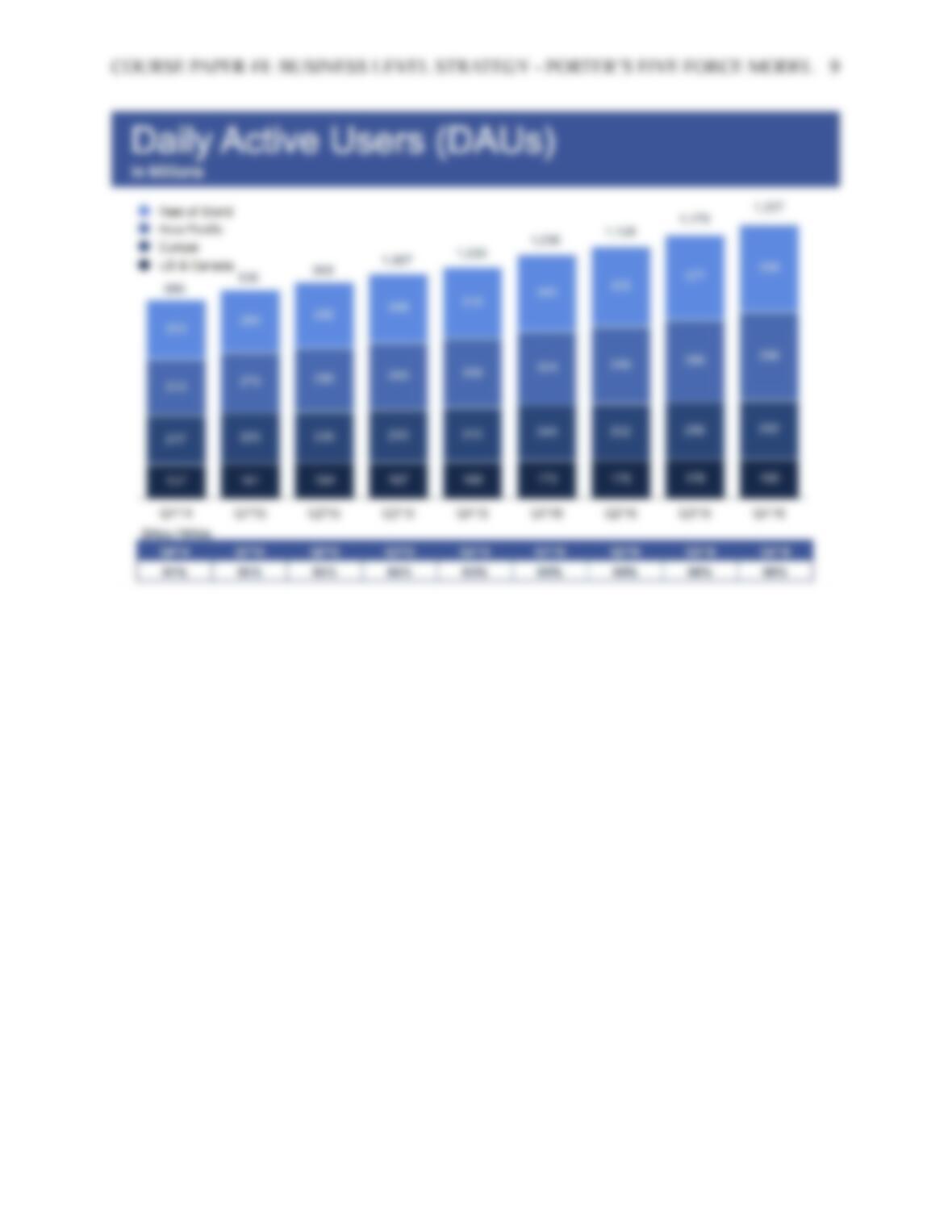
Standard & Poor’s 500 Index to reach a market cap of $250 billion. Facebook has more than 1.86
billion monthly active users as of December 31, 2016, and as of April 2016, Facebook was the
most popular social networking site in the world, based on the number of active user accounts.
Among the hundreds of online social media sites on the Internet, sites that compete
directly with Facebook include Instagram, Snapchat and LinkedIn. These three sites are gaining
exposure and fans quickly.