1
Principles of Macroeconomics, 9e – TB1 (Case/Fair/Oster)
Chapter 14 The Labor Market in the Macroeconomy
14.1 The Labor Market: Basic Concepts
1 Multiple Choice
1) The functioning of the labor market primarily affects the shape of the
A) aggregate demand curve.
B) money demand curve.
C) aggregate supply curve.
D) planned investment curve.
Answer: C
Diff: 1
Topic: The Labor Market: Basic Concepts
Skill: Conceptual
AACSB: Reflective Thinking
2) The type of unemployment that is due to changes in the structure of the economy is
A) adjustable unemployment.
B) structural unemployment.
C) frictional unemployment.
D) cyclical unemployment.
Answer: B
Diff: 1
Topic: The Labor Market: Basic Concepts
Skill: Definition
3) The type of unemployment that arises during recessions is known as
A) the natural rate of unemployment.
B) cyclical unemployment.
C) structural unemployment.
D) frictional unemployment.
Answer: B
Diff: 1
Topic: The Labor Market: Basic Concepts
Skill: Definition
4) The type of unemployment that is most likely to arise as a result of technological changes is
A) cyclical unemployment.
B) seasonal unemployment.
C) frictional unemployment.
D) structural unemployment.
Answer: D
Diff: 1
Topic: The Labor Market: Basic Concepts
Skill: Definition
2
5) If you hear a person saying “I lost my job because I was replaced by a machine,” you should
conclude that this person is ________ unemployed.
A) cyclically
B) structurally
C) frictionally
D) seasonally
Answer: B
Diff: 1
Topic: The Labor Market: Basic Concepts
Skill: Conceptual
AACSB: Reflective Thinking
6) If you hear a person saying “I lost my job at the GM plant because car manufacturing is slow
due to a slowdown in the economy,” you should conclude that this person is ________
unemployed.
A) cyclically
B) structurally
C) frictionally
D) seasonally
Answer: A
Diff: 1
Topic: The Labor Market: Basic Concepts
Skill: Conceptual
AACSB: Reflective Thinking
7) The labor force includes those people with a job and
A) those people who are looking for work.
B) those people training for a job.
C) those people who formerly worked and are now retired.
D) homemakers.
Answer: A
Diff: 1
Topic: The Labor Market: Basic Concepts
Skill: Definition
8) The unemployment rate is
A) the number unemployed divided by the labor force.
B) the number unemployed divided by the number employed.
C) the number unemployed divided by the population.
D) the difference between the population and the number employed divided by the
population.
Answer: A
Diff: 1
Topic: The Labor Market: Basic Concepts
Skill: Definition
3
9) If a country has a population of 400 million, 160 million people employed and 40 million
people looking for work, then its unemployment rate is
A) 10%.
B) 20%.
C) 25%.
D) 40%.
Answer: B
Diff: 2
Topic: The Labor Market: Basic Concepts
Skill: Analytic
AACSB: Analytic Skills
10) Employment tends to rise when
A) aggregate output falls.
B) unemployment rises.
C) aggregate output rises.
D) labor productivity falls.
Answer: C
Diff: 2
Topic: The Labor Market: Basic Concepts
Skill: Conceptual
AACSB: Reflective Thinking
2 True/False
1) If a household member is not in the labor force, it is because he or she has decided his or her
time is more valuable in nonmarket activities.
Answer: TRUE
Diff: 1
Topic: The Labor Market: Basic Concepts
Skill: Conceptual
AACSB: Reflective Thinking
2) If a person is not employed but is looking for work, she is in the labor force.
Answer: TRUE
Diff: 1
Topic: The Labor Market: Basic Concepts
Skill: Conceptual
AACSB: Reflective Thinking
3) Frictional unemployment is the type that arises due to recessions.
Answer: FALSE
Diff: 1
Topic: The Labor Market: Basic Concepts
Skill: Definition
4) Structural unemployment arises when the economy changes making some jobs obsolete.
Answer: TRUE
Diff: 1
Topic: The Labor Market: Basic Concepts
Skill: Definition
4
5) Cyclical unemployment is that which rises in recessions and shrinks during expansions.
Answer: TRUE
Diff: 1
Topic: The Labor Market: Basic Concepts
Skill: Definition
6) The unemployment rate will never be zero because the economy is dynamic and always
changing.
Answer: TRUE
Diff: 1
Topic: The Labor Market: Basic Concepts
Skill: Conceptual
AACSB: Reflective Thinking
7) The unemployment rate is the fraction of the labor force without a job.
Answer: TRUE
Diff: 1
Topic: The Labor Market: Basic Concepts
Skill: Definition
14.2 The Classical View of the Labor Market
1 Multiple Choice
1) Changes in the ________ market affect the shape of the short run aggregate supply curve.
A) money
B) labor
C) goods
D) financial
Answer: B
Diff: 1
Topic: The Classical View of the Labor Market
Skill: Conceptual
AACSB: Reflective Thinking
2) According to Classical economists, the only types of unemployment that exist in an economy
are
A) structural and frictional unemployment.
B) cyclical and frictional.
C) seasonal and cyclical.
D) frictional and seasonal.
Answer: A
Diff: 1
Topic: The Classical View of the Labor Market
Skill: Fact
5
3) According to Classical economists, excessive unemployment does not persist in the economy
because
A) wages will always adjust to ensure equilibrium in the labor market.
B) the labor demand does not change in the economy.
C) the labor supply does not change in the economy.
D) interest rates always change to insure equilibrium in the money market.
Answer: A
Diff: 2
Topic: The Classical View of the Labor Market
Skill: Fact
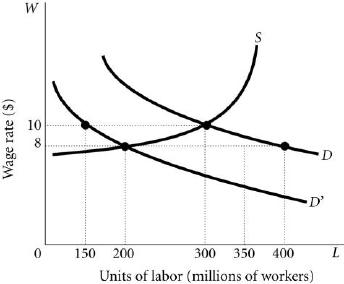
Refer to the information provided in Figure 14.1 below to answer the questions that follow.
Figure 14.1
4) Refer to Figure 14.1. Suppose there is a decrease in the fertility rate and this causes some
men and women to place a lower value on their time spent in nonmarket activities. This will
cause
A) the labor supply curve to shift to the left of S.
B) the labor supply curve to shift to the right of S.
C) the labor demand curve to shift from D to D‘.
D) the labor demand curve to shift from D‘ to D.
Answer: B
Diff: 2
Topic: The Classical View of the Labor Market
Skill: Analytic
AACSB: Analytic Skills
5) Refer to Figure 14.1. If the demand for labor falls from D to D‘ and wages are sticky on the
downward side, there will be unemployment of ________ million.
A) 200
B) 150
C) 100
D) 50
Answer: B
Diff: 2
Topic: The Classical View of the Labor Market
Skill: Analytic
AACSB: Analytic Skills
6
6) Refer to Figure 14.1. The demand for labor falls from D to D‘. If firms enter into social, or
implicit, contracts with workers not to cut wages, then the wage rate will remain at $10 and
A) employment will fall to 150 million.
B) employment will fall to 200 million.
C) employment will remain at 300 million.
D) labor supply will decrease to restore the market to equilibrium.
Answer: A
Diff: 2
Topic: The Classical View of the Labor Market
Skill: Analytic
AACSB: Analytic Skills
7) Firms might pay efficiency wages above the equilibrium wage for all of the following
reasons EXCEPT
A) to reduce employee shirking.
B) to improve employee morale.
C) to reduce employee turnover.
D) to reduce taxes.
Answer: D
Diff: 2
Topic: The Classical View of the Labor Market
Skill: Conceptual
AACSB: Reflective Thinking
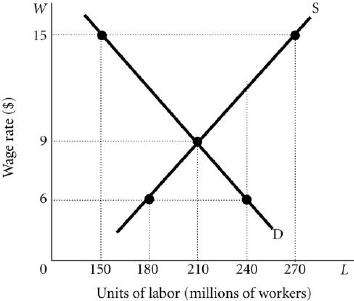
Refer to the information provided in Figure 14.2 below to answer the questions that follow.
Figure 14.2
8) Refer to Figure 14.2. The equilibrium wage rate is $________ and the equilibrium number of
people employed is ________ million people.
A) 15; 270
B) 9; 210
C) 15; 150
D) 6; 180
Answer: B
Diff: 1
Topic: The Classical View of the Labor Market
Skill: Analytic
AACSB: Analytic Skills
9) Refer to Figure 14.2. At wage rate $15, there is a ________ of labor equal to ________ million
people.
A) surplus; 150
B) shortage; 150
C) shortage; 120
D) surplus; 120
Answer: D
Diff: 2
Topic: The Classical View of the Labor Market
Skill: Analytic
AACSB: Analytic Skills
10) Refer to Figure 14.2. At wage rate $6, there is a ________ of labor equal to ________ million
people.
A) shortage; 180
B) shortage; 60
C) surplus; 180
D) surplus; 60
Answer: B
Diff: 2
Topic: The Classical View of the Labor Market
Skill: Analytic
AACSB: Analytic Skills