SYLLABUS
Some or all of the materials in this course may be protected by copyright. Federal copyright law prohibits the reproduction, distribution,
public performance, or public display of copyrighted materials without the express and written permission of the copyright owner, unless
fair use or another exemption under copyright law applies.
Rev 08/19/2019
Syllabus – ME1160 Medical Terminology
Page 1 of 5
COURSE:
ME1160 – Medical Terminology
CLOCK/CREDIT
HOURS:
60 Clock Hours (60 Lecture / 0 Lab) – 4.0 Semester Credits
120 Out–of–Class Hours over five weeks*
COURSE LENGTH:
5 Weeks
MODE OF
DELIVERY:
Online
UNIT OF ACADEMIC
MEASUREMENT
X Semester Credit
PREREQUISITES:
None
CO–REQUISITES:
None
COURSE
DESCRIPTION:
Medical terminology is a language used to describe the human body, as well as
its conditions. In this course, students will learn how to combine words to create
me
aningful medical terms, utilize correct spelling as well as to comprehend a
variety of definitions. Coursework includes a survey of all major body systems
including: musculoskeletal, respiratory, circulatory, digestive, reproductive and
the urinary system.
This course is an essential foundation for the allied health
professional and serves to prepare individuals for a career in the medical field.
TEXTBOOKS:
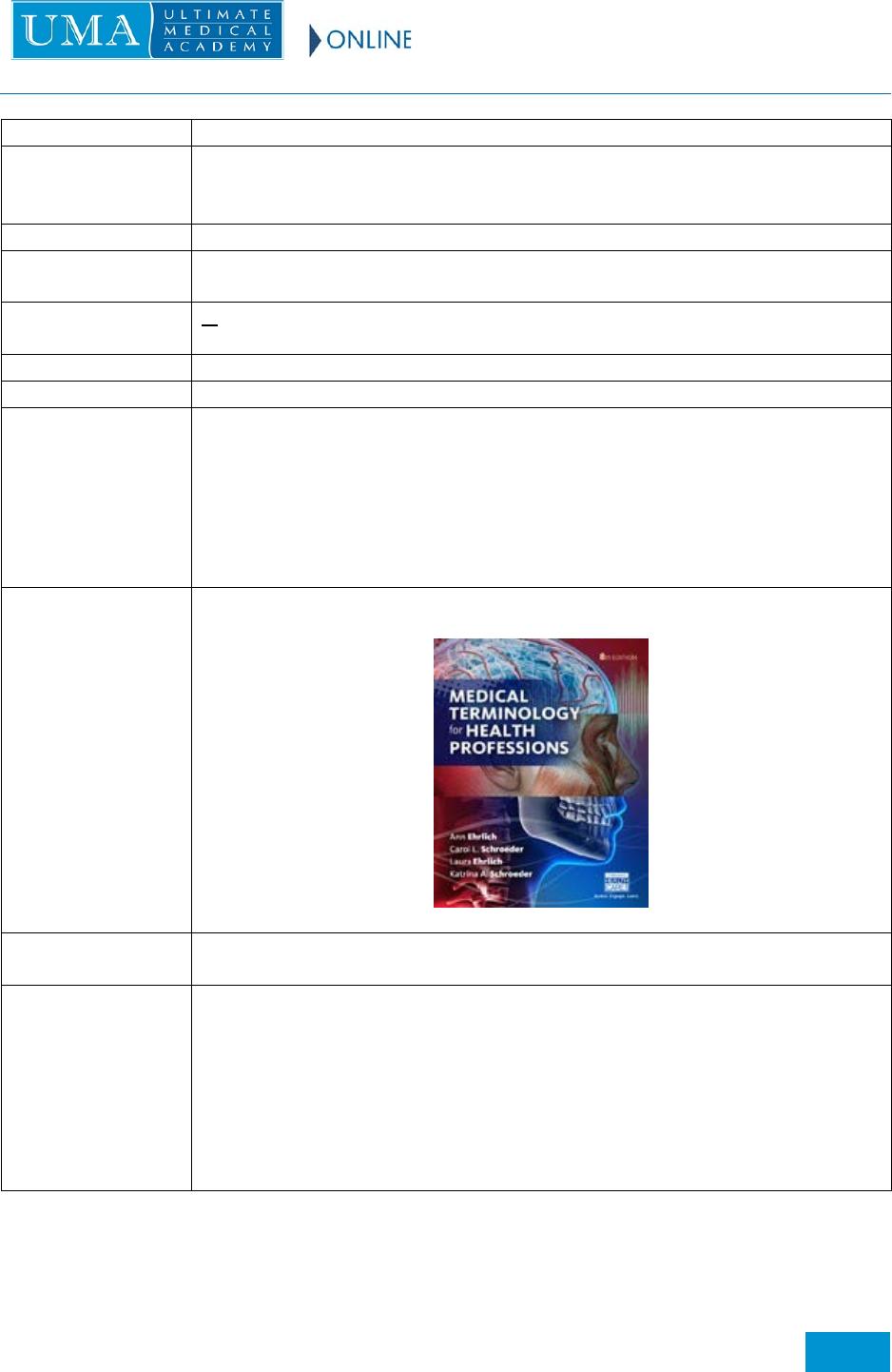
Ehrlich, A., Schroeder, C., Ehrlich, L., Schroder, K. (2017). Medical Terminology
for Health Professions. (8th Ed.). Boston, MA. Cengage (Textbook)
RESOURCES &
SUPPLIES
UMA Virtual Library and other online resources.
COURSE
EDUCATIONAL
OBJECTIVES
Upon completion of this course, the student will be able to:
1. Explain medical word structure.
2. Classify vocabulary related to the body as a whole.
3. Construct medical terms from component parts.
4. Interpret constructed medical terms.
5. Utilize medical terms related to each of the body systems.
SYLLABUS
GRADING:
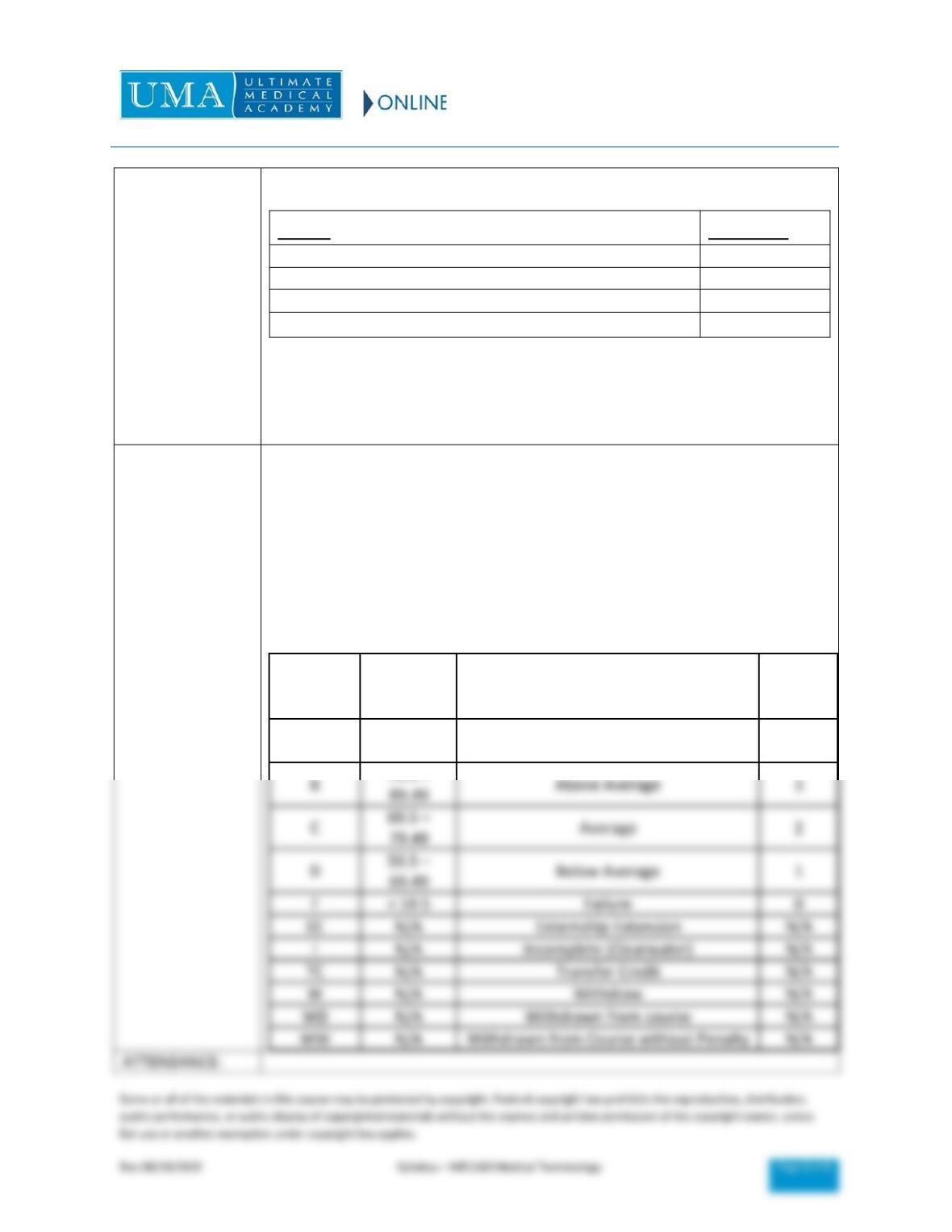
Student performance will be evaluated based upon the following criteria:
Criteria Percentage
Discussions
30 %
Assignments (Out of Class)
25 %
Assessments
45%
Total Percentage for all criteria listed above
100%
GRADING SCALE:
Students are assessed and must pass examinations and skills demonstrations
(i.e. practical demonstration, practice assignments, formative assessments,
etc.) for every course attempted and completed. An “attempt” occurs when a
student attends class with the intention of earning credit towards the
completion of the course. Grades are assigned for course attempts and
completions. Non–passing grades result in course repeats. A grade of ‘D’ or
higher is required for successful course completion in the programs listed in
the scale below:
Grade Range Definitions
Quality
Points
A
89.5 –
100.0
Outstanding 4
79.5 –
89.49
69.5 –
79.49
59.5 –
69.49