Natural Sciences Tripos Part II
MATERIALS SCIENCE
II
MATERIALS
SCIENCE
C3: Optical Properties of Materials
Dr C. Ducati
Lent Term
2014
15
Name……………………….. College……………………..
Lent
Term
2014
–
15
2
Synopsis
The optical behaviour of solids provide an important tool for studying a range of properties: energy
band structure, impurity levels and crystal defects, excitons and lattice vibrations (and certain
magnetic excitations).The central question is the relationship between experimental observations
and the energy bands of the solid.
This module is designed to cover the basic concepts behind the optical properties of materials,
from the classical description used for metals and insulators, to the quantum mechanical approach
used for semiconductors. Examples of materials and applications will complement the theoretical
framework.
Classical description of the optical properties of materials. Relevant electro-optical
quantities, electromagnetic wave propagation and coupling to matter.
Classical description of the optical properties of metals and insulators. Harmonic
oscillator and damping. The Lorentz Model for insulators. The Drude Model for Metals.
Brief notes on quantum theory of absorption and dispersion. Oscillator strength
Band structure and optical properties of semiconductors. Direct and indirect transitions.
Joint Density of States. Band edge absorption in direct and indirect semiconductors.
Absorption above the band edge.
Brief notes on measuring the optical properties of materials by UV-vis spectroscopy
Absorption in semiconductors: examples. Solar cells and photodetectors.
Photoemission in semiconductors: examples. Electroluminescence and lasing, light
emitting diodes, LASER diodes.
Recommended textbooks:
Rolf Hummel “Electronic properties of materials”, 3rd ed., Springer, 2001 (2005 printing)
Solymar and D. Walsh, “Electrical properties of materials”, 8th ed., Oxford University Press,
2010
Mark Fox “Optical Properties of Solids”, 2nd ed., Oxford University Press, 2006
F. Wooten, “Optical Properties of Solids”, Academic Press, 1972 [OUT OF PRINT, but available
online]. Figures in Chapters 2-4 have been reproduced from this book, acknowledged as [1].
C. Kittel, “Introduction to solid state physics”, 8th ed., Wiley, 2005
3
Chapter 1
Classical description of the optical properties of Materials
This lecture defines the basic optical properties of solids; in particular the link between these and
the ac conductivity in terms of classical theory of optics. This can handle the broad details of the
differences between metals and dielectrics but not the details of the absorption spectrum which
has to take account of (quantum) band structure.
Photons
Photons are quanta of electromagnetic radiation, possess no mass and no electric charge. By the
De Broglie equation, the wave-particle duality for photons is expressed as:
where λ the wavelength,
c
is the speed of light in vacuum,
E
is the energy of the photon, and h is
Planck’s constant. If ν is the frequency of the photon, the angular frequency of the radiation is ω
πν. We have , where ħ is the reduced Planck’s constant.
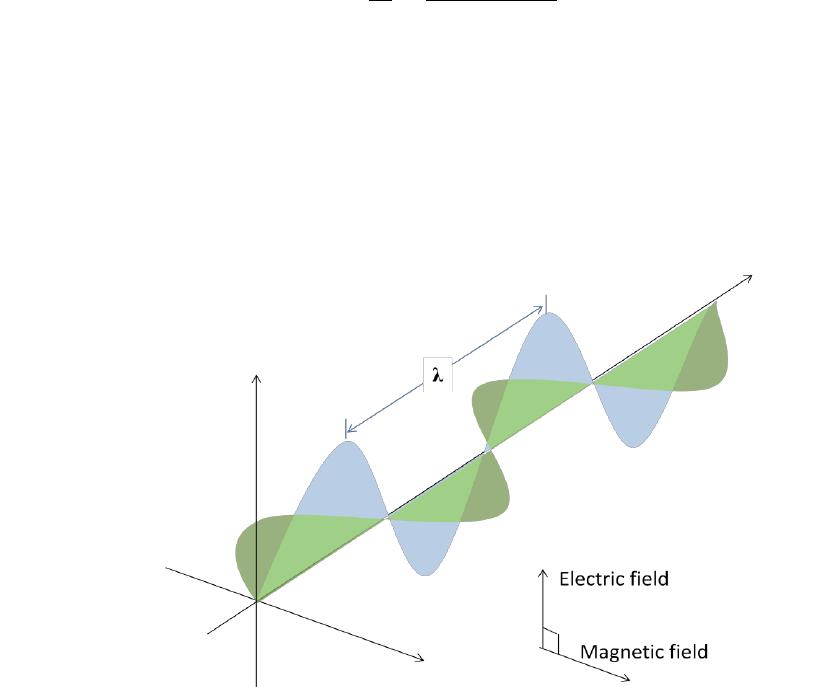
The electric and magnetic field in an electromagnetic wave oscillate sinusoidally at the same
frequency, perpendicular to each other and to the direction of wave propagation (they are
transverse fields). The phase velocity of the EM radiation, vp,= λν ω/k , where k / is the
wave number.
Figure 1: Electromagnetic radiation propagating through space
4
By definition in vacuum / , where is the vacuum permittivity, and is the
vacuum permeability. The phase velocity of the electromagnetic wave propagating through a
medium is / (deduced from Maxwell’s equations) where
ε εoεr
is the absolute
permittivity of the medium, and
μ μoμr
is its magnetic permeability.
We define the refractive index as the ratio between speed of light (phase velocity) in vacuum over
the speed of light in a medium: / or .
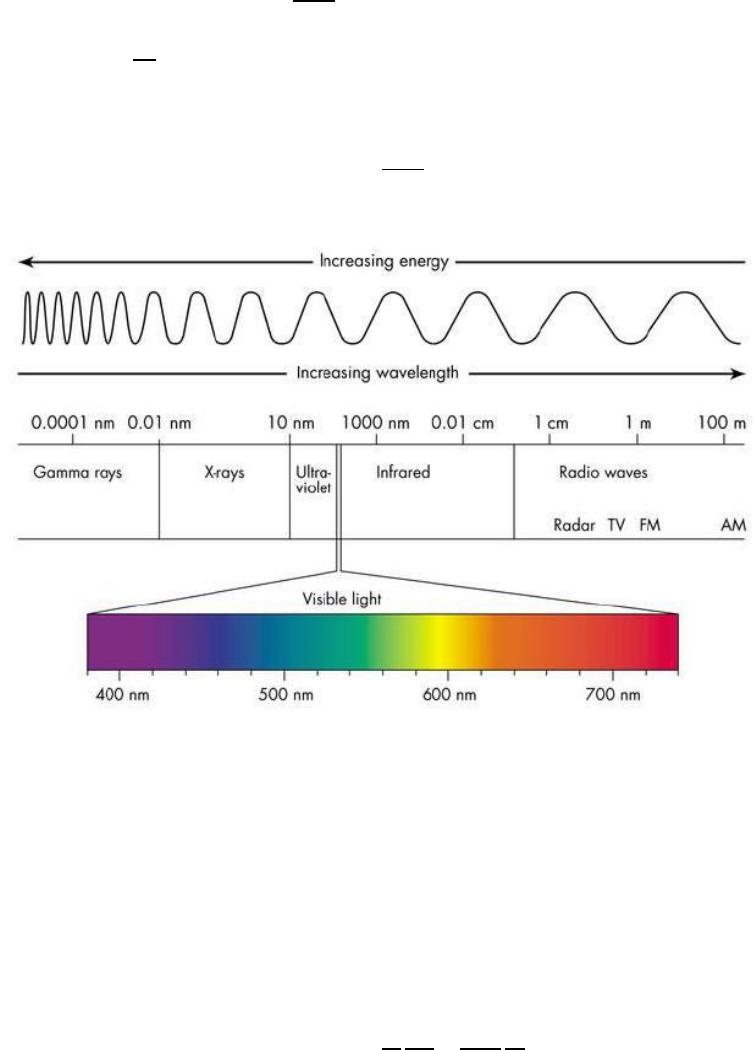
Figure 2: The electromagnetic spectrum
The propagation of the EM field through matter is affected by the charge densities and current
densities in materials, as described by Maxwell’s equations (in Appendix A).
The complex dielectric function and the complex optical conductivity
The plane wave propagating through an energy-absorbing medium has the form of a transverse
plane wave (also in Appendix A)
Eq. 1:
The conductivity should be called optical conductivity to indicate that it is the contribution to the
conductivity arising from electronic transitions that accompany photon absorption (in the infrared,
low energy transfer, optical conductivity dc electrical conductivity).
Looking at the solutions of the wave equation in an isotropic medium we have
where is the amplitude of the wave and is perpendicular to the wave vector
. can be
approximated as a plane wave only for λ that are large compared with the lattice constant of the
5
solid (fine for visible, NOT for x-rays). NOTE: The complex wave vector allows us to describe energy
dissipation.
Substituting into Eq. 1, we see that
We define a complex refractive index such that
, where is the refractive
index and is the extinction coefficient. Now we can rewrite:
We now define a complex relative dielectric function
. We can write these two
components as:
, which is the real part of the dielectric function, which describes the propagation
of the EM wave in the solid, and
which is the imaginary part of the dielectric function, which describes the
absorption of the EM wave in the solid.
The two components of the complex dielectric function are not independent. By analogy the two
components of the complex refractive index are not independent. Also, and are clearly related
to each other.
Interaction of light with matter
When light interacts with matter, the optical processes observed in solid-state materials can be
classified as reflection, propagation and transmission. Within the propagation subgroup, we have
refraction, absorption, luminescence, scattering.
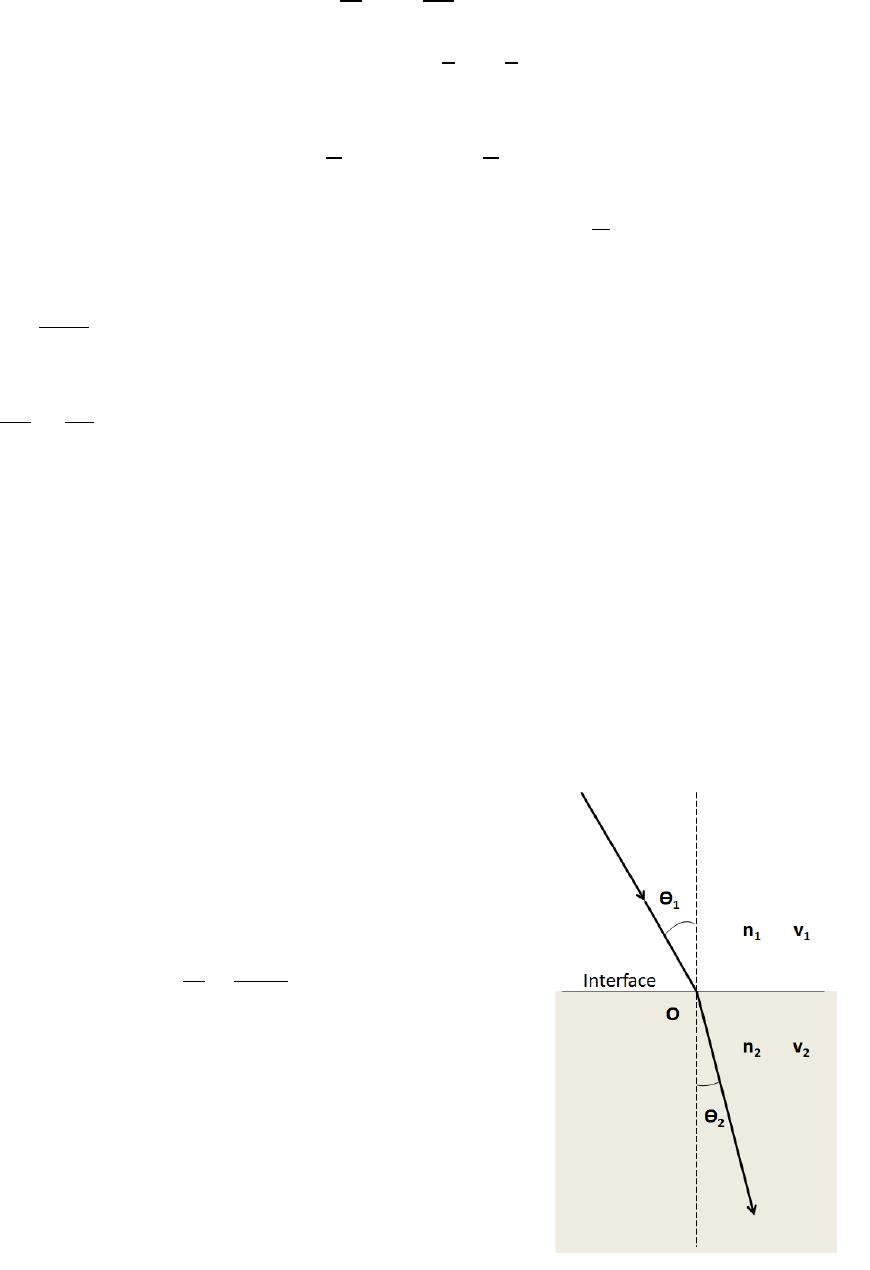
Refraction
Refraction causes the light to propagate with a different
velocity in a solid than in free space (usually . This
leads to the bending of light rays at interfaces described by
Snell’s law of refraction:
where and are the refractive index and angle between
surface normal and propagation direction in each of the two
regions.
Figure 3: Schematic diagram of the
process of refraction

6
Absorption
Absorption occurs during propagation if the frequency of the light is resonant with transition
frequencies of the atoms in the solid. The intensity of the light beam is attenuated as it travels
through the absorbing medium, and therefore transmission is clearly related to absorption.
Selective absorption is responsible for the colour of some optical materials.
Absorption is quantified by a frequency dependent absorption coefficient, , the fraction of
power absorbed per unit length of the medium. To describe the intensity of the light beam
propagating through an absorbing medium (in the z direction), we use Beer’s law:
where is an optical intensity at (the entrance surface).
The absorption coefficient
and
where is the wavelength of light in
vacuum and is the extinction coefficient.
Dispersion
The refractive index depends on the frequency of the light. So, as a polychromatic light beam
travels through matter, the beam is dispersed according to its wavelength. This effect is called
dispersion (see later chapters).
Luminescence
Luminescence is the generic name for the spontaneous emission of light given by the
recombination of excited electrons in solid-state materials. One of the ways in which electrons can
be excited is by absorption of light, and therefore luminescence and absorption can happen
alongside. However luminescence is just one of the mechanisms of de-excitation, and its efficiency
depends heavily on the specific band structure of the material.
Scattering
Scattering changes the direction of propagation, and possibly frequency, of the light after
interacting with the medium. The total number of photons is unchanged, but the number
travelling in the forward direction is reduced. Scattering can be elastic (no change of light
frequency) or inelastic (change of frequency as well as propagation direction). Scattering typically
happens with random inhomogeneities which form electric dipoles. This process, if the wavelength
is larger than the scattering centre, is described by the Rayleigh scattering law:
Optical coefficients
A number of parameters can be used to quantify the macroscopic optical properties of materials.
In particular the reflection coefficient, or reflectivity, , the absorption coefficient, or absorbance,
, and the coefficients of transmission, or transmittivity, , are defined as the ratio of reflected to
incident power, absorbed to incident power, and transmitted to incident power, respectively.
The interaction of light with solids obeys the relationship (neglecting the scattering term):
.
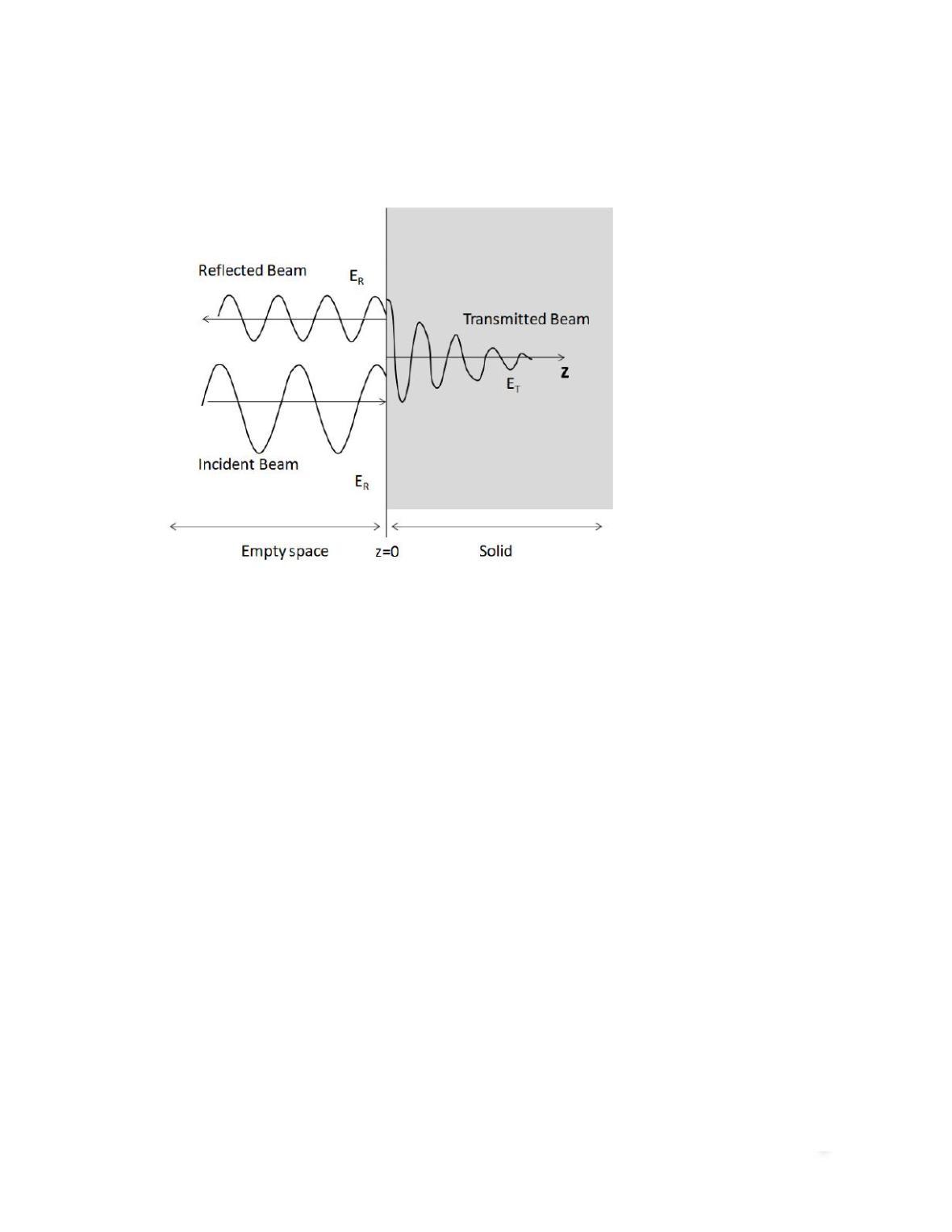
Figure 4: Schematic diagram for normal incidence reflectivity