RUNNING HEAD: INVESTMENT TRUSTS
INVESTMENT TRUSTS
NAME
INSTITUTION

INVESTMENT TRUSTS
INTRODUCTION
In this text, we are going to look at historical performance of four investment funds over
the past 20 years. A report will be produced for a wealthy client after analysis of the performance
of the four investment trusts. An analysis of the return characteristics of the fund relative to the
market and each other will be computed and analyzed, changes in beta over the last 20 years,
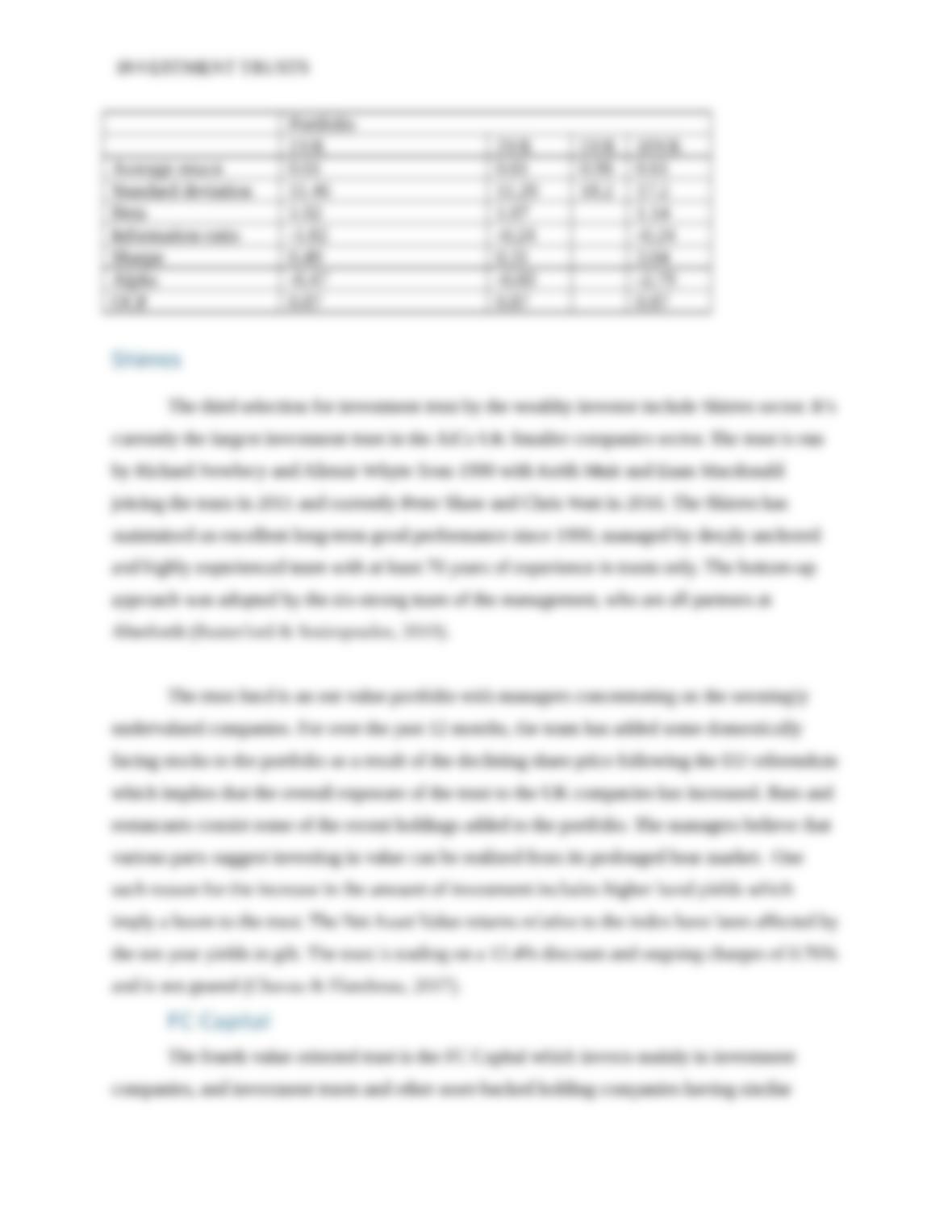
funds performance analysis based on information ratio, m-squared and Sharpe ratio using the
FTSE All share index as the benchmark. A conclusion shall be made for each performance
measure on every investment trust fund and further consideration shall be made on the popularity
with European investment fund managers. Finally, a summary of the findings will be drafted.
EXECUTIVE SUMMARY
Caledonia, Alliance Trust, City of London and Bankers are the only investment trusts
having a long reputation of increasing payouts every year. The above mentioned four trusts are
sometimes known as dividend heroes. They are only desirable by people yearning for a steady
stream of income or depend on dividend income as expense. The figures on performance indicate
total return that includes share price gains and dividends gained. The revenues for these four
trusts consistently increased over the years due to revenue reserves. Investment trusts have more
dividends compared to unit trusts. Investment trusts do not have to pay out all the dividends it
receives from companies in its portfolio and instead put its income in reserves. During
underperforming years when dividends in most companies are static or falling, the trust can dip
into its reserve and increase the payout to shareholders. This means investment trust can smooth
out the payment paths of dividends over the long term and the four investment trusts have been
particularly better at smoothing the process (Cassis, 2016).

INVESTMENT TRUSTS
What is the performance of these trusts compared to others? Two of these 50-year heroes
have underperformed – Alliance Trust and City of London trust-but they still have the appeal of
the investors. The city of London only invests in the UK and hence has inevitably missed out on
some the fastest growing stocks elsewhere in the world particularly the US. They, however, have
good yields. The other underperformer- Alliance Trust- has hard times in the recent past.
Consistency is essential for investors relying on dividend income in living expenses. The
dividend income should be reliable. They were able to maneuver during the deepwater horizon