2-1
Copyright © 2015 McGraw-Hill Education. All rights reserved. No reproduction or distribution without the prior written consent of McGraw-Hill
Education.
Chapter 02
Business Ethics and Social Responsibility
True / False Questions
1.
Business ethics refers to principles and standards that determine acceptable conduct in
business organizations.
True False
2.
Ethics and social responsibility mean the same thing.
True False
3.
All business decisions cannot be judged as right or wrong, ethical or unethical.
True False
4.
The most basic ethical concerns have been codified by laws and regulations that encourage
businesses to conform to society’s values and norms.
True False
5.
All a business has to do to maintain ethical conduct is to follow the law.
True False
6.
Only for-profit organizations have to worry about ethics scandals and social responsibility
issues.
True False
2-2
Copyright © 2015 McGraw-Hill Education. All rights reserved. No reproduction or distribution without the prior written consent of McGraw-Hill
Education.
7.
An ethical issue is an identifiable problem, situation, or opportunity that requires a person or
organization to choose from among several actions that may be evaluated as ethical or
unethical.
True False
8.
One of the principal causes of unethical behavior in organizations is overly aggressive financial or
business objectives.
True False
9.
Since all ethical standards are universally accepted, they do not depend on the culture in which a
business operates.
True False
10.
Employees spending their working hours on social networking or shopping sites is not considered
as an area of misconduct observed in the workplace.
True False
11.
Like sexual harassment, workplace bullying creates a hostile environment, but unlike sexual
harassment, workplace bullying has little legal recourse at this time.
True False
12.
Conflicts of interest are payments, gifts, or special favors intended to influence the outcome of a
decision.
True False
13.
Fairness and honesty are at the heart of business ethics and relate to the general values of
decision makers.
True False
2-3
Copyright © 2015 McGraw-Hill Education. All rights reserved. No reproduction or distribution without the prior written consent of McGraw-Hill
Education.
14.
Ethical decisions in an organization are influenced by three key factors.
True False
15.
Without a code of ethics or formal policy on ethics, employees are likely to base their decisions
on how their peers and superiors behave.
True False
16.
Professional codes of ethics are formalized rules and standards that describe what the company
expects of its employees.
True False
17.
Establishing and enforcing ethical standards and policies within business can help reduce
unethical behavior by prescribing which activities are acceptable and which are not and by
removing the opportunity to act unethically.
True False
18.
There are three dimensions of social responsibility: economic, legal, and ethical.
True False
19.
Voluntary responsibilities are optional activities that promote human welfare or goodwill.
True False
20.
Corporate citizenship is the extent to which businesses meet the legal, ethical, economic, and
voluntary responsibilities placed on them by their owners.
True False
21.
Most companies are introducing eco-friendly and marketing efforts to satisfy consumer demand
and improve their images.
True False
2-4
Copyright © 2015 McGraw-Hill Education. All rights reserved. No reproduction or distribution without the prior written consent of McGraw-Hill
Education.
22.
The concept of social responsibility is universally accepted.
True False
23.
A major social responsibility for business is providing equal opportunities for all employees.
True False
24.
The right to safety requires that businesses provide a safe place for consumers to shop.
True False
25.
Sustainability involves conducting activities in such a way as to provide for the long-term well-
being of the natural environment, including all biological entities.
True False
Multiple Choice Questions
26.
The principles and standards that determine acceptable conduct in business organizations are
referred to as:
A.
social responsibility.
B.
business strategies.
C.
business ethics.
D.
business stances.
E.
corporate citizenship.
2-5
Copyright © 2015 McGraw-Hill Education. All rights reserved. No reproduction or distribution without the prior written consent of McGraw-Hill
Education.
27.
Which of the following statements is true?
A.
All actions deemed unethical by society are also illegal.
B.
The concerns of what is legal and ethical do not change over time.
C.
The terms social responsibility and ethics should be used interchangeably.
D.
Companies can be both profitable and socially responsible.
E.
A business whose sole objective is to maximize profits is not likely to consider its social
responsibility, and its activities will also be illegal.
28.
The term social _____ refers to a business’s obligation to maximize its positive impact and
minimize its negative impact on society.
A.
citizenship
B.
strategy
C.
ethics
D.
responsibility
E.
rule
29.
The _____ Act criminalized securities fraud and toughened penalties for corporate fraud.
A.
Dodd-Frank
B.
Federal Trade Commission
C.
Foreign Corrupt Practices
D.
Sarbanes-Oxley
E.
Sherman Antitrust
2-6
Copyright © 2015 McGraw-Hill Education. All rights reserved. No reproduction or distribution without the prior written consent of McGraw-Hill
Education.
30.
Which of the following statements about business ethics is FALSE?
A.
It concerns the impact of a business’s activities on society.
B.
It refers to principles and standards that define acceptable behavior in business organizations.
C.
It relates to an individual’s values and moral standards and the resulting business decisions he
or she makes.
D.
What is ethical is determined by the public, government regulators, interest groups,
competitors, and each individual’s personal moral values.
E.
Studying it can help one recognize ethical issues and understand how others take unethical
decisions.
31.
Studying business ethics will NOT necessarily:
A.
help you recognize ethical issues.
B.
help you understand the importance of ethical decisions.
C.
inform you about the impact of the work group on ethical decisions.
D.
describe the ethical decision-making process.
E.
motivate individuals to perform acts of social responsibility.
32.
The Sarbanes-Oxley Act was passed to:
A.
punish those who committed accounting fraud in the late 1990s.
B.
improve corporate profits.
C.
help laid-off employees get their jobs back.
D.
help investors recoup their losses.
E.
help restore confidence in corporate America.
2-7
Copyright © 2015 McGraw-Hill Education. All rights reserved. No reproduction or distribution without the prior written consent of McGraw-Hill
Education.
33.
One of the most difficult things for a business to restore after an ethics scandal is:
A.
regulations.
B.
ethics training programs.
C.
trust.
D.
codes of conduct.
E.
morale.
34.
Which of the following statements is FALSE about ethics?
A.
Ethical issues are limited to for-profit organizations.
B.
Business ethics goes beyond legal issues.
C.
Ethical conduct builds trust among individuals and in business relationships.
D.
Ethical conflicts may evolve into legal disputes.
E.
Regardless of what an individual believes about a particular action, if society judges it to be
unethical, that judgment directly affects the organization’s ability to achieve its objectives.
35.
According to the National Business Ethics Survey, _____ is the number one area of misconduct
observed in the workplace.
A.
plagiarism
B.
discrimination
C.
abusive behavior
D.
misuse of company time
E.
stealing
2-8
Copyright © 2015 McGraw-Hill Education. All rights reserved. No reproduction or distribution without the prior written consent of McGraw-Hill
Education.
36.
If Laura, a manager, chooses to act so that she benefits financially at the expense of her firm,
then she:
A.
is bullying.
B.
is engaging in bribery.
C.
has a conflict of interest.
D.
is cheating.
E.
has broken the law.
37.
The fact that businesspeople are expected not to harm customers, clients, and competitors
knowingly through deception, misrepresentation, coercion, or discrimination is part of:
A.
business relationships.
B.
communications.
C.
conflict of interest.
D.
fairness and honesty.
E.
consumerism.
38.
A video gaming company was investigated for allegedly raising prices of its video game consoles
during the Christmas shopping season and thereby manipulating the supply of games available at
that time. This ethical issue is primarily concerned with:
A.
conflict of interest.
B.
communications.
C.
fairness and honesty.
D.
cost control.
E.
game rules.
2-9
Copyright © 2015 McGraw-Hill Education. All rights reserved. No reproduction or distribution without the prior written consent of McGraw-Hill
Education.
39.
In the realm of business ethics, making claims about dietary supplements or the health benefits
of certain unproven ingredients is an issue related to:
A.
conflict of interest.
B.
communications.
C.
product design.
D.
business relationships.
E.
financing.
40.
Managers use the _____ of their position to influence employees’ decisions and actions.
A.
responsibility
B.
standards
C.
principles
D.
authority
E.
acceptance
41.
_____ involves taking someone else’s work and presenting it as your own.
A.
Conflict of interest
B.
Bullying
C.
Inspiration
D.
Bribery
E.
Plagiarism
42.
The warning on cigarette packages about the health implications of smoking is an example of:
A.
conflict of interest.
B.
fairness and honesty.
C.
communications.
D.
relationships within a business.
E.
environmental issues.
2-10
Copyright © 2015 McGraw-Hill Education. All rights reserved. No reproduction or distribution without the prior written consent of McGraw-Hill
Education.
43.
Which of the following behavior is an example of ethical consideration within the purview
business relationships?
A.
Keeping company secrets
B.
Communicating with customers
C.
Whistleblowing
D.
Obeying environmental laws
E.
Donating to local charities
44.
If a manager pressures a subordinate to engage in activities that he or she may otherwise view
as unethical, such as engaging in accounting fraud or stealing a competitor’s secrets, this would
be an ethical issue related to:
A.
plagiarism.
B.
business relationships.
C.
communications.
D.
fairness and honesty.
E.
conflicts of interest.
45.
If an employee learned of a significant cost-saving idea from a coworker and then informed
management of the idea without revealing its true source, then the employee would be involved
in:
A.
keeping a secret.
B.
career advancement.
C.
plagiarism.
D.
bullying.
E.
bribery.
2-11
Copyright © 2015 McGraw-Hill Education. All rights reserved. No reproduction or distribution without the prior written consent of McGraw-Hill
Education.
46.
According to the text, ethical decisions in an organization are influenced by individual moral
standards, the influence of managers and co-workers, and the:
A.
religious values.
B.
informal ethical policies or rules.
C.
opportunity to engage in misconduct.
D.
family influence.
E.
founder’s values.
47.
Which of the following would help reduce the incidence of unethical behavior in an organization?
A.
Understanding individual moral standards, the influence of managers and coworkers, and
opportunity to influence ethical behavior
B.
Encouraging supervisors to engage in intimidating behavior when working in groups
C.
Limiting the opportunity for misconduct by providing punishments for violations of the rules
D.
Overlooking the need to reward employees for following codes of ethics
E.
Retaliating against whistleblowers
48.
Which of the following is true of ethics?
A.
Ethical conflict increases when employees feel that their company is exerting pressure on
them to engage in unethical conduct.
B.
Professional codes of ethics are informal rules and standards that describe what the company
expects of its employees.
C.
Codes of ethics need to be very detailed so that they take into account every situation.
D.
The development of a code of ethics should include only a firm’s executives and board of
directors.
E.
Employees always utilize the same ethical standards at work as they do at home.
49.
A set of formalized rules and standards that describes what a company expects of its employees
is called a(n) ____.
A.
contractual capacity
B.
consumerist code
C.
moral philosophy
D.
social responsibility
E.
code of ethics
50.
A code of ethics represents _____ rules and standards of what a company expects of its
employees.
A.
unceremonious
B.
short-term
C.
comprehensive
D.
formalized
situational
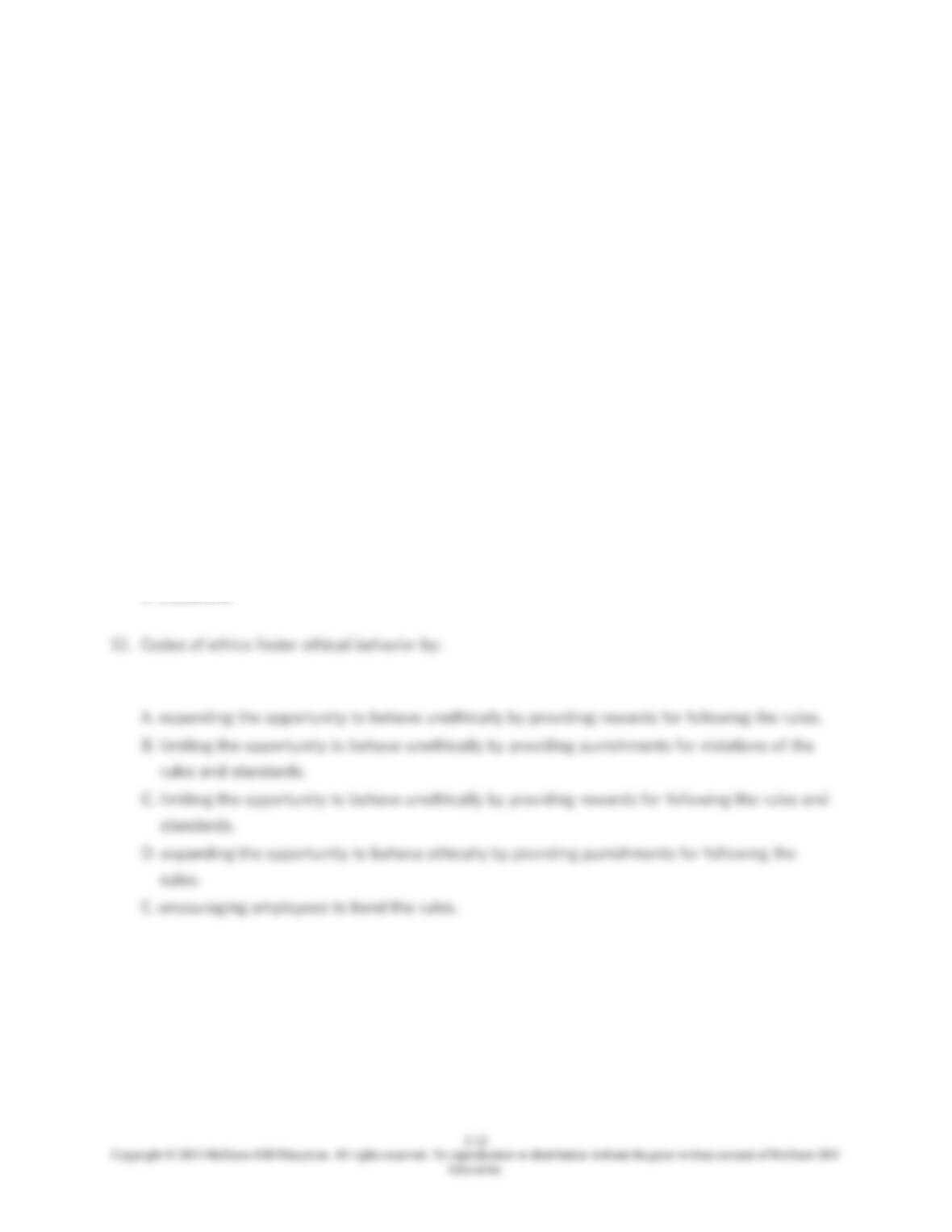
A.
expanding the opportunity to behave unethically by providing rewards for following the rules.
rules and standards.
standards.
rules.
encouraging employees to bend the rules.