ANSWERS TO QUESTIONS
1. Cash normally consists of coins and currency on hand, bank deposits, and various
kinds of orders for cash such as bank checks, money orders, travelers’ checks,
demand bills of exchange, bank drafts, and cashiers’ checks. Balances on deposit
in banks which are subject to immediate withdrawal are properly included in cash.
Money market funds that provide checking account privileges may be classified as
cash. There is some question as to whether deposits not subject to immediate
withdrawal are properly included in cash or whether they should be set out
separately. Savings accounts, time certificates of deposit, and time deposits fall in
this latter category. Unless restrictions on these kinds of deposits are such that they
cannot be converted (withdrawn) within one year or the operating cycle of the entity,
whichever is longer, they are properly classified as current assets. At the same
time, they may well be presented separately from other cash and the restrictions as
to convertibility reported.
2. (a) Cash (h) Investments, possibly
other assets.
(b) Trading securities. (i) Cash.
(c) Temporary investments. (j) Trading securities.
(d) Accounts receivable. (k) Cash.
(e) Accounts receivable, a loss if uncollectible. (l) Cash.
(f) Other assets if not expendable, cash if ex- (m) Postage expense, or
prepaid ex-
pendable for goods and services in the for- pense, or office
supplies inventory.
eign country. (n) Receivable from
employee if the
(g) Receivable if collection expected within one company is to be
reimbursed;
year; otherwise, other asset. otherwise, prepaid
expense.
3. A compensating balance is that portion of any cash deposit maintained by an
enterprise which constitutes support for existing borrowing arrangements with a
lending institution.
A compensating balance representing a legally restricted deposit held against short–
term borrowing arrangements should be stated separately among the cash and cash-
equivalent items. A restricted deposit held as a compensating balance against long-
term borrowing arrangements should be separately classified as a noncurrent asset in
either the investments or other assets section.
4. Restricted cash for debt redemption would be reported in the long-term asset
section, probably in the investments section. Another alternative is the other assets
section. Given that the debt is long term, the restricted cash should also be reported
as long term.
5. The seller normally uses trade discounts to avoid frequent changes in its catalogs, to
quote different prices for different quantities purchased, and to hide the true invoice
price from competitors. Trade discounts are not recorded in the accounts because
the price finally quoted is generally an accurate statement of the fair market value of
the product on that date. In addition, no subsequent changes can occur to affect this
value from an accounting standpoint. With a cash discount, the buyer receives a
choice and events subsequent to the original transaction dictate that additional
entries may be needed.
6. Two methods of recording accounts receivable are:
1. Record receivables and sales gross.
2. Record receivables and sales net.
Questions Chapter 7 (Continued)
The net method is desirable from a theoretical standpoint because it values the
receivable at its net realizable value. In addition, recording the sales at net provides
a better assessment of the revenue that was earned from the sale of the product. If
the purchasing company fails to take the discount, then the company should reflect
this amount as income. The gross method for receivables and sales is used in
practice normally because it is expedient and its use does not generally have any
significant effect on the presentation of the financial statements.
7. The basic problems that relate to the valuation of receivables are (1) the
determination of the face value of the receivable, (2) the probability of future
collection of the receivable, and (3) the length of time the receivable will be
outstanding. The determination of the face value of the receivable is a function of
the trade discount, cash discount, and certain allowance accounts such as the
Allowance for Sales Returns and Allowances.
8. The theoretical superiority of the allowance method over the direct write-off method
of accounting for bad debts is two-fold. First, since revenue is considered to be
recognized at the point of sale on the assumption that the resulting receivables are
valid liquid assets merely awaiting collection, periodic income will be overstated to
the extent of any receivables that eventually become uncollectible. The proper
matching of revenue and expense requires that gross sales in the income statement
be partially offset by a charge to bad debt expense that is based on an estimate of
the receivables arising from gross sales that will not be converted into cash.
Second, accounts receivable on the balance sheet should be stated at their
estimated net realizable value. The allowance method accomplishes this by
deducting from gross receivables the allowance for doubtful accounts. The latter is
derived from the charges for bad debt expense on the income statement.
9. The percentage-of-sales method. Under this method Bad Debt Expense is
debited and Allowance for Doubtful Accounts is credited with a percentage of the
current year’s credit or total sales. The rate is determined by reference to the
relationship between prior years’ credit or total sales and actual bad debts arising
therefrom. Consideration should also be given to changes in credit policy and
current economic conditions. Although the rate should theoretically be based on and
applied to credit sales, the use of total sales is acceptable if the ratio of credit sales
to total sales does not vary significantly from year to year.
The percentage-of-sales method of providing for estimated uncollectible receivables
is intended to charge bad debt expense to the period in which the corresponding
sales are recorded and is, therefore, designed for the preparation of a fair income
statement. Due to annually insignificant but cumulatively significant errors in the
experience rate which may result in either an excessive or inadequate balance in
the allowance account, however, this method may not accurately report accounts
receivable in the balance sheet at their estimated net realizable value. This can be
prevented by periodically reviewing and, if necessary, adjusting the balance in the
allowance account. The materiality of any such adjustment would govern its
treatment for reporting purposes.
The necessity of such adjustments of the allowance account indicates that bad debt
expenses have not been accurately matched against related sales. Further, even
when the experience rate does not result in an excessive or inadequate balance in
the allowance account, this method tends to have a smoothing effect on reported
periodic income due to year-to-year differences between the amounts of bad debt
write-offs and estimated bad debts.
Questions Chapter 7 (Continued)
The aging method. With this method each year’s debit to the expense account and
credit to the allowance account are determined by an evaluation of the collectibility
of open accounts receivable at the close of the year. An analysis of the accounts
according to their due dates is the usual procedure. For each of the age categories
established in the analysis, average percentage rates may be developed on the
basis of past experience and applied to the accounts in the respective age
categories. This method may also utilize individual analysis for some accounts,
especially those that are considerably past due, in arriving at estimated
uncollectible receivables. On the basis of the foregoing analysis the balance in the
valuation account is then adjusted to the amount estimated to be uncollectible.
This method of providing for uncollectible accounts is quite accurate for purposes of
reporting accounts receivable at their estimated net realizable value in the balance
sheet. From the stand-point of the income statement, however, the aging method
may not match accurately bad debt expenses with the sales which caused them
because the charge to bad debt expense is not based on sales. The accuracy of
both the charge to bad debt expense and the reported value of receivables
depends on the current estimate of uncollectible accounts. The accuracy of the
expense charge, however, is additionally dependent upon the timing of actual write-
offs.
10. A major part of accounting is the measurement of financial data. Changes in values
should be recognized as soon as they are measurable in objective terms in order for
accounting to provide useful information on a periodic basis.
The very existence of accounts receivable is based on the decision that a credit
sale is an objective indication that revenue should be recognized. The alternative is
to wait until the debt is paid in cash. If revenue is to be recognized and an asset
recorded at the time of a credit sale, the need for fairness in the statements
requires that both expenses and the asset be adjusted for the estimated amounts of
the asset that experience indicates will not be collected.
The argument may be persuasive that the evidence supporting write-offs permits a
more accurate decision than that which supports the allowance method. The latter
method, however, is “objective” in the sense in which accountants use the term and
is justified by the need for fair presentation of receivables and income. The direct
write-off method is not wholly objective; it requires the use of judgment in
determining when an account has become uncollectible.
11. Because estimation of the allowance requires judgment, management could either
over-estimate or under-estimate the amount of uncollectible accounts depending on
whether a higher or lower earnings number is desired. For example, Sun Trust bank
(referred to in the chapter) was having a very profitable year. By over-estimating the
amount of bad debts, Sun Trust could record a higher allowance and expense,
thereby reducing income in the current year. In a subsequent year, when earnings
are low, they could under-estimate the allowance, record less expense and get a
boost to earnings.
12. The receivable due from Kishwaukee Company should be written off to an
appropriately named loss account and reported in the income statement as part of
income from operations. Note that the profession specifically excludes write-offs of
receivables from being extraordinary. In this case, classification as an unusual item
would seem appropriate. The loss may properly be reduced by the portion of the
allowance for doubtful accounts at the end of the preceding year that was allocable
to the Kishwaukee Company account.
Estimates for doubtful accounts are based on a firm’s prior bad debt experience with
due consideration given to changes in credit policy and forecasted general or
industry business conditions.
Questions Chapter 7 (Continued)
The purpose of the allowance method is to anticipate only that amount of bad debt
expense which can be reasonably forecasted in the normal course of events; it is
not intended to anticipate bad debt losses which are abnormal and nonrecurring in
nature.
13. If the direct write-off method is used, the only alternative is to debit Cash and credit
a revenue account entitled Uncollectible Amounts Recovered. If the allowance
method is used, then the accountant may debit Accounts Receivable and credit the
Allowance for Doubtful Accounts. An entry is then made to credit the customer’s
account and debit Cash upon receipt of the remittance.
14. The journal entry on John Singer’s books would be:
Notes Receivable . . . . . . . . . . . . . . . . . . . . . . . . . . . . . . . . . . . . . . . 1,000,000
Discount on Notes Receivable . . . . . . . . . . . . . . . . . . . . . . . . . . 380,000
Sales Revenue . . . . . . . . . . . . . . . . . . . . . . . . . . . . . . . . . . . . . . 620,000*
*Assumes that seller is a dealer in this property. If not, the property might be
credited, and a loss on sale of $70,000 would be recognized.
15. Imputed interest is the interest ascribed or attributed to a situation or circumstance
which is void of a stated or otherwise appropriate interest factor. Imputed interest is
the result of a process of interest rate estimation called imputation.
An interest rate is imputed for notes receivable when (1) no interest rate is stated for
the transaction, or (2) the stated interest rate is unreasonable, or (3) the stated face
amount of the note is materially different from the current cash price for the same or
similar items or from the current market value of the debt instrument.
In imputing an appropriate interest rate, consideration should be given to the
prevailing interest rates for similar instruments of issuers with similar credit ratings,
the collateral, and restrictive covenants.
16. A company might sell receivables because money is tight and access to normal
credit is not available or prohibitively expensive. Also, a company may have to sell
its receivables, instead of borrowing, to avoid violating existing lending
arrangements. In addition, billing and collection of receivables are often time-
consuming and costly.
17. A financial components approach is used when receivables are sold but there is
continuing involve-ment by the seller in the receivable. Examples of continuing
involvement are recourse provisions or continuing rights to service the receivable. A
transfer of receivables should be recorded as a sale when the following three
conditions are met:
(a) The transferred asset has been isolated from the transferor (put beyond reach
of the transferor and its creditors).
(b) The transferees have obtained the right to pledge or exchange either the
transferred assets or beneficial interests in the transferred assets.
(c) The transferor does not maintain effective control over the transferred assets
through an agreement to repurchase or redeem them before their maturity.
18. Recourse is a guarantee from Hale that if any of the sold receivables are
uncollectible, Hale will pay the factor for the amount of the uncollectible account.
This recourse obligation represents continuing involvement by Hale after the sale.
Under the financial components model, the estimated fair value of the recourse
obligation will be reported as a liability on Hale’s balance sheet.
Questions Chapter 7 (Continued)
19. Several acceptable solutions are possible depending upon assumptions made as to
whether certain items are collectible within the operating cycle or not. The following
illustrates one possibility:
Current Assets
Accounts receivable—Trade (of which accounts in the amount
of $75,000 have been assigned as security for loans payable)
($523,000 + $75,000) $598,000
Federal income tax refund receivable 15,500
Advance payments on purchases 61,000
Investments
Advance to subsidiary 45,500
Other Assets
Travel advance to employee 22,000
Notes receivable past due plus accrued interest 27,000
20. The accounts receivable turnover ratio is computed by dividing net sales by average
net receivables outstanding during the year. This ratio is used to assess the liquidity
of the receivables. It measures the number of times, on average, receivables are
collected during the period. It provides some indication of the quality of the
receivables and how successful the company is in collecting its outstanding
receivables.
21. Because the restricted cash can not be used by Hawthorn to meet current
obligations, it should not be reported as a current asset – it should be reported in
investments or other assets. Thus, although this item has cash in its label, it should
not be reflected in liquidity measures, such as the current or acid-test ratios.
*22. (1) The general checking account is the principal bank account of most
companies and frequently the only bank account of small companies. Most if
not all transactions are cycled through the general checking account, either
directly or on an imprest basis.
(2) Imprest bank accounts are used to disburse cash (checks) for a specific
purpose, such as dividends, payroll, commissions, or travel expenses. Money
is deposited in the imprest fund from the general fund in an amount
necessary to cover a specific group of disbursements.
(3) Lockbox accounts are local post office boxes to which a multi-location
company instructs its customers to mail remittances. A local bank is
authorized to empty the box daily and credit the company’s accounts for
collections.

SOLUTIONS TO BRIEF EXERCISES
BRIEF EXERCISE 7-1
Cash in bank—savings account $63,000
Cash on hand 9,300
Checking account balance 17,000
Cash to be reported $89,300
BRIEF EXERCISE 7-2
June 1 Accounts Receivable ……………………… 40,000
Sales ……………….…..….….….…..… 40,000
June 12 Cash ………………………………………..….… 38,800*
Sales Discounts ………………..…..….…... 1,200
Accounts Receivable ……………… 40,000
*$40,000 – ($40,000 X .03) = $38,800
BRIEF EXERCISE 7-3
June 1 Accounts Receivable ……………………… 38,800*
Sales ……………….…..….….….…..… 38,800
June 12 Cash ………………………………………..….… 38,800
Accounts Receivable ……………… 38,800

*$40,000 – ($40,000 X .03) = $38,800
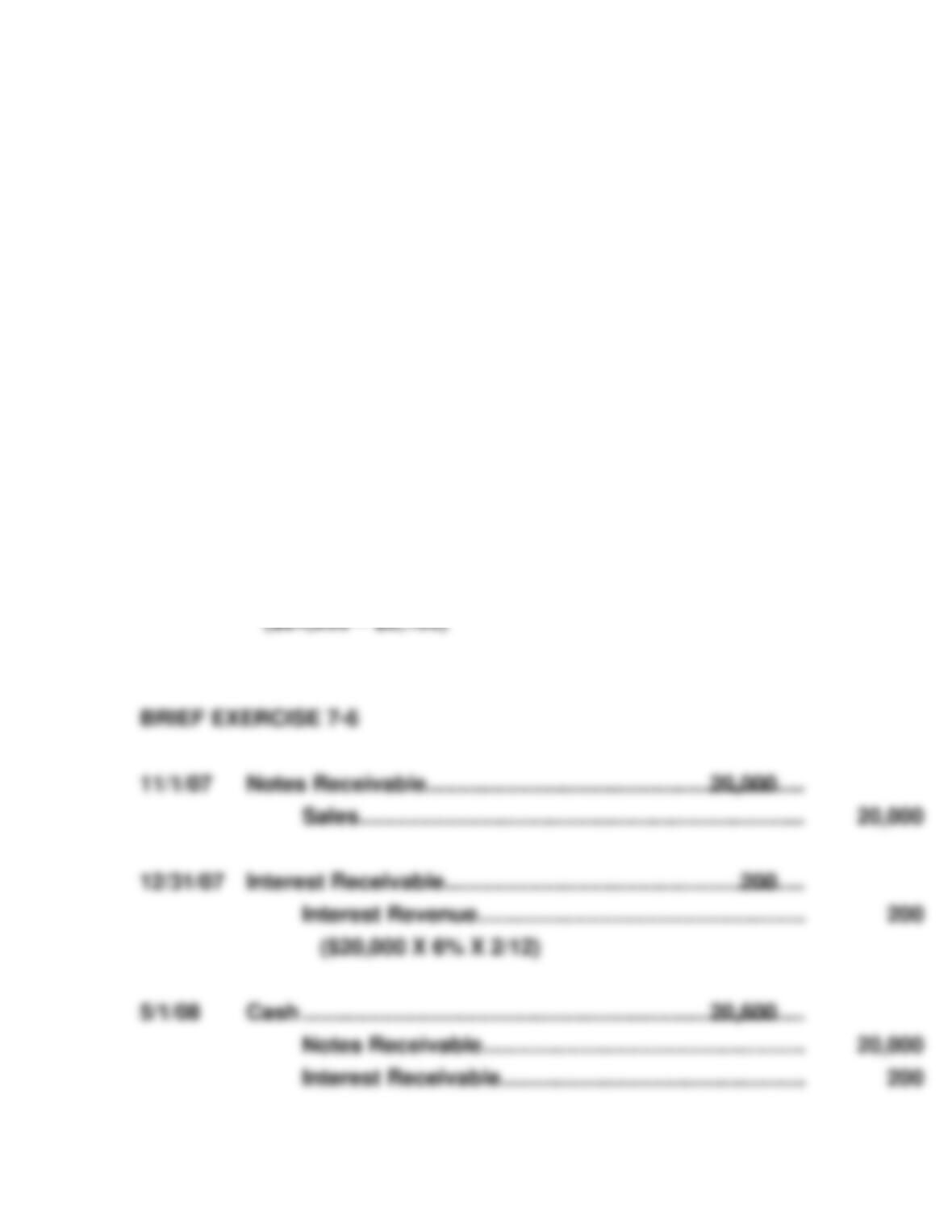
BRIEF EXERCISE 7-4
Bad Debt Expense…………………………..…..….….….…..…... 24,000
Allowance for Doubtful Accounts……..…..….….….. 24,000
($1,200,000 X 2% = $24,000)
BRIEF EXERCISE 7-5
(a) Bad Debt Expense…………………………..…..….….….…..…...22,900
Allowance for Doubtful Accounts……..…..….….….. 22,900
[(10% X $250,000) – $2,100]
(b) Bad Debt Expense………………………….….….….…..….….….22,500
Allowance for Doubtful Accounts……..…..….….….. 22,500