MIS – FINAL REVIEW
Duration: 90 minutes
Close book – 4 pages of A4 writing notes are allowed.
Part 01: Case analysis 50%
Part 02: Questions Answers – 50% – 5 questions
Chapter 9,10,11,12
Chapter 9
Case: Customer relationship helps Celcom
CASE STUDY QUESTIONS
1. What was the problem at Celcom described in this case? What management, organization, and
technology factors contributed to this problem?
To become number one in the Malaysian market again, Celcom’s senior management knew that the
company had to build better networks and market more aggressively. But the real key to success lay in
improving the customer experience.
Management: Malaysia’s customer base of 14 million is large and diverse, which requires multiple
approaches to interacting with them.
Older customers prefer in-person service from Celcom dealers or retail outlets, while sophisticated young
urban users prefer to do business online. Everyone wanted reliable mobile service.
Organization: Celcom service representatives wasted valuable company and customer time making sense of
a customer’s multiple SIM IDs scattered among various records in the system. The company wanted to be
able to see a customer as a specific person, not a SIM or a number.
Technology: Celcom was saddled with a siloed information technology architecture and business processes
that could not provide a complete view of customers. Customer data from one system such as billing were
not easily available to other systems such as inventory
2. What was Celcom’s business strategy, and what was the role of customer relationship management in
that strategy?
Celcom’s Business Strategy:
Celcom’s strategy to come back in top position in the market was to build more effective networks, be more
aggressive from a marketing perspective, and improving on the overall customer experience. Also, Celcom had
to imply ERP system for young urban users to do business on the digital platform than the traditional method
Customer Relationship Management:

Celcom had to manage a customer’s structure based on over 14million people which was included older &
young urban mobile users, dealers, and retailers. So, Celcom’s CRM system was an Oracle-based business
support system that integrated with customer’s data, information, centralized inventory management. It was
connected to every single piece of information of consumers to improvise customer service across online,
retails channels. The firm even implemented CRM tools that support multichannel and cross-channel markets,
for that Oracle is one of the best suitable for efficient outputs
3. Describe Celcom’s solution to its problem. What management, organization, and technology issues
had to be addressed by the solution?
– Management: The company wanted the most complete suite of customer relationship
management (CRM) tools that would support multichannel and cross-channel marketing
efforts. Management understood the importance of cross-channel customer experiences and
wanted to make this differentiate the company from its competitors.
– Organization: The new system helped Celcom manage and integrate customer interactions
across multiple channels to improve customer support, reduce problem resolution time,
customize marketing to narrow market segments, and expedite time-to-market for new
products and services. The BSS provides a single customer record, regardless of how many
services (mobile, landline, and data) and devices a customer purchases, that is populated with
data from various touchpoints. By consolidating customer data into a unified customer
– Technology: Celcom’s transformation plans entailed retaining some of Celcom’s existing
systems, and the Celcom team liked Oracle Communications’ modularity and inter-operability
as well as its cross-channel capabilities
4. How effective was this solution? How did it affect the way Celcom ran its business and its business
performance?
The solution was noticeably effective for Celcom as it opened new gateways to increase more productivity
and customer support call-handling time was decreased by 15 to 20 percent. It changed their business
model and operations to handle the market’s challenges, conditions in a better way. It showed that new
sim activation will take only two minutes as compared to two hours which may lead them to people’s first
choice. Celcom can now set targets on specific markets and gray areas. It even made it easy to keep a track
record of inventory and related issues in better ways. The company now can launch and market the
products at a faster pace with reduced operational costs, which was the old business model was inefficient
to do.
5. (không biết thầy có bỏ không, nên HP thêm vô Cho chắc) Describe two operational activities and two
business decisions that were improved by Celcom’s new CRM capabilities
Answer:
Operational Activities:-Dealers and clients were now able to be paid more frequently and inventory
management could be tracked within both supplier-dealer prospects.-Inventory management was improved
by providing a direct solution between the demand of the products/services and supply of it, was updated in
real-time and accurate.
Business Decisions:-Change of legacy technology to new Oracle-based business support system which
integrated with customer’s data, information, centralized inventory management.–To focus on targeted
market and/or region to establish or run marketing campaigns in became supported by data to find areas
within the process that could be a cost reduction.-The centralization of inventory, increased efficiencies with
call centers, faster payment terms with vendors help to reduce storage expenses, labor, and late charges on
billing
QUESTIONS
(1) Define an enterprise system and explain how enterprise software works.
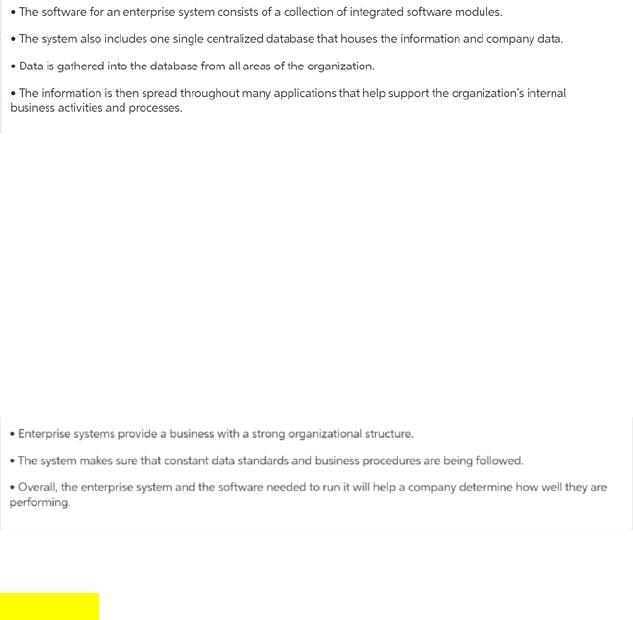
– ERP
– Integrated software (integrate + share data between business process) + common database
– Collect data from divisions
– Consistent information
Another:
(2) Describe how enterprise systems provide value for a business
→ Information created by one process in immediately available for other processes
– Improve operational efficiency
– Support decision making
– Rapid response
– Evaluate overall performance
Another:
Chapter 10
(1) Name and describe four business trends and three technology trends shaping e-commerce today.
→ Four business trends
1. Social Networking – used by companies to promote goods or services to a massive online
audience (this contributes to a massive online audience that is attractive to marketers)
2. Online Advertising – The larger online audience will see the ad when they open a site rather than
if the ad were in print. (grows twice as fast as TV and print advertising)
3. Online Newspapers –traditional newspapers have gone to offering online subscriptions to their
newspapers to reach the online audience. (have adopted interactive models and some have made
their service subscription-based.)
4. Online Entertainment Business Models – Netflix and other sites and have adopted interactive
models and some have made their service subscription-based. apps like it are making it possible
for the public to have access to movies and TV shows instantly. E-books are another example of
being able to get your book right when you want it via the Internet. (They offer television, movies,
music, sports, and eBooks in cooperation with the major copyright owners.)
→ Three Technology trends
+ Social commerce – is the use of social networks (Facebook, Etsy, eBay, Pinterest) in the context of e-
commerce transactions.
+ Mobile commerce – the use of wireless devices to conduct both business to consumer and business to
business e-commerce transactions over the Internet.