This case was prepared by Abeel A. Mangi, EMBA Class of 2016, Cate Reavis, Associate Director, Curriculum Development,
and Professor Roberto Fernandez. Names and certain data have been disguised.
Copyright © 2016, Abeel A. Mangi, Cate Reavis, and Roberto Fernandez. This work is licensed under the Creative Commons
Attribution–Noncommercial–No Derivative Works 3.0 Unported License. To view a copy of this license visit
http://creativecommons.org/licenses/by–nc–nd/3.0/ or send a letter to Creative Commons, 171 Second Street, Suite 300, San
Francisco, California, 94105, USA.
15-167
May 7, 2016
Conserving Blood During Cardiac Surgery at Huntington
University Hospital (A)
Abeel A. Mangi, Cate Reavis, and Roberto Fernandez
Patients who underwent cardiac surgery often required a blood transfusion or other blood products. In
order for surgeons to work upon or inside the heart, certain parts of the heart or great vessels
surrounding it needed to be opened and then repaired with suture material. Opening a chamber of the
heart disrupted its hermetic seal and permitted blood to spill out and into the surrounding space.
While bleeding was undesirable for obvious reasons, restoring blood via transfusions was not a
panacea. According to a 2006 study published in the Annals of Thoracic Surgery, a cardiac patient
who received a blood transfusion after an aortic valve replacement (AVR) or a coronary artery bypass
grafting (CABG) had a 30% lower chance of survival at six months and a 50% lower chance at 10
years.1 The 10–year survival rate without a transfusion was 90%.2
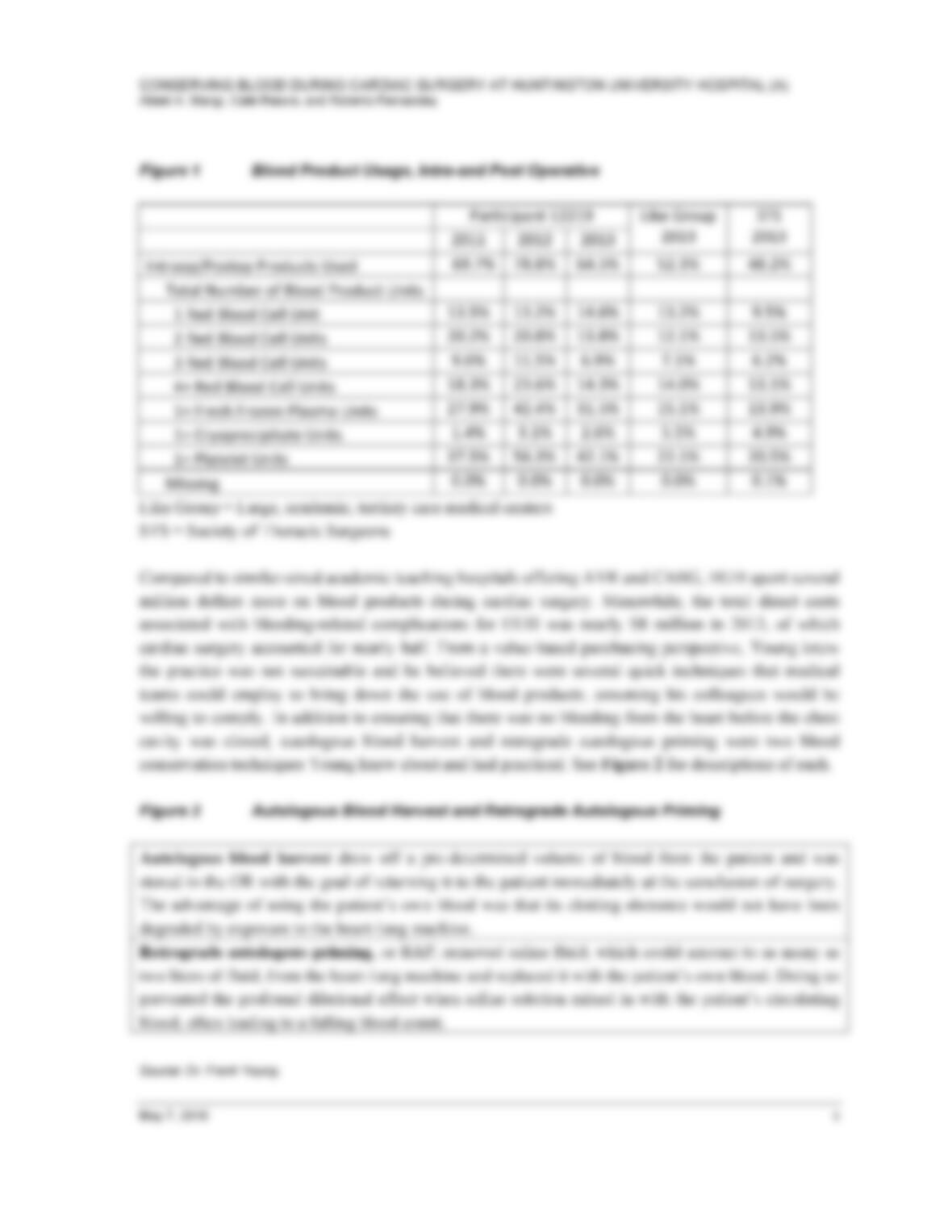
On average, 48.9% of patients in the United States who underwent an AVR or a CABG required a
blood transfusion.3 At Huntington University Hospital (HUH), where 500 patients underwent an AVR
or CABG annually, the percentage of patients who received blood transfusions in 2011, 2012, and
2013 was around 71%. This was happening at a time when the Affordable Care Act of 2010 was
forcing hospitals to provide quality care in a cost efficient way.
Dr. Frank Young, who joined HUH’s for Cardiac Medicine in 2011 and whose patients were among
the hospital’s sickest, wanted to help bring down the Center’s transfusion rate by leading a blood
1 Koch, C.G., et al. “Transfusion in CABG Is Associated with Reduced Long–Term Survival,” Annals of Thoracic Surgery, 2006, 81:1650–1657.
2 Ibid.
3 Ibid.
2 Ibid.
3 Ibid.
CONSERVING BLOOD DURING CARDIAC SURGERY AT HUNTINGTON UNIVERSITY HOSPITAL (A)
Abeel A. Mangi, Cate Reavis, and Roberto Fernandez
conservation project involving the medical teams that worked together during the intra– and post–
operative phases. The goal was to reduce the hospital’s blood product4 utilization during cardiac
surgery and after by two–thirds within one year, by the end of 2014, thereby bringing transfusion rates
down to the national average and resulting in annual cost savings of $2.5 million. More importantly,
it would save the lives of an additional 125 people per year over 10 years.
Young knew he faced an uphill battle in convincing his fellow surgeons and the medical teams that
accompanied them during surgeries to make changes to their surgical routines. Autonomy was
critically important to physicians and he was attempting a professional intervention of sorts.
Furthermore, he was a new arrival to HUH, especially considering some of his senior colleagues had
spent their entire careers there. Then there was the challenge posed by the complex organizational
structure inherent in most teaching hospitals: fellow cardiac surgeons aside, few, if any, members of
the medical teams Young worked with during and after surgery reported to him. He would have to
convince colleagues, over whom he had no formal influence, that one, there was a problem and, two,
that it could be solved as long as they were willing to change their ways.
Huntington University Hospital
With 7,500 employees including 2,800 nurses, 2,400 university and community physicians, and 400