Dylan Pastoor
Vinfast and the Electric Vehicle Market in Vietnam
The Vietnamese electric vehicle (EV) market is full of energy. Rapid economic growth is increasing
disposable income levels and major infrastructure projects are improving connectivity. Although
motorcycles are still the vehicle of preference, the car market has been steadily growing in
importance. According to the International Organization of Motor Vehicle manufacturers, Vietnam
possessed just 23 cars per 1,000 people in 2015. This compares with 439 in Malaysia, 228 in Thailand
and 145 in Singapore (NIA 2018). UK based automotive market research firm, JATO Dynamics
highlighted that Vietnam’s car market was the second fastest growing one in the world in 2016.
Accordingly, BMO research expect the Vietnamese market to grow with 11.1% per year over 2017–
2021 (BMO research 2018). In 2016, Vietnam reportedly spent nearly US$500,000 on purchasing EVs
from overseas markets, including Japan, China and the US (Vietnamnet 2017). The Ministry of Industry
and Trade expects new auto sales to more than double to 600,000 units annually in 2025 (NIA 2018).
Experts envision an especially promising future for electric vehicles given a number of local conditions.
First of all, EVs meet the healthy and high mobility criteria associated with the smart city concept.
Vietnam’s cities are attracting more and more people each year amounting to an accelerating
urbanization rate of around 3% per annum. The already highly congested roads, which serve 94% of
all transportation, are being expanded quickly (Granthorton 2017). The young and increasingly
wealthy middle–class is open to change and attaches more importance to personal and environmental
health. Hanoi and Ho Chi Minh City suffer from – at times extreme – pollution and a chronically
underperforming public transport system. Rising global fuel prices and low Vietnamese electricity
prices work in favor of EV. In a recent study by Nissan, Vietnam’s consumers showed to possess one
of the strongest latest demands for electric vehicles in ASEAN.
As of now, Vietnam’s supportive policies for EV’s lag behind the ones from Thailand, Malaysia and
Indonesia and to a lesser extent also to Singapore and the Philippines. Changing political winds could
quickly create an enabling environment and to a booming EV market. These changing winds seem to
be in the air due to the launch of a new national prestige project: VinFast. This subsidiary of Vingroup
aims to earn a prominent place in the highly protectionist and oligopolistic car market with a specific
commitment to EVs. Without taking into account Vinfast’s operations, Vietnam produces just 190,000
cars a year – around 10% of Thailand’s output –
and most is limited to assembly of imported
components (NIA 2018). In 2018 the inter–ASEAN
tariffs on imported cars were abolished leading to
fiercer competition and rising non–tariff barriers.
Little by little, the electric car market has been
manifesting itself in Vietnam. Tourists are already
driven around the sights of Hanoi, Ha Long Bay Ho
Chi Minh City and Da Nang in EVs. Last year, the
country’s first public charging station was opened
in Da Nang. DHL is planning to modernize its fleet
with electric vehicles and creating several fast
charging points for private use.

Dylan Pastoor
VinFast
VinFast is part of Vingroup which is Vietnam’s biggest private enterprise. Owned by the country’s
unparalleled business mogul and sole billionaire, Mr. Pham Nhat Vuong, venture capital is abundant.
Vingroup is aggressively trying to leapfrog into industrial manufacturing industries (e.g. smartphones,
smart household appliances). With vested interests of government officials and a crucial role in the
national development roadmap focusing on Industry 4.0, the Vietnamese administration shows itself
highly supportive. Vingroup cooperates with 50 of Vietnam’s leading universities and explicitly
committed to employing 100.000 technology students within the next 10 years.
Vingroup announced the building of:
1) Two research institutes (i.e. Big Data Research Institute and Vin Hi–Tech Research Institute)
2) Two investment funds. One for technology investment and the other for start–ups and
scientific research. The latter will amount to VNĐ2 trillion (US$86 million).
3) Vintech City, a “ Silicon Valley in Hanoi”. dedicated to exploring A.I. and software
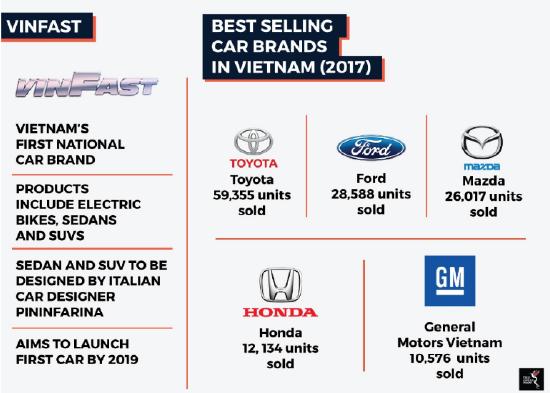
VinFast aims to become the leading automobile and motorcycle manufacturer in Southeast Asia. It
plays a key role in Vingroup’s vision to become an international standard technology–industry–service
conglomerate by 2028 with a focus on technology development and application. Of those, technology
will be the mainstream focus. (Vingroup, 2018). Initially targeting the domestic vehicle market, VinFast
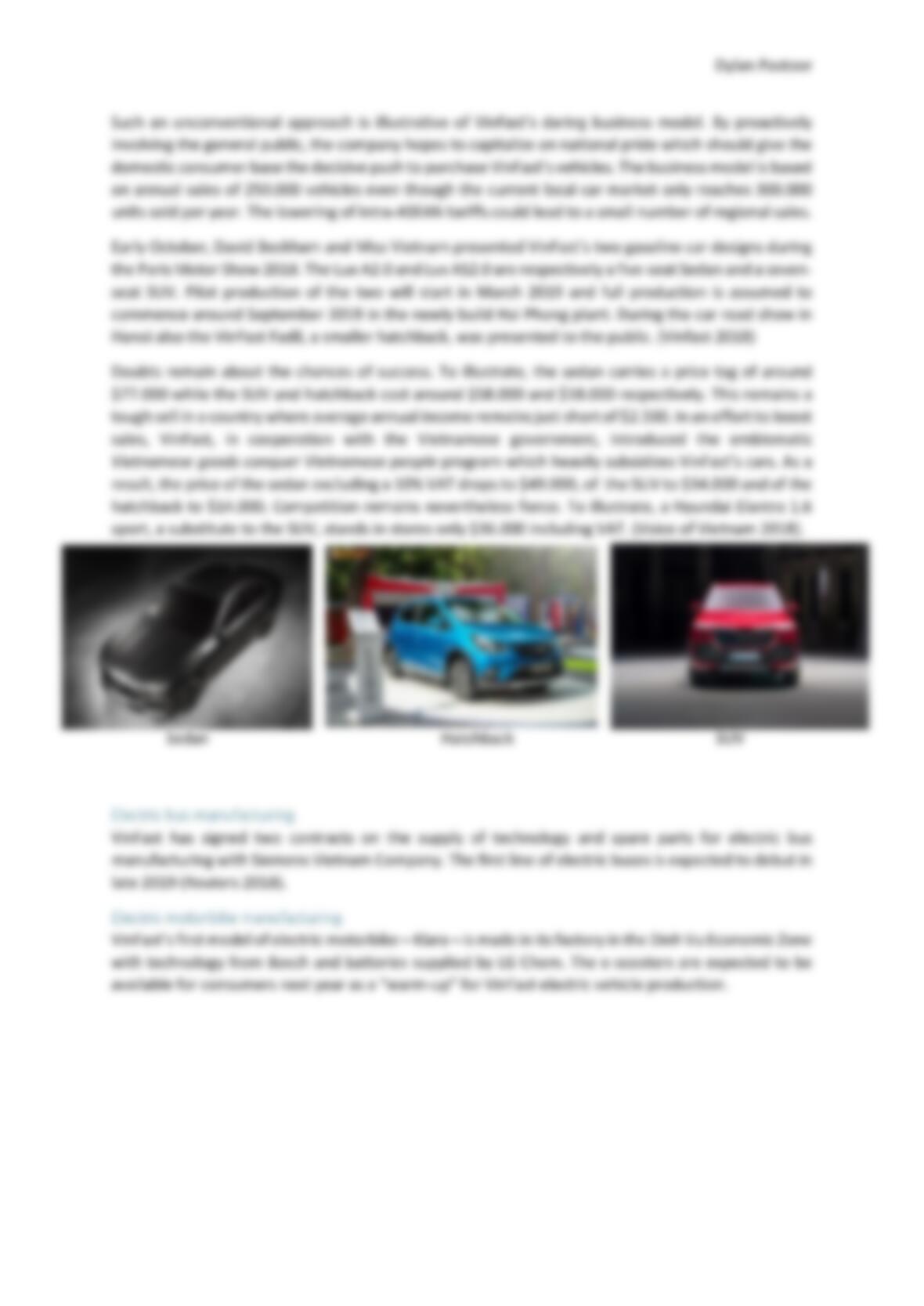
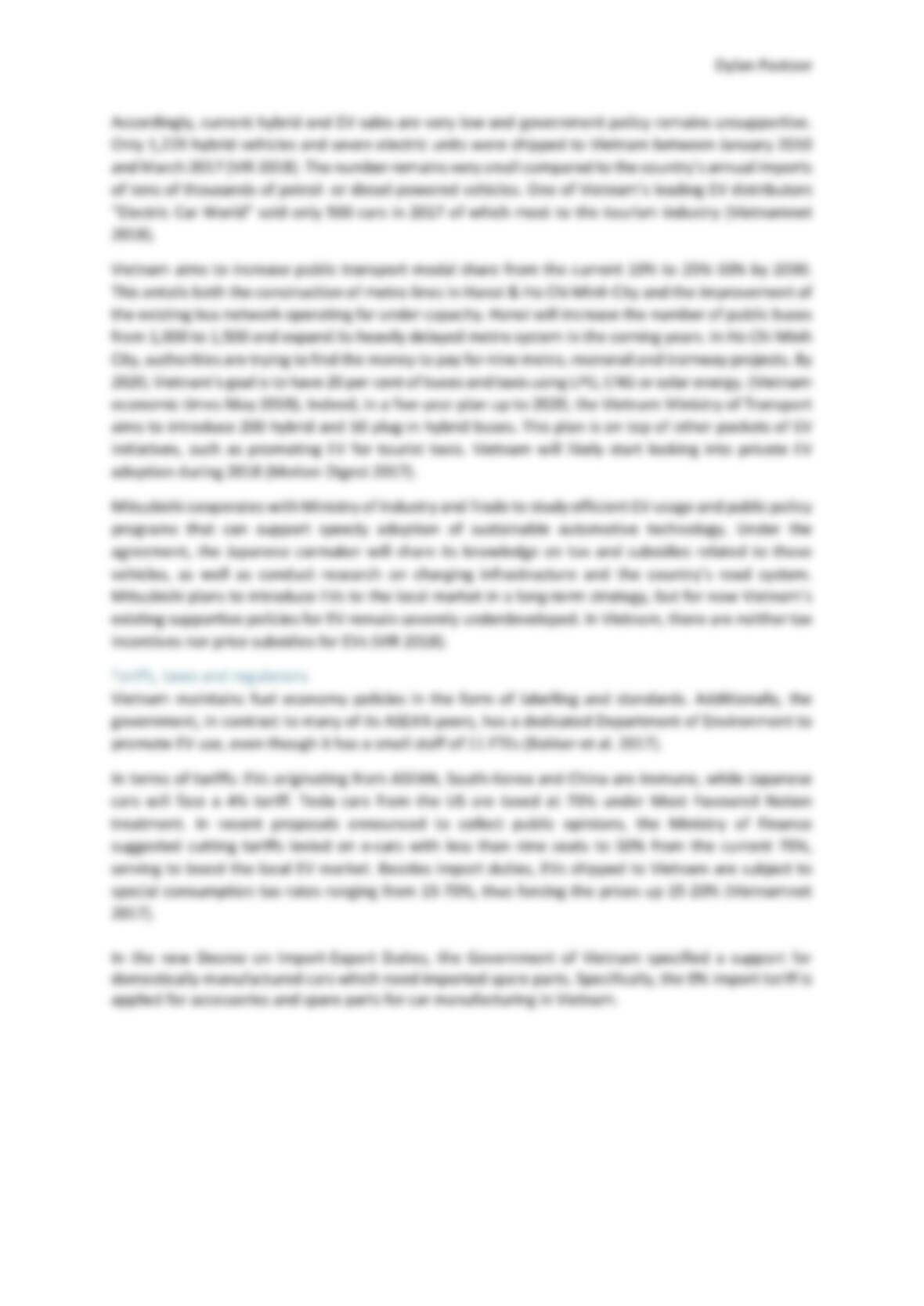
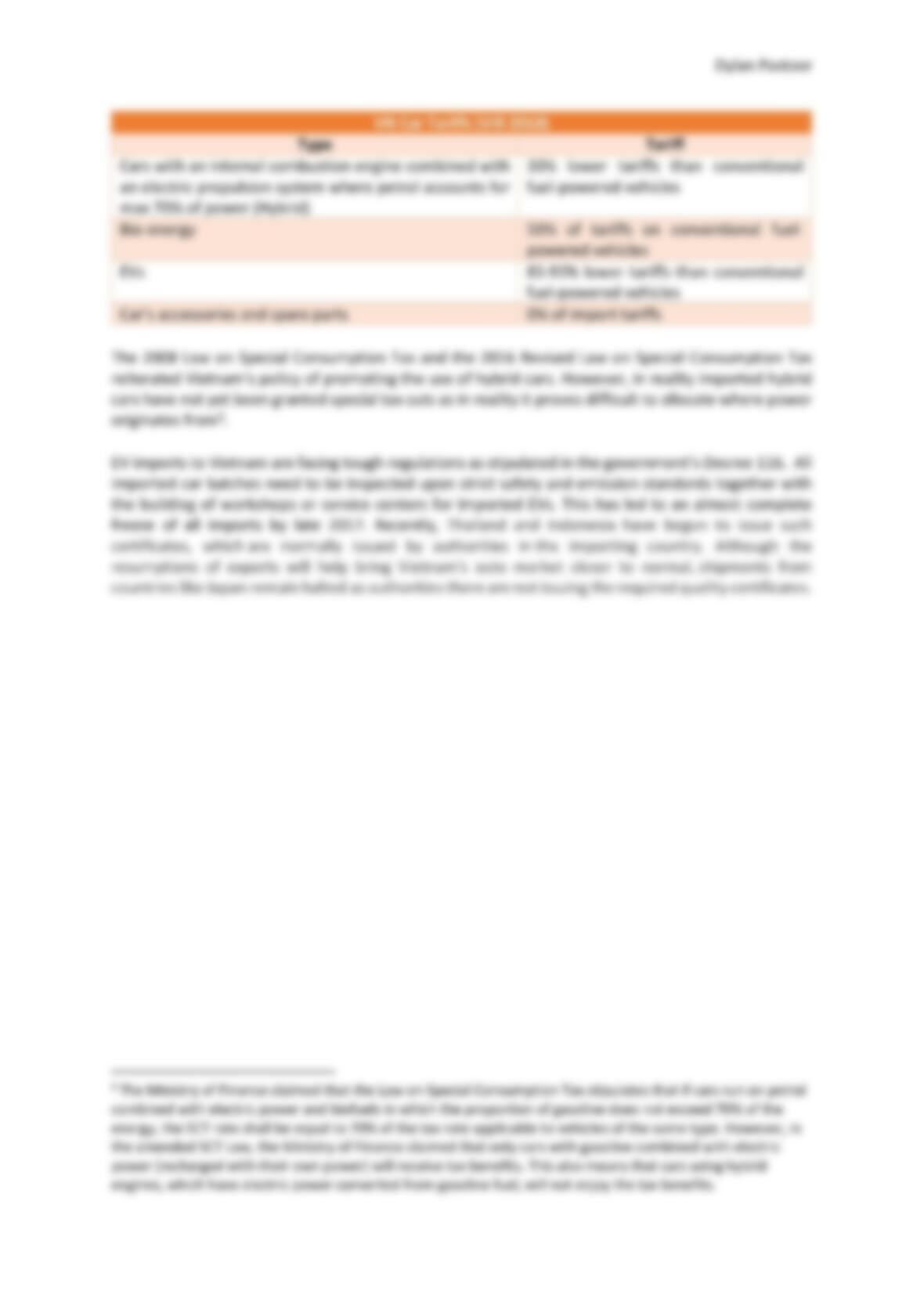
will fabricate electric motorbikes, electric buses and (electric) cars. Previously a company named
Vinaxuki also aspired to build the first home–grown autos but failed due to the high entry barriers.
Car manufacturing