Chapter 8
Master Budgeting
Solutions to Questions
8-1 A budget is a detailed quantitative plan
for the acquisition and use of financial and other
resources over a given time period. Budgetary
control involves using budgets to increase the
likelihood that all parts of an organization are
working together to achieve the goals set down
in the planning stage.
8-2
1. Budgets communicate management’s
plans throughout the organization.
2. Budgets force managers to think about
and plan for the future. In the absence of the
necessity to prepare a budget, many managers
would spend all of their time dealing with day-
to-day emergencies.
3. The budgeting process provides a means
of allocating resources to those parts of the
organization where they can be used most
effectively.
4. The budgeting process can uncover
potential bottlenecks before they occur.
5. Budgets coordinate the activities of the
entire organization by integrating the plans of its
various parts. Budgeting helps to ensure that
everyone in the organization is pulling in the
same direction.
6. Budgets define goals and objectives that
can serve as benchmarks for evaluating
subsequent performance.
8-3 Responsibility accounting is a system in
which a manager is held responsible for those
items of revenues and costs—and only those
items—that the manager can control to a
significant extent. Each line item in the budget is
made the responsibility of a manager who is
then held responsible for differences between
budgeted and actual results.
8-4 A master budget represents a summary
of all of management’s plans and goals for the
future, and outlines the way in which these
plans are to be accomplished. The master
budget is composed of a number of smaller,
specific budgets encompassing sales,
production, raw materials, direct labor,
manufacturing overhead, selling and
administrative expenses, and inventories. The
master budget usually also contains a budgeted
income statement, budgeted balance sheet, and
cash budget.
8-5 The level of sales impacts virtually every
other aspect of the firm’s activities. It
determines the production budget, cash
collections, cash disbursements, and selling and
administrative budget that in turn determine the
cash budget and budgeted income statement
and balance sheet.
8-6 No. Planning and control are different,
although related, concepts. Planning involves
developing goals and developing budgets to
achieve those goals. Control, by contrast,
involves the means by which management
attempts to ensure that the goals set down at
the planning stage are attained.
8-7 Creating a “budgeting assumptions” tab
simplifies the process of determining how
changes to a master budget’s underlying
assumptions impact all supporting schedules and
the projected financial statements.
8-8 A self-imposed budget is one in which
persons with responsibility over cost control
prepare their own budgets. This is in contrast to
a budget that is imposed from above. The major
advantages of a self-imposed budget are: (1)
Individuals at all levels of the organization are
recognized as members of the team whose
views and judgments are valued. (2) Budget
estimates prepared by front-line managers are
often more accurate and reliable than estimates
prepared by top managers who have less
intimate knowledge of markets and day-to-day
operations. (3) Motivation is generally higher
when individuals participate in setting their own
goals than when the goals are imposed from
above. Self-imposed budgets create
commitment. (4) A manager who is not able to
meet a budget that has been imposed from
above can always say that the budget was
unrealistic and impossible to meet. With a self–
imposed budget, this excuse is not available.
Self-imposed budgets do carry with
them the risk of budgetary slack. The budgets
prepared by lower-level managers should be
carefully reviewed to prevent too much slack.
8-9 The direct labor budget and other
budgets can be used to forecast workforce
staffing needs. Careful planning can help a
company avoid erratic hiring and laying off of
employees.
8-10 The principal purpose of the cash
budget is NOT to see how much cash the
company will have in the bank at the end of the
year. Although this is one of the purposes of the
cash budget, the principal purpose is to provide
information on probable cash needs
during
the
budget period, so that bank loans and other
sources of financing can be anticipated and
arranged well in advance.

The Foundational 15
1. The budgeted sales for July are computed as follows:
Unit sales (a) ………………………..
10,000
Selling price per unit (b) ………….
$70
Total sales (a) × (b) ……………….
$700,000
2. The expected cash collections for July are computed as follows:
July
June sales:
$588,000 × 60% ……………….
$352,800
July sales:
$700,000 × 40% ……………….
280,000
Total cash collections …………….
$632,800
3. The accounts receivable balance at the end of July is:
July sales (a) ………………………..
$700,000
Percent uncollected (b) ……………
60%
Accounts receivable (a) × (b) ……
$420,000
4. The required production for July is computed as follows:
July
Budgeted sales in units ………………
10,000
Add desired ending inventory* …….
2,400
Total needs ……………………………..
12,400
Less beginning inventory** …………
2,000
Required production ………………….
10,400
*August sales of 12,000 units × 20% = 2,400 units.
**July sales of 10,000 units × 20% = 2,000 units.

The Foundational 15 (continued)
5. The raw material purchases for July are computed as follows:
July
Required production in units of finished goods ……………..
10,400
Units of raw materials needed per unit of finished goods ..
5
Units of raw materials needed to meet production …………
52,000
Add desired units of ending raw materials inventory* …….
6,100
Total units of raw materials needed …………………………...
58,100
Less units of beginning raw materials inventory** …………
5,200
Units of raw materials to be purchased ……………………….
52,900
*61,000 pounds × 10% = 6,100 pounds.
**52,000 pounds × 10% = 5,200 pounds.
6. The cost of raw material purchases for July is computed as follows:
Units of raw materials to be purchased (a)………
52,900
Unit cost of raw materials (b) ……………………….
$2.00
Cost of raw materials to be purchased (a) × (b) .
$105,800
7. The estimated cash disbursements for materials purchases in July is
computed as follows:
July
June purchases:
$88,880 × 70% ………………….
$62,216
July purchases:
$105,800 × 30% ………………..
31,740
Total cash disbursements ………..
$93,956
8. The accounts payable balance at the end of July is:
July purchases (a) ………………….
$105,800
Percent unpaid (b) …………………
70%
Accounts payable (a) × (b) ………
$74,060

The Foundational 15 (continued)
9. The estimated raw materials inventory balance at the end of July is
computed as follows:
Ending raw materials inventory (pounds) (a) ……
6,100
Cost per pound (b) …………………………..………..
$2.00
Raw material inventory balance (a) × (b) ……….
$12,200
10. The estimated direct labor cost for July is computed as follows:
July
Required production in units …………..
10,400
Direct labor hours per unit ……………..
× 2.0
Total direct labor-hours needed (a)…..
20,800
Direct labor cost per hour (b) ………….
$15
Total direct labor cost (a) × (b) ……….
$312,000
11. The estimated unit product cost is computed as follows:
Quantity
Cost
Total
Direct materials …………………..
5 pounds
$2 per pound
$10.00
Direct labor ………………………..
2 hours
$15 per hour
30.00
Manufacturing overhead ……….
2 hours
$10 per hour
20.00
Unit product cost …………………
$60.00
12. The estimated finished goods inventory balance at the end of July is
computed as follows:
Ending finished goods inventory in units (a) …….
2,400
Unit product cost (b) ………………………………….
$60.00
Ending finished goods inventory (a) × (b) ……….
$144,000

The Foundational 15 (continued)
13. The estimated cost of goods sold for July is computed as follows:
Unit sales (a) ……………………………………………
10,000
Unit product cost (b) ………………………………….
$60.00
Estimated cost of goods sold (a) × (b) …………..
$600,000
The estimated gross margin for July is computed as follows:
Total sales (a) …………………………………………..
$700,000
Cost of goods sold (b) ………………………………..
600,000
Estimated gross margin (a) – (b) …………………..
$100,000
14. The estimated selling and administrative expense for July is computed
as follows:
July
Budgeted unit sales ……………………………..
10,000
Variable selling and administrative …………..
expense per unit ……………………………….
× $1.80
Total variable expense ………………………….
$18,000
Fixed selling and administrative expenses …
60,000
Total selling and administrative expenses …
$78,000
15. The estimated net operating income for July is computed as follows:
Gross margin (a) ……………………………………….
$100,000
Selling and administrative expenses (b) ………….
78,000
Net operating income (a) – (b) ……………………..
$ 22,000

Exercise 8-1 (20 minutes)
1.
April
May
June
Total
February sales:
$230,000 × 10% …….
$ 23,000
$ 23,000
March sales: $260,000
× 70%, 10% ………….
182,000
$ 26,000
208,000
April sales: $300,000 ×
20%, 70%, 10% …….
60,000
210,000
$ 30,000
300,000
May sales: $500,000 ×
20%, 70% …………….
100,000
350,000
450,000
June sales: $200,000 ×
20% …………………….
40,000
40,000
Total cash collections ….
$265,000
$336,000
$420,000
$1,021,000
Notice that even though sales peak in May, cash collections peak in
June. This occurs because the bulk of the company’s customers pay in
the month following sale. The lag in collections that this creates is even
more pronounced in some companies. Indeed, it is not unusual for a
company to have the least cash available in the months when sales are
greatest.
2. Accounts receivable at June 30:
From May sales: $500,000 × 10% ……………………
$ 50,000
From June sales: $200,000 × (70% + 10%) ………
160,000
Total accounts receivable at June 30 …………………
$210,000

Exercise 8-2 (10 minutes)
April
May
June
Quarter
Budgeted unit sales ……………..
50,000
75,000
90,000
215,000
Add desired units of ending
finished goods inventory* ……
7,500
9,000
8,000
8,000
Total needs ………………………..
57,500
84,000
98,000
223,000
Less units of beginning finished
goods inventory ………………..
5,000
7,500
9,000
5,000
Required production in units …..
52,500
76,500
89,000
218,000
*10% of the following month’s sales in units.

Exercise 8-3 (15 minutes)
Quarter—Year 2
First
Second
Third
Fourth
Year
Required production in units of finished
goods …………………………..………………….
60,000
90,000
150,000
100,000
400,000
Units of raw materials needed per unit of
finished goods …………………………………..
× 3
× 3
× 3
× 3
× 3
Units of raw materials needed to meet
production ………………………………………..
180,000
270,000
450,000
300,000
1,200,000
Add desired units of ending raw materials
inventory ………………………………………….
54,000
90,000
60,000
42,000
42,000
Total units of raw materials needed ………….
234,000
360,000
510,000
342,000
1,242,000
Less units of beginning raw materials
inventory ………………………………………….
36,000
54,000
90,000
60,000
36,000
Units of raw materials to be purchased ……..
198,000
306,000
420,000
282,000
1,206,000
Unit cost of raw materials ……………………….
× $1.50
× $1.50
× $1.50
× $1.50
× $1.50
Cost of raw materials to purchased …………..
$297,000
$459,000
$630,000
$423,000
$1,809,000

Exercise 8-4 (20 minutes)
1. Assuming that the direct labor workforce is adjusted each quarter, the direct labor budget is:
1st
Quarter
2nd
Quarter
3rd
Quarter
4th
Quarter
Year
Required production in units ……………………….
8,000
6,500
7,000
7,500
29,000
Direct labor time per unit (hours) …………………
× 0.35
× 0.35
× 0.35
× 0.35
× 0.35
Total direct labor-hours needed……………………
2,800
2,275
2,450
2,625
10,150
Direct labor cost per hour …………………………..
× $12.00
× $12.00
× $12.00
× $12.00
× $12.00
Total direct labor cost ………………………………..
$ 33,600
$ 27,300
$ 29,400
$ 31,500
$121,800
2. Assuming that the direct labor workforce is not adjusted each quarter and that overtime wages are
paid, the direct labor budget is:
1st
Quarter
2nd
Quarter
3rd
Quarter
4th
Quarter
Year
Required production in units ………………………
8,000
6,500
7,000
7,500
Direct labor time per unit (hours) ………………..
× 0.35
× 0.35
× 0.35
× 0.35
Total direct labor-hours needed ………………….
2,800
2,275
2,450
2,625
Regular hours paid …………………………………..
2,600
2,600
2,600
2,600
Overtime hours paid …………………………………
200
0
0
25
Wages for regular hours (@ $12.00 per hour) ..
$31,200
$31,200
$31,200
$31,200
$124,800
Overtime wages (@ 1.5 × $12.00 per hour) ….
3,600
0
0
450
4,050
Total direct labor cost ……………………………….
$34,800
$31,200
$31,200
$31,650
$128,850

Exercise 8-5 (15 minutes)
1.
Yuvwell Corporation
Manufacturing Overhead Budget
1st
Quarter
2nd
Quarter
3rd
Quarter
4th
Quarter
Year
Budgeted direct labor-hours …………………………..
8,000
8,200
8,500
7,800
32,500
Variable manufacturing overhead rate ……………..
× $3.25
× $3.25
× $3.25
× $3.25
× $3.25
Variable manufacturing overhead ……………………
$26,000
$26,650
$27,625
$25,350
$105,625
Fixed manufacturing overhead ……………………….
48,000
48,000
48,000
48,000
192,000
Total manufacturing overhead ……………………….
74,000
74,650
75,625
73,350
297,625
Less depreciation …………………………..……………
16,000
16,000
16,000
16,000
64,000
Cash disbursements for manufacturing overhead .
$58,000
$58,650
$59,625
$57,350
$233,625
2.
Total budgeted manufacturing overhead for the year (a) …
$297,625
Budgeted direct labor-hours for the year (b) …………………
32,500
Predetermined overhead rate for the year (a) ÷ (b) ……….
$9.16
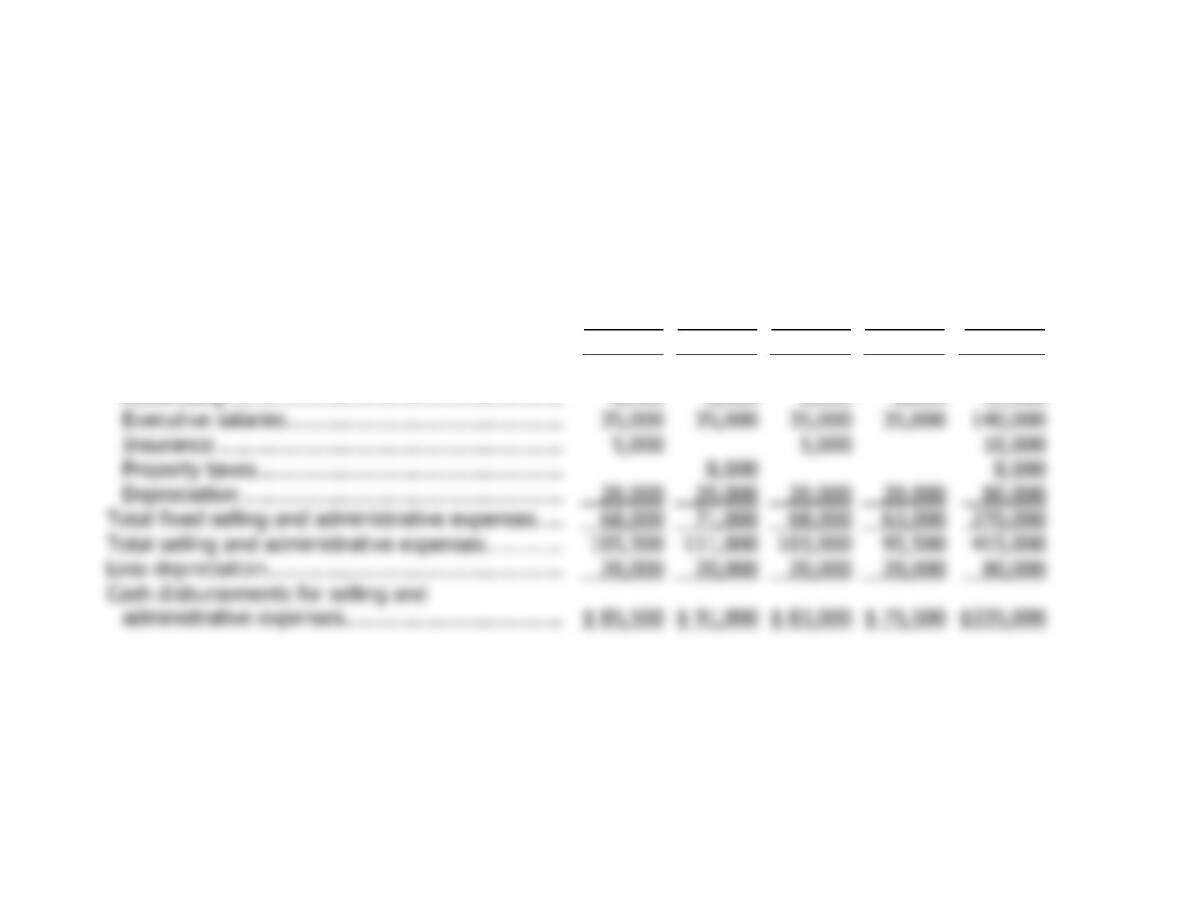
Exercise 8-6 (15 minutes)
Weller Company
Selling and Administrative Expense Budget
1st
Quarter
2nd
Quarter
3rd
Quarter
4th
Quarter
Year
Budgeted unit sales …………………………………….
15,000
16,000
14,000
13,000
58,000
Variable selling and administrative expense per
unit ……………………………………………………….
× $2.50
× $2.50
× $2.50
× $2.50
× $2.50
Variable selling and administrative expense ………
$ 37,500
$ 40,000
$ 35,000
$ 32,500
$145,000
Fixed selling and administrative expenses:
Executive salaries ……………………………………..
Insurance ……………………………………………….
Property taxes ………………………………………….
Total fixed selling and administrative expenses ….
105,500
111,000
103,000
$ 85,500
$ 91,000
$ 83,000
$ 75,500
$335,000