Fin 335, Chapter 9 page
1
Chapter 9: The Basics of Capital Budgeting
I. What is Capital Budgeting?
The process of determining what capital projects to accept
Project Classification is the starting point for determining the appropriate discount rate
Replacement to maintain current operations
Replacement to reduce costs
Expansion of existing products or markets
Expansion into new products or markets
Pure research & development (example: pharmaceutical firms)
Exploration (example: energy firms)
Safety and /or environmental (government mandated) projects
II. Decision Criteria
What are the major investment decision criteria?
Net Present Value – NPV
Internal Rate of Return – IRR
Modified Internal Rate of Return – MIRR
Payback Period – Payback
Discounted Payback Period – Discounted Payback
Profitability Index – PI
What are they used for?
To evaluate the cash flows from capital investment projects
To make the accept or reject decision

Fin 335, Chapter 9 page
2
A. The NPV Rule:
1. Why Is Net Present Value the Best Decision Criteria?
– It considers the time value of money (TVM)… a dollar today is worth more than a
dollar in the future
– It considers all cash flows during the project’s entire life
– NPV lets you know exactly how much value is being added by the project
– You can set the appropriate require rate of return (discount rate or hurdle rate)
depending on a project’s risk
2. Calculating Net Present Value (NPV:
NPV =CF0 + CF1 + CF2 + … + CFt
(1 + r)1 (1 + r)2 (1 + r)t
3. The NPV decision (accept/reject) rule:
– Accept the project (investment) if NPV > zero
– Reject the project if NPV < zero
4. What does a positive NPV mean?
– The PV of cash inflows > PV of cash outflows
– The value of the company is being increased by the amount of NPV
– The project meets the required rate of return…and then some

Fin 335, Chapter 9 page
3
NPV Example 1:
A friend asks you to invest $20,000 and promises to pay you $26,000 at the end of 2
years. Your required rate of return is 15%. Do you take the offer?
NPV =CF0 + CF2
(1 + r)2
NPV = -20,000 + 26,000 => -20,000 + 19,660
1.15 2
NPV = $-340 You should reject your friend’s offer!
* If this were a capital investment project, acceptance would reduce the value of the
company by $340!
* Acceptance of the project would not increase the value of the company by $6,000!
The key variable here is the required rate of return (or discount rate).
The required rate of return (RRR) is:
* The hurdle rate
* The cost of capital (funds)
* The best rate of return the company could expect on other projects of similar risk
Note:
In a competitive market, positive NPV projects are considered rare and require diligent
effort to uncover
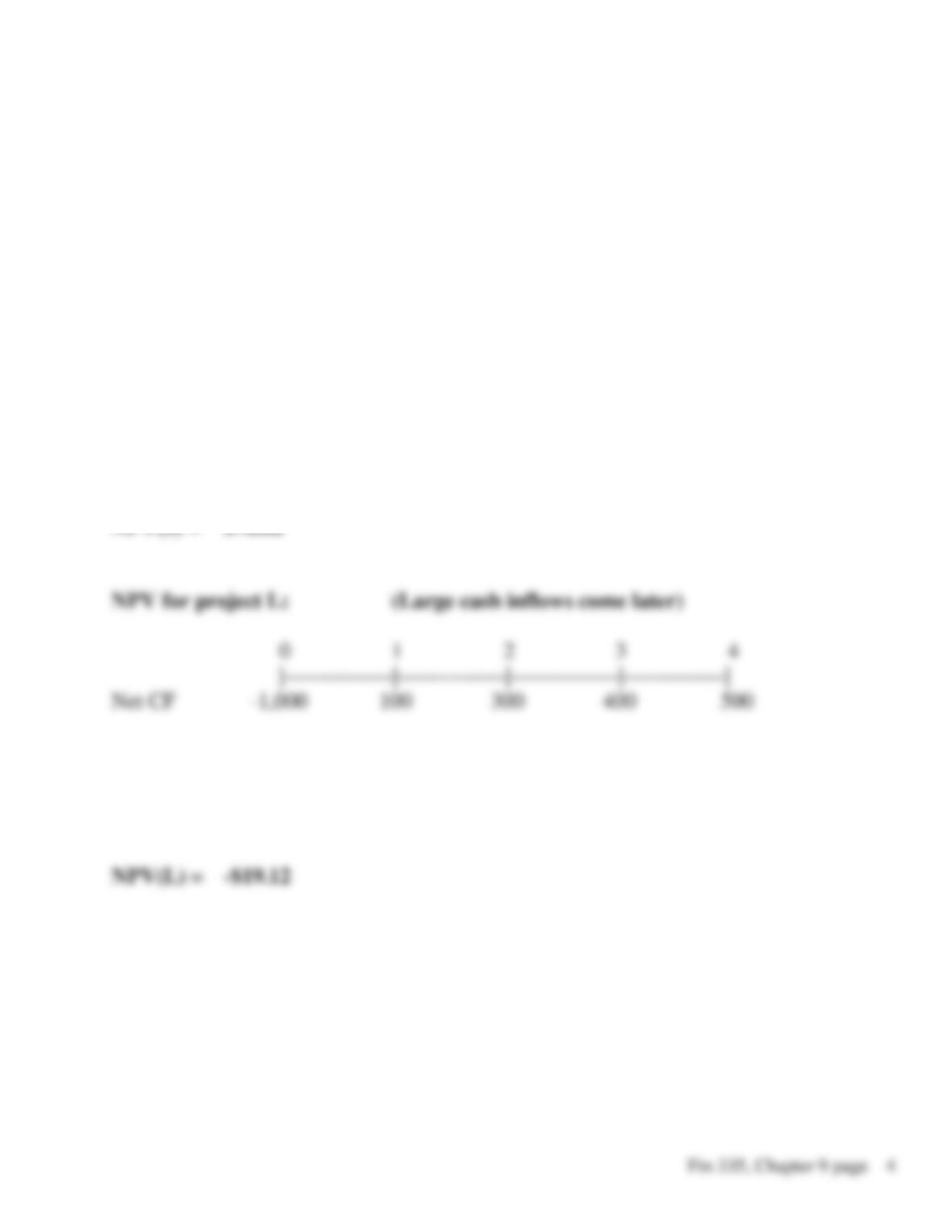
NPV Example 2:
Two projects with identical cash outflows (investment =$1,000) but different timing of
cash inflows. Discount rate = 10%
NPV for project S: (Large cash inflows come sooner)
0 1 2 3 4
|———-—–|—————-|——-——–|————–|
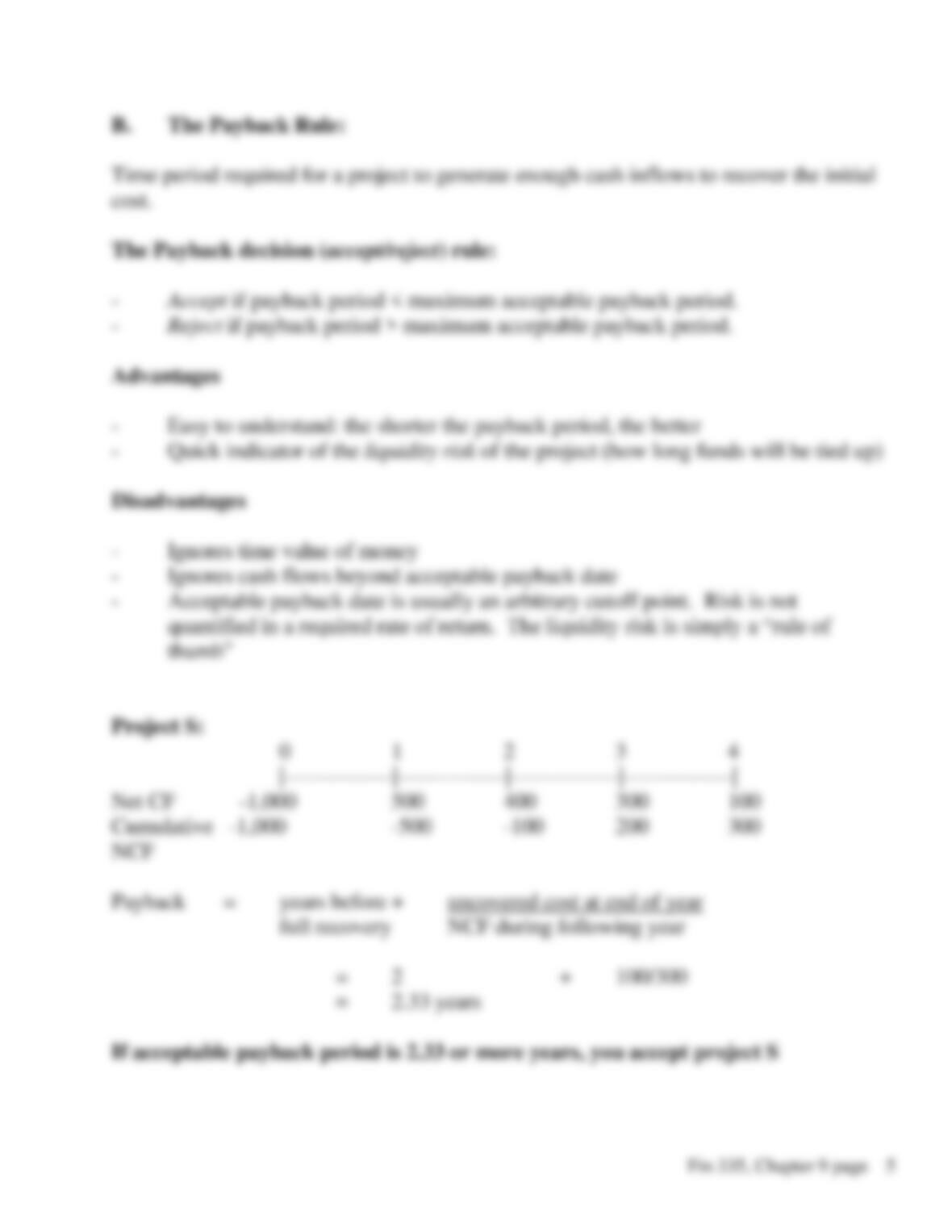
Net CF -1,000 500 400 300 100