Laura Soto Sierra
BIOCH 755
Professor Dr. Michal Zolkiewski
September 26, 2014
BRCA1, a cell function regulator and tumor suppressor protein
BRCA1 is a normally expressed protein breast cells and other tissues, which helps them
to repair damaged DNA or destroy cells if DNA cannot be repaired. Moreover, this protein is in–
volved in the repair of chromosomal damage with an important role in the error-free repair of
DNA double-strand breaks(Friedenson, 2007), which contribute to tumor suppression in cells
(Khanna & Jackson, 2001). Like many other tumor suppressor genes, BRCA1 regulates the cycle
of cell division by keeping cells from growing and dividing too rapidly or in an uncontrolled
way. Many of these functions are linked to protein:protein interactions involving different por–
tions of the 1,863 amino acid (aa) BRCA1 protein( Rosem et al., 2003).
Due to its function of DNA and Chromosomal repair, mutations in structure increase the
risk of inherited breast cancer up to 65%. In addition, BRCA1 mutation in some specific amino
acids, is also related with other types of cancer. Particularly, according to the most recent
estimates, 39% of women who inherit a harmful BRCA1 mutation (Chen S, Parmigiani G., 2007)
will develop ovarian cancer by age of 70 years. Similarly, BRCA1 mutated carriers have a higher
risk of colon cancer, whereas male carriers face an increased risk of prostate cancer
(www.cancer.gov).
Moreover, even though this molecule is related to some types of cancer in humans, it is
known that homologous of it have been found in some other mammal species. Regarding their
primary structures, in order of similarity, these species are: gorilla, rhesus macaque, chimpanzee,
mouse, rat, bovine and dogs.
In this reviewed BRCA1 functions, mutations, structures and their relationship will be an–
alyzed and compare with current data.
Regarding its general structure, the molecular weight of the protein is estimated,
according to ProtParam software in 207.720,8 g/ mol, and its theoretical isoelectric point is 5.29.
This protein is negatively charged, and is classified as an unstable protein. Additionally, in terms
of amino acid composition, it shows a 5% higher than the average occurrence of Serine (12%)
and a 3% higher than the average occurrence of Glutamic Acid (10.6%)..
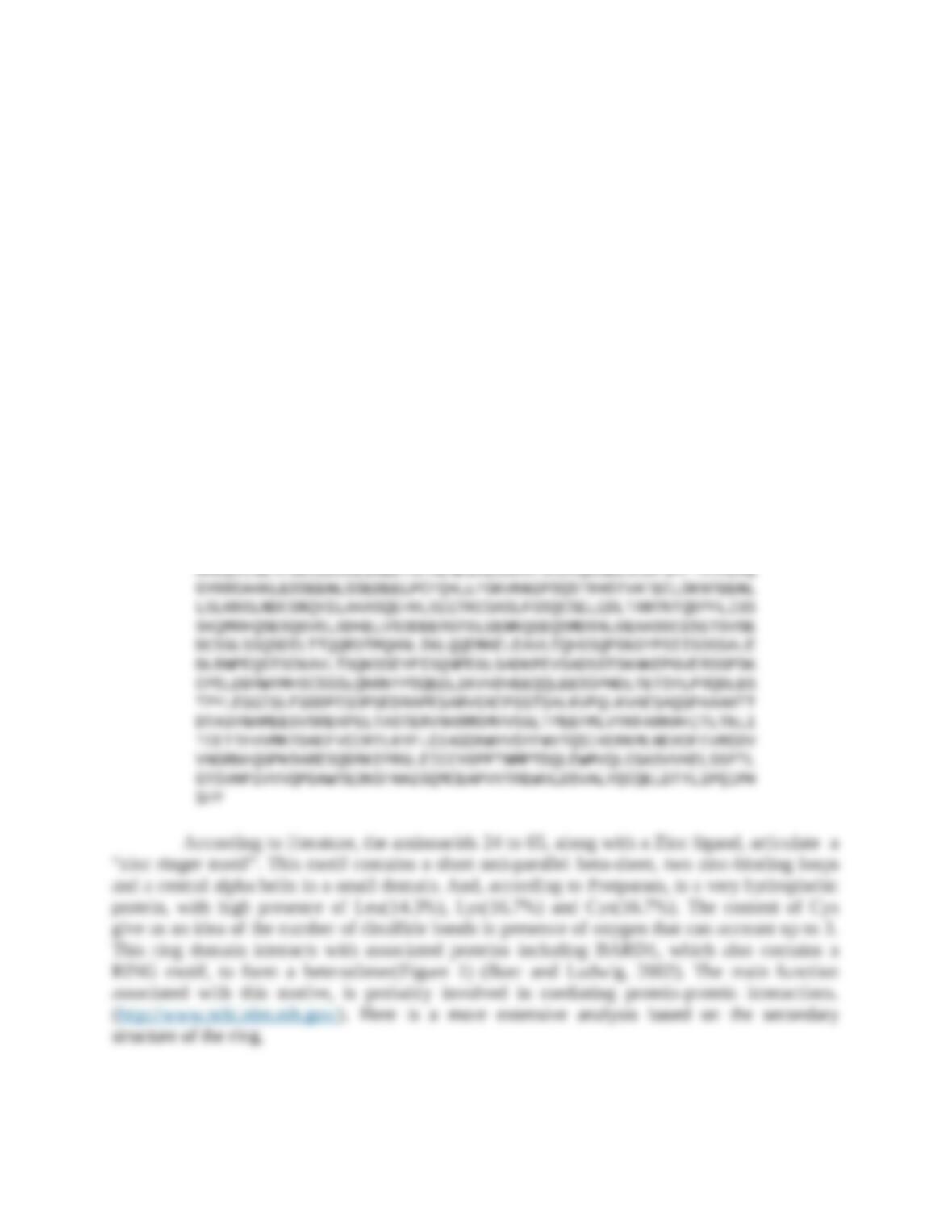
Due to its complexity and very large chain of amino acids, there is no complete 3D
structure for this protein, and only 2 of its motifs are available in PDB format. That is why, in
order to analyze more deeply its amino acid composition, the primary structure is showed below:
MDLSALRVEEVQNVINAMQKILECPICLELIKEPVSTKCDHIFCKFCMLKLLNQKKGPSQ
CPLCKNDITKRSLQESTRFSQLVEELLKIICAFQLDTGLEYANSYNFAKKENNSPEHLKD
EVSIIQSMGYRNRAKRLLQSEPENPSLQETSLSVQLSNLGTVRTLRTKQRIQPQKTSVYI
ELGSDSSEDTVNKATYCSVGDQELLQITPQGTRDEISLDSAKKAACEFSETDVTNTEHHQ
PSNNDLNTTEKRAAERHPEKYQGSSVSNLHVEPCGTNTHASSLQHENSSLLLTKDRMNVE
KAEFCNKSKQPGLARSQHNRWAGSKETCNDRRTPSTEKKVDLNADPLCERKEWNKQKLPC
SENPRDTEDVPWITLNSSIQKVNEWFSRSDELLGSDDSHDGESESNAKVADVLDVLNEVD
EYSGSSEKIDLLASDPHEALICKSERVHSKSVESNIEDKIFGKTYRKKASLPNLSHVTEN
LIIGAFVTEPQIIQERPLTNKLKRKRRPTSGLHPEDFIKKADLAVQKTPEMINQGTNQTE
QNGQVMNITNSGHENKTKGDSIQNEKNPNPIESLEKESAFKTKAEPISSSISNMELELNI
HNSKAPKKNRLRRKSSTRHIHALELVVSRNLSPPNCTELQIDSCSSSEEIKKKKYNQMPV
RHSRNLQLMEGKEPATGAKKSNKPNEQTSKRHDSDTFPELKLTNAPGSFTKCSNTSELKE
FVNPSLPREEKEEKLETVKVSNNAEDPKDLMLSGERVLQTERSVESSSISLVPGTDYGTQ
ESISLLEVSTLGKAKTEPNKCVSQCAAFENPKGLIHGCSKDNRNDTEGFKYPLGHEVNHS
RETSIEMEESELDAQYLQNTFKVSKRQSFAPFSNPGNAEEECATFSAHSGSLKKQSPKVT
FECEQKEENQGKNESNIKPVQTVNITAGFPVVGQKDKPVDNAKCSIKGGSRFCLSSQFRG
NETGLITPNKHGLLQNPYRIPPLFPIKSFVKTKCKKNLLEENFEEHSMSPEREMGNENIP
STVSTISRNNIRENVFKEASSSNINEVGSSTNEVGSSINEIGSSDENIQAELGRNRGPKL
NAMLRLGVLQPEVYKQSLPGSNCKHPEIKKQEYEEVVQTVNTDFSPYLISDNLEQPMGSS