CHAPTER 7: BOND MARKETS
• BOND MARKET
Bonds are long-term debt securities (meaning their maturities are more than one year) that
are issued by government agencies or corporations.
Bond markets are the markets where bonds are issued and traded. They are used to assist in
the transfer of funds from individuals, corporations, and government units with excess funds
to corporations and government units in need of long-term debt funding.
• BOND MARKET SECURITIES
are long term debt securities issued by government agencies or corporations wherein the
issuer of a bond is obligated to pay coupon payments (interest payments) periodically
(annually or semi-annually) and the par value or principal at maturity date.
An issuer must be able to show that its future cash flows will be sufficient to enable it to make
its coupon and principal payments to bondholders. But if not, some investors will consider
buying bonds for which the repayment is questionable only if the expected return from
investing in the bonds is sufficient to compensate for the risk.
Cash flows are being ensured by issuers by guaranteeing the buyers on the cash flows that will
be generated from the purpose of the bond offering; ensured by the Philippine government
of any sovereign government if treasury bond; and ensured by issuing corporations if
corporate bond via a document called “indenture” , a legal contract that specifies the rights
and obligations of the bond issuer and the bond holders; all covenants ( terms of the bonds )
and cash flow movements are overseen by a trustee; in this case the coupon tends to go lower
since it lowers risk
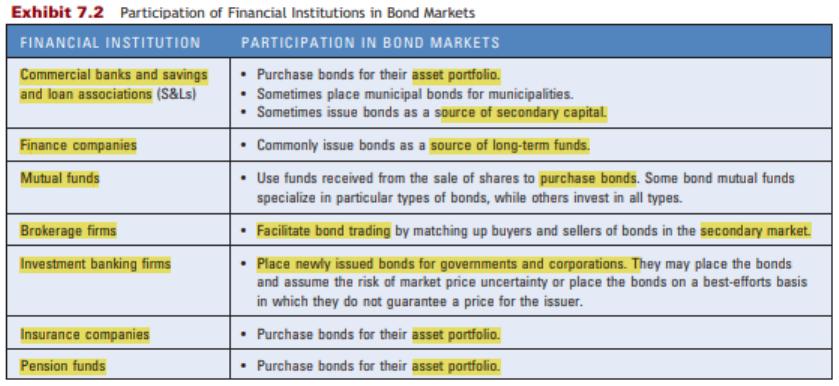
• INSTITUTIONAL PARTICIPATION IN BOND MARKETS
These are investors in the bond market and it can be noted that financial institutions dominate
the bond market because they purchase a large proportion of bonds issued.
• BOND YIELDS
The yield on a bond can be viewed from the perspective of the issuer of the bond, who is
obligated to make payments on the bond until maturity, or from the perspective of the
investors who purchase the bond
o Yield from the Issuer’s Perspective. The issuer’s cost of financing with bonds is
commonly measured by the yield to maturity, which reflects the annualized yield that
is paid by the issuer over the life of the bond.
The yield to maturity is the annualized discount rate that equates the future coupon
and principal payments to the initial proceeds received from the bond offering. It is
based on the assumption that coupon payments received can be reinvested at the
same yield.
o Yield from the Investor’s Perspective. An investor who invests in a bond when it is
issued and holds it until maturity will earn the yield to maturity. But since many
investors don’t really hold bond ‘til its maturity, they focus more on the holding
period return which is return from their investment over a particular holding period.
This means that if they hold the bond for a very short time period (such as less than
one year), they may estimate their holding period return as the sum of the coupon
payments plus the difference between the selling price and the purchase price of the
bond, as a percentage of the purchase price.
If they hold the bond for long periods, a better approximation of the holding period
yield is the annualized discount rate that equates the payments received to the initial
investment.
Since the selling price to be received by investors is uncertain if they do not hold the
bond to maturity, their holding period yield is uncertain at the time they purchase the