Case Questions:
Q1. What are the costs and benefits of using Bitcoins for transactions?
Benefits:
1: Transparency: There is increased transparency with Bitcoin as every transaction
that has ever occurred in the Bitcoin network is recorded in the system.
2: Cost effective: For online transaction, Bitcoin is 60% cheaper than some online
payment systems, like Paypal, Alipay,etc…and hence easier to use for small
businesses and a wide variety of vendors in the emerging markets.
3: True global availability: The BTC also provides true global access as there is no
complicated exchange rates and further charges for facilitating currency conversion
like in the case of traditional currency.
4: Data privacy and security: Bitcion transactions have total privacy as only their
public keys, time and amount is recorded. Hence no personal information is ever
stored, collected or transmitted unlike traditional online purchases.
5: No interference from institutions: Bitcoin can provide institution-free access to
financial services in several parts of the developing world where institutions and
regimes are corrupt, and are a major bottleneck to any form of economic upturn.
Cost:
1: Bitcoin is just a digital code and does not have any guarantor that provides
assurance of its intrinsic value unlike traditional currency. Its value is purely
speculative and based on supply and demand. Therefore, what buyers are willing to
pay plays a vital role in the valuation of Bitcoin.
2: Once a user is to lose or erase records of ownership of his Bitcoin account, there is
no way to reclaim the ownership, even though the ownership of Bitcoin is verified
and registered. In this case, the employment of Bitcoin instead of traditional currency
might lead to potential loss of the users.
3: Recent research has revealed that there is still a sequence of technical problems that
makes Bitcoin unable to be used widespread in the marketplaces. It takes 10 minutes
to confirm and verify a Bitcoin transaction while a traditional online transaction might
be instantaneously confirmed, not to mention that the inefficient Bitcoin system is
only capable of handling at most 7 transactions in total per second. Clearly there is a
long way to go before Bitcoin is well accepted by the world.
Q2. According to economic theory, a true currency must be capable of serving as
a unit of account, a medium of exchange, and a store of value. Does Bitcoin fulfill
these criteria?
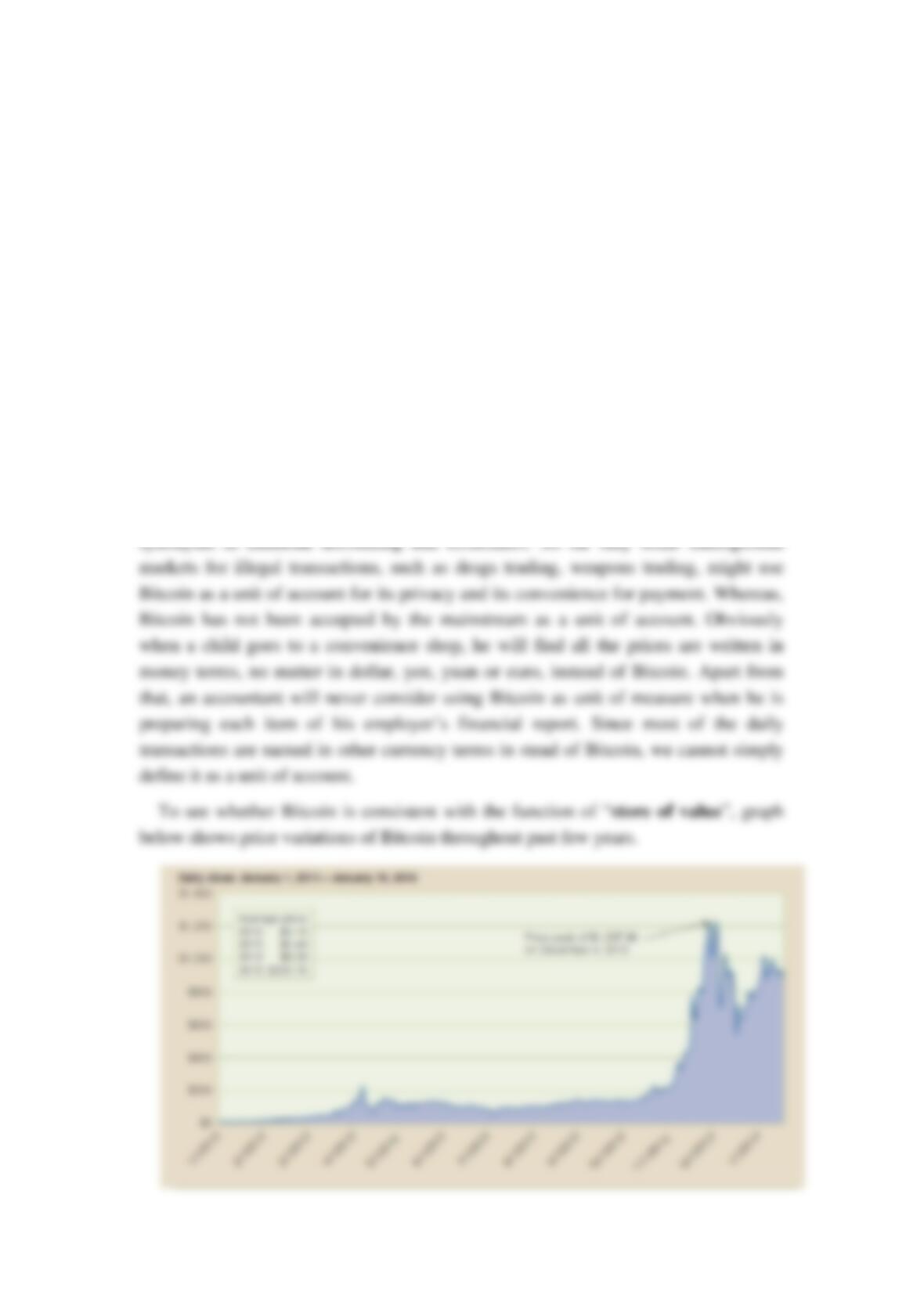
So far we can safely say that Bitcoin doesn’t fulfill the criteria of “unit of
account” and “ store of value”, while whether it can be listed as a kind of
“ medium of exchange” remains controversial.
A unit of account in economics is a nominal monetary unit of measure or
currency used to represent the real value (or cost) of any economic item; i.e. goods,
services, assets, liabilities, income, expenses. Besides, a unit of account in
financial accounting refers to the words that are used to describe the specific assets
and liabilities that are reported in financial statements rather than the units used to
measure them. Unit of account and unit of measure are sometimes treated as