BMEN 3320.002 Cardiac Pacemaker
The University of Texas at Dallas
BMEN 3320: Project 1
Cardiac Pacemaker
Bistees Abdelmalak
Snigdha Amara
Kazandra Gabriel
November 12, 2015
11/13/15 1
BMEN 3320.002 Cardiac Pacemaker
Background
Today’s heart pacemakers are used to treat a condition called arrhythmia, in which the
heart beats in an irregular manner. A person diagnosed with arrhythmia may experience
tachycardia, fast heartbeat, or bradycardia, slow heartbeat. If left untreated, one may experience:
fainting due to heart’s inability to pump blood efficiently, and because of the small blood clots
formed in the heart, a stroke can occur which can lead to heart failure and immediate death. A
cardiac pacemaker is a small device that is surgically implanted in the chest to regulate abnormal
heartbeat.
Figure 1: Illustrates where the pacemaker would be placed in the chest [1]
The heart’s natural pacemaker is the sinoatrial node or the SA node. This node regulates
the heart beat by sending electrical signals through atrioventricular node or the AV node, the AV
bundle, down to the apex of heart and finally to the Purkinje fibers where it dissipates and the SA
nodes sends another signal to start the process all over. The cardiac pacemaker takes the role
from the SA node and sends the signals itself. The electrode from the pacemaker is placed on the
heart wall and sends the signals
Figure 2: Shows the electrical pathway of the signal to stimulate heart beats [1]
11/13/15 2
BMEN 3320.002 Cardiac Pacemaker
Electrical Circuitry
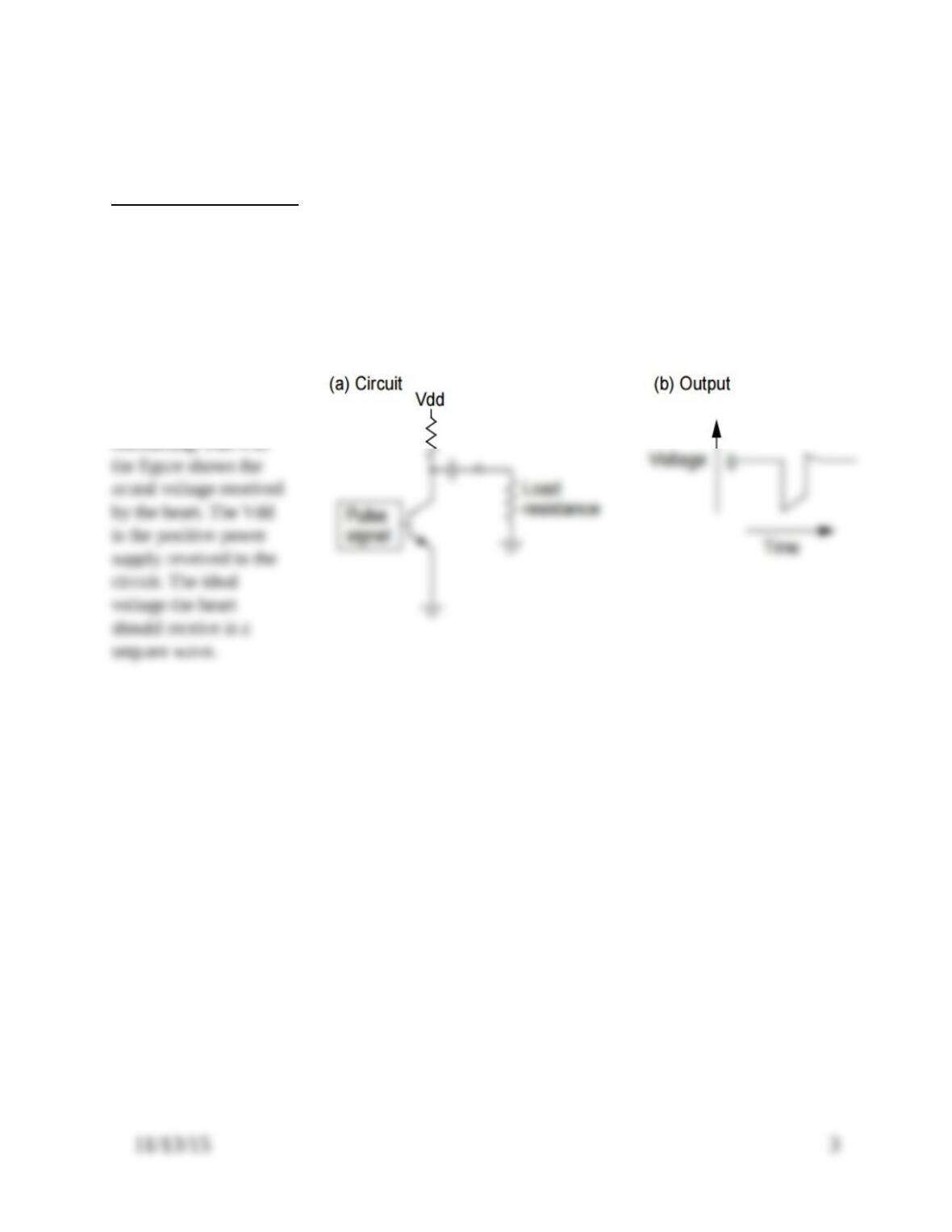
The following figure is a simple capacitor discharge system. This is one of the simple ciruits that
simulate muscle contraction. When the transistor in the circuit is off, the capacitor charges. Once
the transistor gets a signal, it turns on. The collector would become the ground and cause a
voltage drop in the transistor. This drop of voltage, -Vdd, becomes the resistance across the
resisitor and causes the heart to contract. Once the signal is removed, the transisor is turned off
and the capacitor
recharges back up to
Vdd. This causes the
heart to stop