Lecture 19:
Urinary system:
• Kidneys– urine forms
• Ureters- duct that channels urine from kidney to bladder
• Urinary bladder- smooth muscle, storage of urine
• Urethra- urine is eliminated
• Primary function- filter blood, remove waste products, filtrate to urine,
eliminate urine
• Secondary function-formation of calcitriol, regulation, produce
erythropoietin, form glucose
Kidney:
• Maintains ECF volume, electrolyte, and osmolarity
• Adjusts H2O quantity (osmo dec., water stores)
• Renal cortex (outer) & renal medulla (inner)
• Renal columns, pyramids (striated)
• Renal sinus– urine collected
o Minor calyces- smallest
o Major calyces- 2/3 per kidney, form minor cal.
o Renal pelvis– form major cal.
• Hilium- vessels, nerves, and ureter enter/exit into kidney
Nephron:
• Functional filtration
• Renal corpuscle– contact b/w blood vessels & tubules
o Glomerulus= tuft of capillaries, h2o filtered, converted to urine
o Afferent arterioles= blood flow
o Efferent arterioles= carry blood not filtered by tubular
o Bowmans capsule= cupping glomerulus, blunt ended tube
o Vascular= efferent & afferent connect
o Tubular= renal tubule originates
• Renal tubule– modifies filtrate, creates urine
o Proximal convoluted (cortex)
o Proximal straight (medulla)
o Loop of henle= dips into medulla. Desc. (medulla), asc. (cortex)
o Distal tubule= extends past ascending loop of henle
• Reside in cortex, striated
• Superficial= process fluid, outer cortex, don’t dive deep
• Juxtamedullary= inner cortex, entire medulla, osmotic grad., vasa recta
Tubules/ducts/apparatus:
• Collecting tubules- receives filtrate, empties into collecting
• Collecting ducts- projects through medulla, empties into papillary duct
• Principal cells- aldosterone & ADH, regulates hydration
• Intercalated cells-blood & urine pH, acids & base of filtrate
• Juxtaglomerular apparatus– between afferent & efferent
o Granular- smooth muscle cells, regulates BP into glomerus
o Macula densa- long term BP reg., detect NaCl to release renin
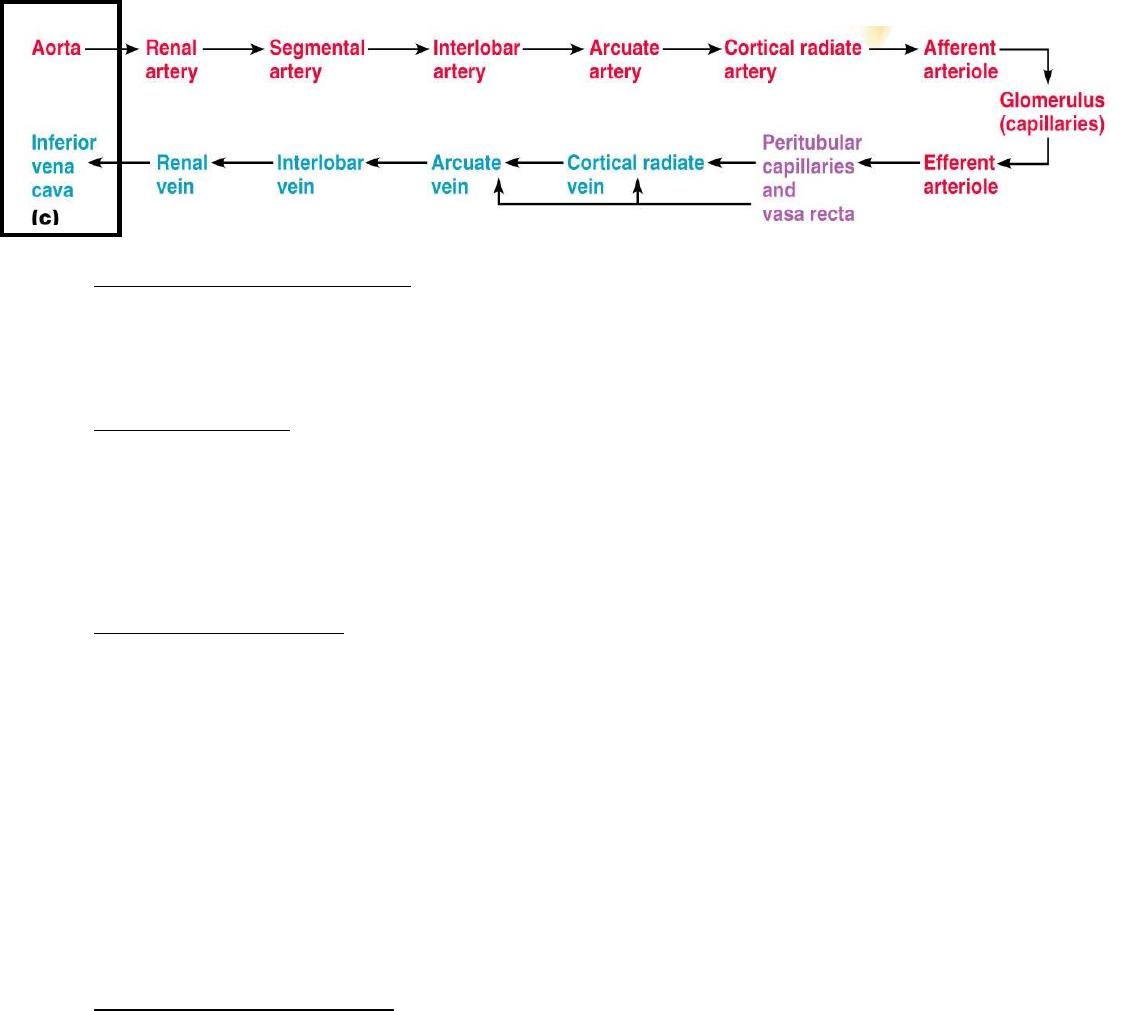
Blood flow through kidney:
• Peritubular capillaries- material exchange, around tubular component,
supplies kidney with blood
• Vasa recta- follow loop of Henle, maintain osmotic gradient
Renal processes:
• Glomerular filtration- filtered by glomerulus
• Tubular reabsorption- filtered substances returned to blood
• Tubular secretion- selective transfer of substances
• Filtration fraction–glucose passes through filtrate, amount of blood
passes through glomerulus
Glomerular filtration:
• Glomerular capillary BP- least resistant, goes to bowman’s
• Blood colloid oncotic- pulls toward, negative pressure, h2o move down
osmotic gradient
• Bowman’s space hydrostatic– push away, positive pressure, fluid
prevents flow from going in
• Bowmans space oncotic- small, negligible
• GFR- dependent on NFP
• Increase in PGC-increase in substrates in filtrate, decrease in filtrate
reabsorption
• Changes in GFR- intrinsic factors (within kidney) & extrinsic factors
(external to kidney)
Autoregulation/feedback:
• Renal– constant blood flow & PGC, maintains constancy
• Myogenic- contraction & relaxation of afferent
o BP drops, smooth muscle relaxes & afferent arteriole dilates
▪ Increase blood flow into glomerulus, BP, & GFR
o BP rises, smooth muscle contracts & afferent arteriole constricts
▪ Decrease into glomerulus, BP, & GFR
• Tubuloglomerual feedback- changes NaCl concentration
o Increase in NaCl, vasoconstriction of afferent, decrease GFR
o Decrease in NaCl, vasodilation of afferent, increase in GFR
• GFR dependent on GBP, more NaCl, faster flow rate
Reabsorption:
• Tubular- Selective process, proximal tubule, high reabsorptive for
substance in body
• Na+- starting point, water goes, everything follows
o Upstream or downstream
o Uses transcellular & paracellular
• H2O- follows salt, hormonal control, aquaporins, pass through leaky
tight junctions, moves with salt
• Cl- follows Na+
• K+– trade k+ for proton. K comes in, proton goes out
o Intercalated cells- moves acid or base
• Glucose- glucose follows Na+, secondary active transport, Na+ co–
transporter
• Amino acids- co-transporters, follows Na+, active- against gradient,
passive- down gradient to ECF
Lecture 20:
Eliminating nitrogenous waste:
• Urea- slow rate, reabsorbed & secreted
o Reabsorbed b/c of osmotic concentrations
o Reabsorbed urea helps establish osmotic gradient
• Uric acid- nuclei acid breakdown in liver, reabsorbed & secreted
• Creatine- metabolism in skeletal muscle, secreted only
Secretion:
• Tubular- selectively take things out of body
o Active process, transcellular
o H+ – proximal, distal, & collecting tubules, more acidity, more
secretion
o K+ – proximal= reabsorbed, distal= maintain plasma
concentrations
• K+ – high in plasma, diffuse into IF
o Increased K+ results in increased urinary K+, decreased plasma K+
o Low Na, low water levels
Organic ions/GFR:
• Eliminated through filtration & secretion
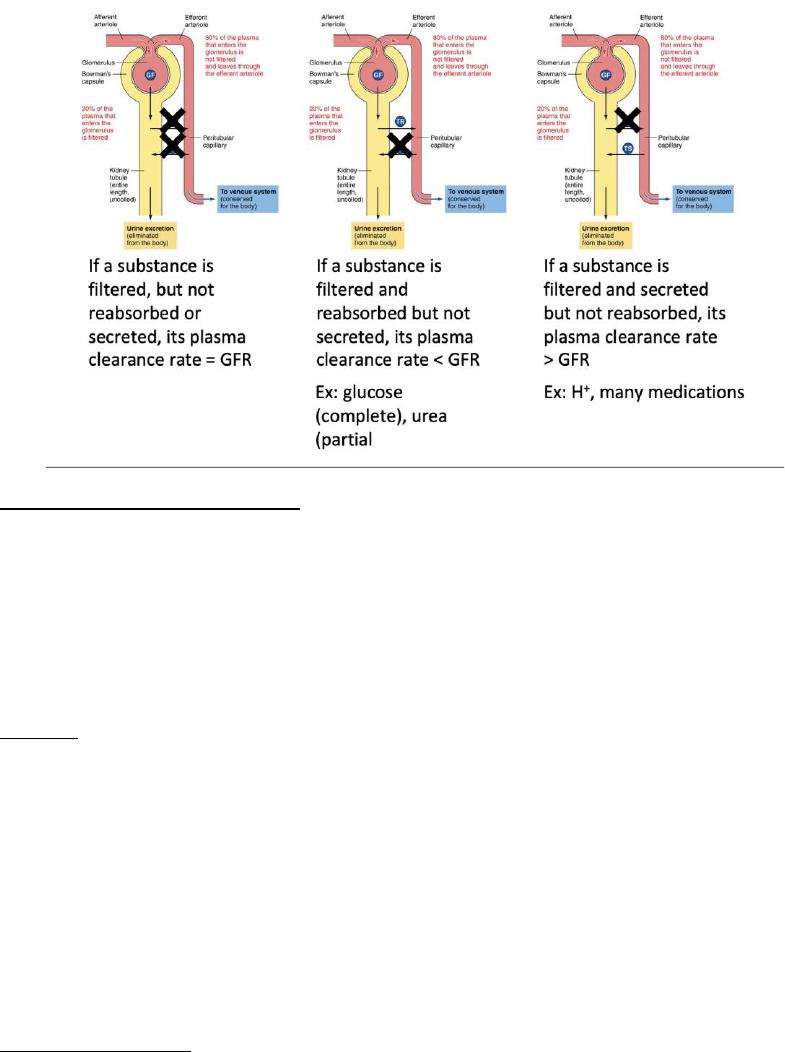
• Serves to increase secretion, rapidly remove substances from blood
• Release ions from carriers
• Localized in proximal tubule, hastens removal from blood
• Evaluating kidney via GFR– GFR low, decrease in kidney function
• Evaluating kidney via renal plasma– volume of plasma cleared, plasma
clearance varies for different substances
Urinary bladder/Urethra:
• Trigone- triangular area of urinary bladder wall
• Parasympathetic fibers- lowest point where urethra is
• Urethra- urine evacuation, 2 sphincters
o Internal urethral sphincter- bladder expands, muscle expands,
smooth muscle
o External– skeletal muscle, motor neurons firing for contraction
Reflex:
• Storage- autonomic & somatic NS
o Sympathetic stimulation- relaxation of muscle as urine enters
bladder & contraction of internal sphincter
o Somatic stimulation- contracts external urethral sphincter
• Micturition- bladder filling, 4 steps involved:
o Volume reaches 200-300 mL
o Baroreceptors send signal to pons
o Nerve signals contract
o Parasympathetic activity cause contraction & relaxation
Countercurrent:
• Tubular fluid reverses
• Multiplier- positive feedback loop increases salt
• Medullary- juxtamedullary nephrons, flow goes up, takes advantage of
pumps & channels in wall & where they’re located. Move to
environment/tubules
o Descending limb- H2O only exits
o Ascending limb- move NaCl out, H2O is absent
▪ Thick- actively transports NaCl out of tube, into IF
▪ Thin- passive diffusion of NaCl out of tube, into IF
Vaso recta/vasopressin/renin:
• Vaso recta- maintains the gradient, redistributes Na+ & H2O
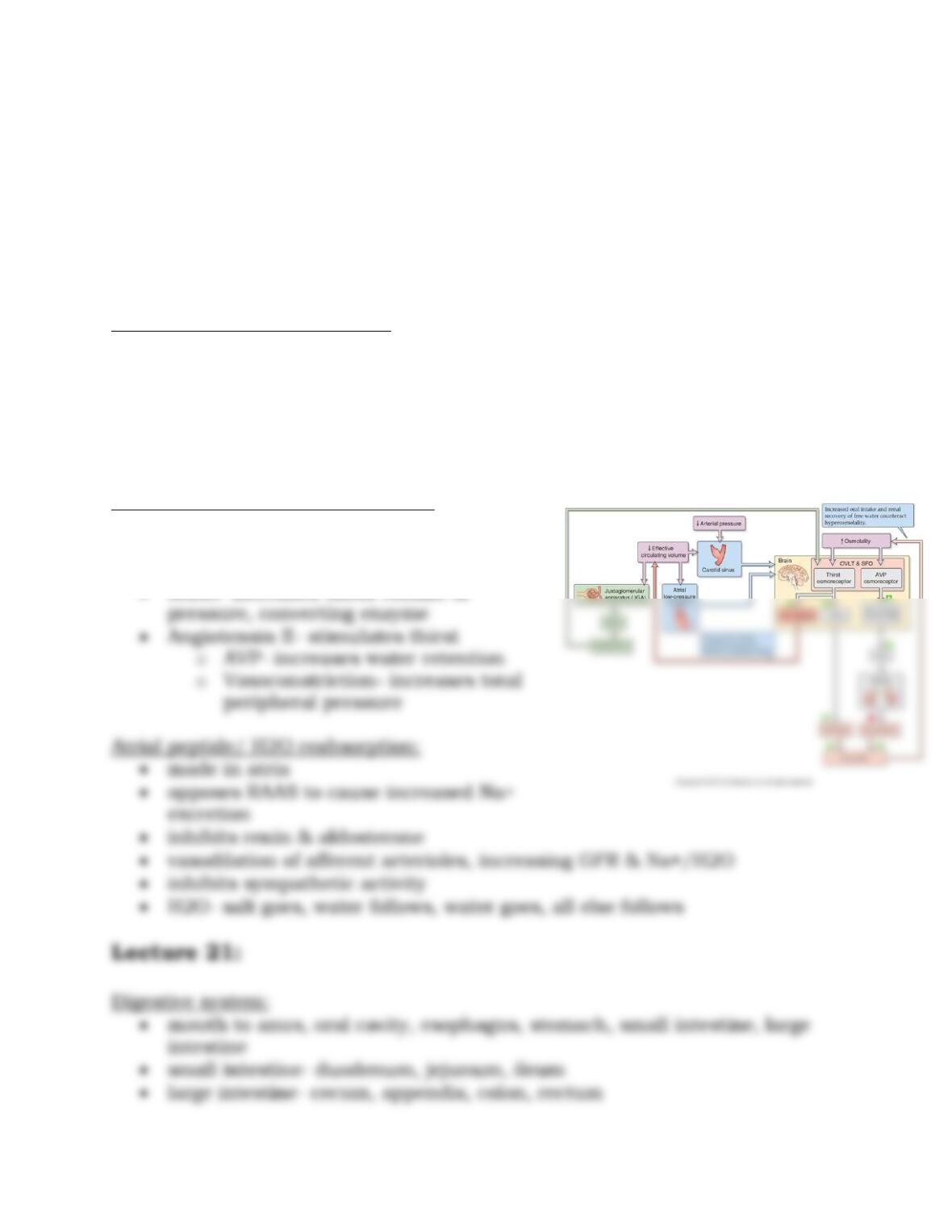
• Vasopressin- distal & collecting tubules impermeable to H2O in presence
• Renin– secreted by granular cells, activate angiotensinogen
o Drops BP
o Low salt in filtrate
o Low ECF volume
Aldosterone/ RAAS/ angiotensin II:
• Aldosterone- secreted by adrenal cortex
o Enables creation of ENaC Na+
channels & K+ pumps