Rory Ramos
Professor Phil Ruder
21, November 2017
Econ 333
Importance of Biodiversity
Biodiversity is essential for the human species. It provides us with cultural, economic,
and environmental prosperity. Without biodiversity we would lack the essential resources to
support the needs of our growing populations. Despite this, we continue to observe massive
reductions in biodiversity across numerous environments every year. The primary candidate
responsible for this reduction in biodiversity is humans—through continual degradation of the
environments caused by overexploitation of natural resources. Because the economic sector does
not place value on biodiversity at the moment, nor have they in the past, these losses will
continue to occur as humans draw on natural resources and pollute negligently. The market must
address the immense value there is in preserving biodiversity. In order to correct the degradation
that the environment has suffered, through ignorance and mismanagement, effective legal
policies must be written and implemented. The World Wildlife Foundation, a non-profit
organization, is attacking this market failure through the conservation of the most biodiverse
areas of geography and keystone species essential for those habitats to thrive. This essay will
analyze the main causes of biodiversity loss, detail and deconstruct policies that WWF are
establishing in collaboration with local government, and explain why biodiversity should be so
highly valued.
The first thing to be addressed is why the value of biodiversity needs to be held highly.
Biodiversity has a number of values that are both direct and indirect. The direct values are the
ones we seem to covet the most because they are easily quantifiable and translate to profit. The
direct values are Consumptive use values and Productive use values. The indirect values are
Aesthetic values, Ethical values, Option values, social value, and Ecosystem service values
(Samiksha 2014). All these factors need to be weighed when establishing a value of biodiversity.
One specific value is undervalued and almost impossible to quantify: the ecosystem services that
biodiversity provides. These ecosystem services are essential for survival of all species because
they are what we rely on for all basic necessities. These ecosystems are what keep all systems on
earth stable, providing a framework for life. The ecosystems services dictate all our basic
necessities climate, air quality, and water quality.
The main candidate for biodiversity loss are humans modifying and exploiting
ecosystems for their financial gain. The pressures to exploit valuable ecosystems continue to
grow as populations explode. Resource use is at an all-time high with steady growth, meaning
that corporations continue to degrade ecosystems with no precautions simply because no one is
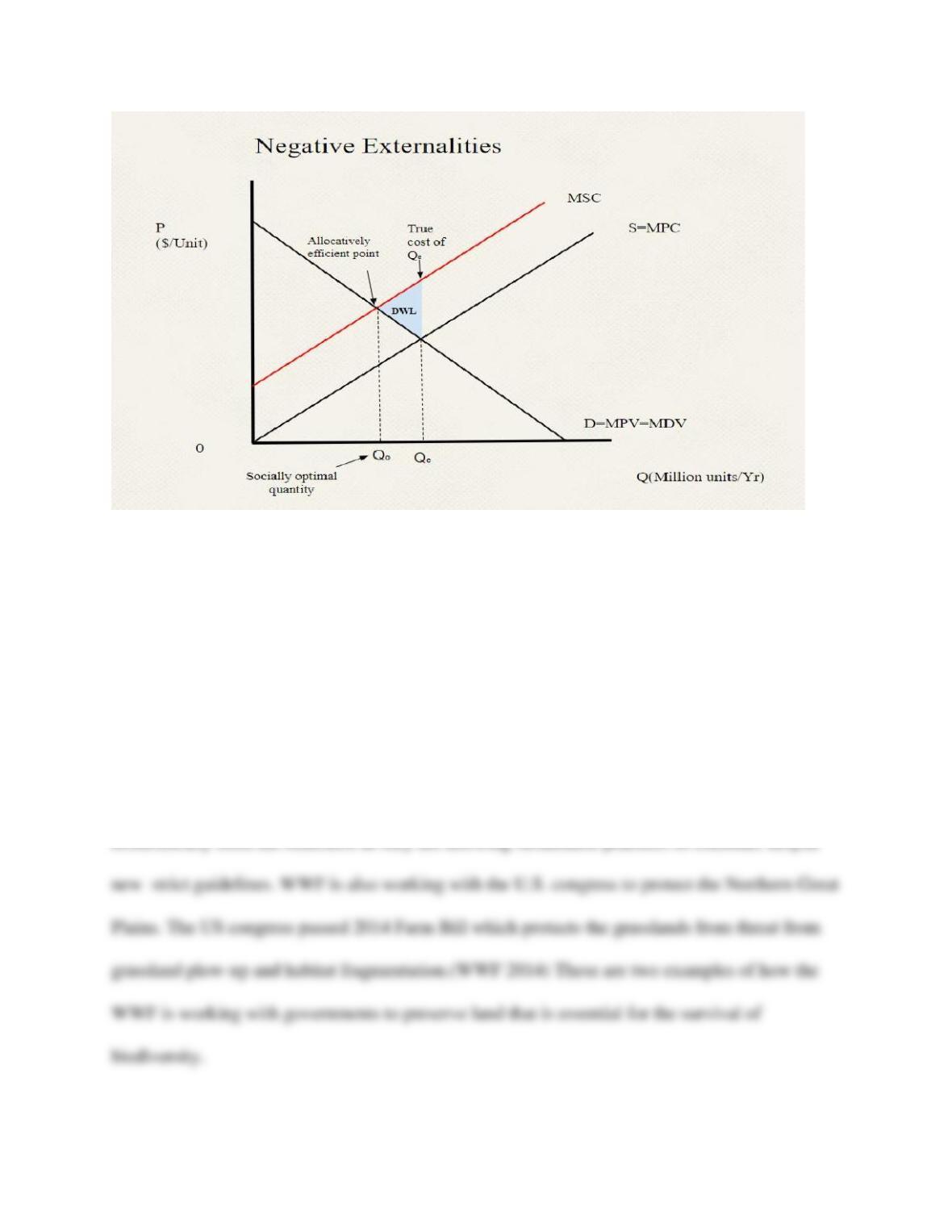
forcing them to pay for the social costs involved in obtaining their resources. Below is a graph
displaying what supply would be if marginal social cost were implemented into the corporation’s
supply curve. Corporations will continue to exploit with no regard until the marginal social cost
of extracting these resources is properly quantified. Once this value is quantified the corporations
will be held responsible for the negative externalities involved in obtaining these resources. Once
the marginal social cost is put into the equation resources will plummet until more efficient ways
of extracting these resources are developed to help reduce the negative externalities and their
costs.
WWF is fighting this market failure by working with multiple governments to preserve
land that is essential for biodiversity. An example of one of their successes is working with the
Brazilian government to create the Amazon Regional Protected Areas. A protected area in the
Amazon rainforest, the ARPA are now bigger than all the United States national parks combined
(WWF 2014). The Amazon is one of the most bio diverse places in the world. With a committed
protector maintaining biodiversity, the Brazilian government will continue to benefit