CASE 3
BEN & JERRY’S HOMEMADE
This case examines issues of asset control for Ben & Jerry’s Homemade, Inc., in light of
the outstanding takeover offers by Chartwell Investments, Dreyer’s Grand, Unilever, and
Meadowbrook Lane Capital in January 2000. The case provides a unique opportunity to discuss
fundamental firm objectives and the implications of poor financial performance as it reviews the
development of Ben & Jerry’s strong social consciousness and the takeover defense mechanisms
that maintain management’s control of company assets. Taking the role of an outside board
member, students may review management’s performance, estimate the economic cost of current
management practice, and evaluate the implications of takeover defense strategies. Ultimately,
students must take a position on whether the board should defend the agenda of the current
management team or accept one of the takeover offers and support a shift toward a more
traditional orientation.
The case provides opportunities for the instructor to develop any of the following
teaching objectives:
Establish the importance of financial performance for a firm in a public capital market.
Stimulate an appreciation for the tension regarding asset control among corporate
stakeholders.
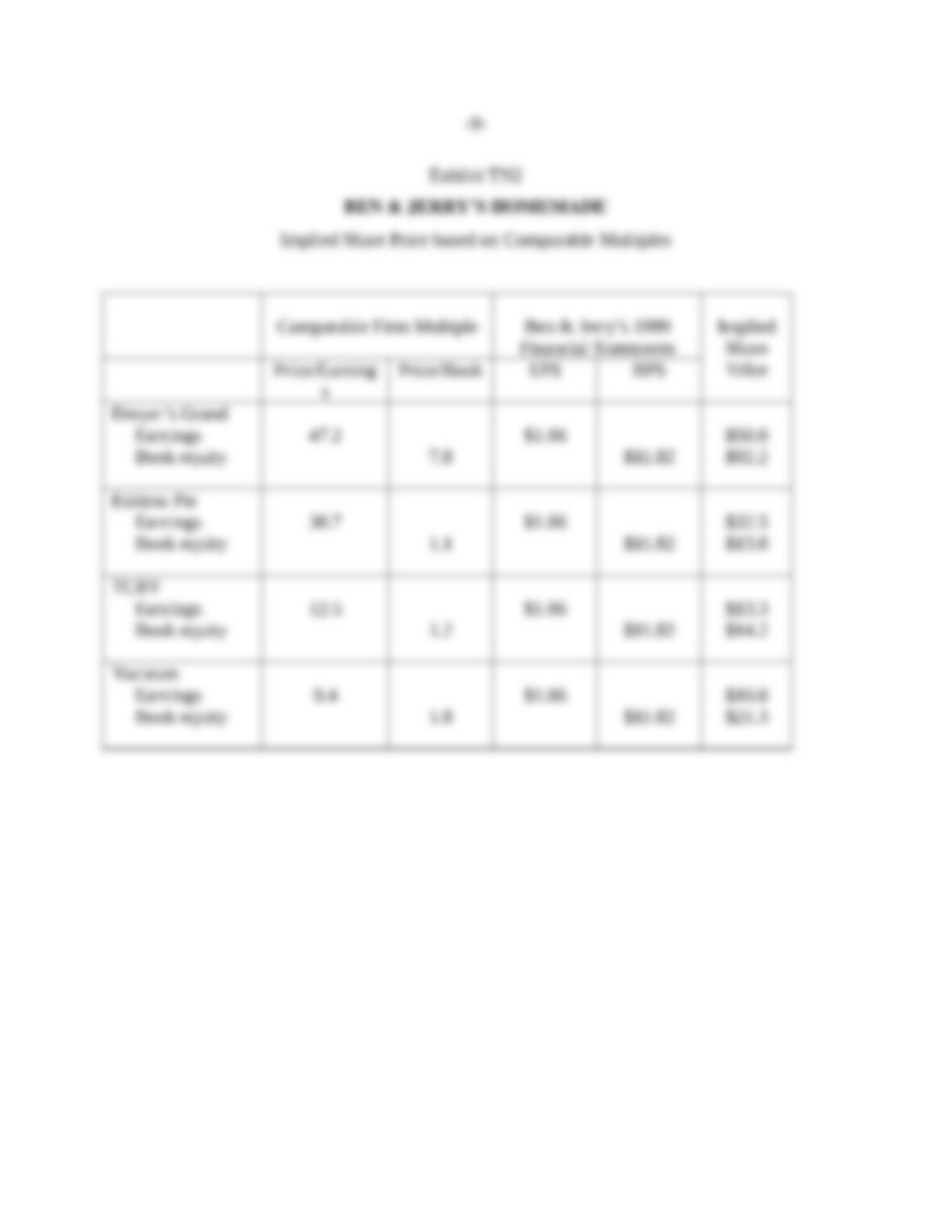
Evaluate the role of corporate takeovers and the merits of takeover defenses.
Introduce corporate valuation using investor multiple measures.
The case requires relatively little prior knowledge of finance, and it largely provides a
stimulating introduction to the principles of a traditional corporate finance curriculum.
This teaching note was prepared by Professor Michael J. Schill, with research assistance from Ruslana Deykun.
Copyright 2001 by the University of Virginia Darden School Foundation, Charlottesville, VA. All rights
reserved. To order copies, send an e-mail to sales@dardenpublishing.com. No part of this publication may be
reproduced, stored in a retrieval system, used in a spreadsheet, or transmitted in any form or by any means—
electronic, mechanical, photocopying, recording, or otherwise—without the permission of the Darden School
Foundation. Rev. 10/03.
Sample Student Study Questions
1. How has Ben & Jerry’s fulfilled its mission statement? What evidence can you provide
regarding Ben & Jerry’s performance on each of the three dimensions of the mission
statement?
2. How did Ben & Jerry’s become a takeover target?
3. Do you think the current takeover offers are justifiable? What might Ben & Jerry’s be
worth to the bidders?
4. Should Henry Morgan defend the agenda of the current management team or support one
of the acquisition offers?
Suggested Supplementary Readings
This case introduces many of the fundamental principles of corporate finance. Little prior
knowledge or supplementary reading on the part of students is required. Instructors may consider
reading Cohen and Greenfield’s Ben & Jerry’s Double-Dip, published by Simon and Schuster, as
it provides a fascinating and entertaining review of the development of Ben & Jerry’s Homemade
and its founders’ business philosophy.
Hypothetical Teaching Plan
1. What decision does Morgan face?
The members of the board must choose either to defend the ongoing agenda of the
current management team or to encourage a change in asset control by supporting an outside
takeover offer. Because most of the board members are part of the management team and
Morgan has been associated with the founders for some time, a vote for a change in control is
likely to be hard to make. As a member of the board, Morgan does have a fiduciary responsibility
to his shareholders. If the case is used as a course opener, the instructor may find it attractive to
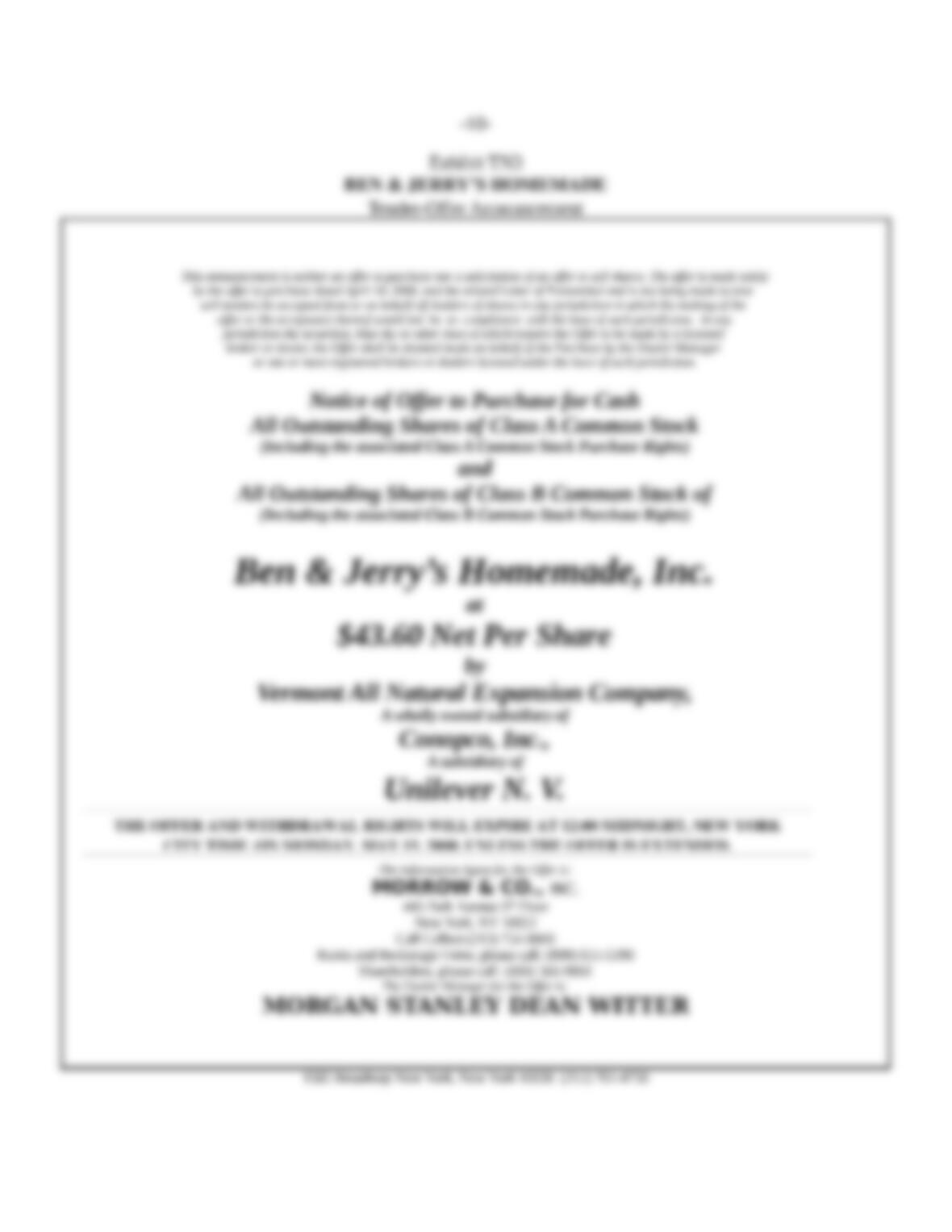
avoid the details of the various offers by focusing on the highest and, arguably, the most
interesting offer, the Unilever offer of $36 in cash. The instructor can close this discussion with a
class vote on the Unilever offer.
2. How did Ben & Jerry’s become a takeover target? Hasn’t Ben & Jerry’s been successful
in fulfilling its mission statement? Would you support a takeover?
The objective of this portion of the discussion is to establish that, at first pass, Ben &
Jerry’s appears to have been successful across all but the financial dimension. The instructor may
begin by asking students to summarize Ben & Jerry’s mission statement. The instructor can then
survey the class by asking students to grade management on its performance across corporate
objectives. The grades become management’s report card. Generally, students give management
-2-
good marks on the product and social objectives (A’s and B’s) and less favorable
grades on the economic objective (C’s and D’s). Students should be asked to defend their
evaluations. Providing some support for this view of Ben & Jerry’s financial performance can be
the stock market performance, return on equity (ROE) and return on assets (ROA) (relative to
comparables and risk-free debt yields), and comparable investor multiples, as well as the
takeover offers. The instructor may emphasize the point by discussing Ben & Jerry’s strong
performance relative to other stakeholders (e.g., suppliers, employees, management). The
conclusion is likely to be that Ben & Jerry’s management has received straight A’s for all but its
financial performance. The instructor can close with a class vote on the takeover decision.
3. What evidence is there that investors are dissatisfied?
The instructor can gather evidence from those who believe that Ben & Jerry’s financial
performance is poor. Such evidence includes poor operating returns (ROE, ROA), poor
cumulative stock returns, and low investor multiples. One theme that could be introduced is the
notion of benchmarks. The only way to state that Ben & Jerry’s performance is unsatisfactory is
to have some standard with which to compare its performance. Much of the curriculum in
standard finance classes is devoted to identifying appropriate benchmarks. Case Exhibit 1
suggests that Ben & Jerry’s ROE has been running on par with the yield on 30-year U.S.
Treasuries. The instructor might probe the merits and faults using government debt yield as the
benchmark for Ben & Jerry’s equity returns.
-3-