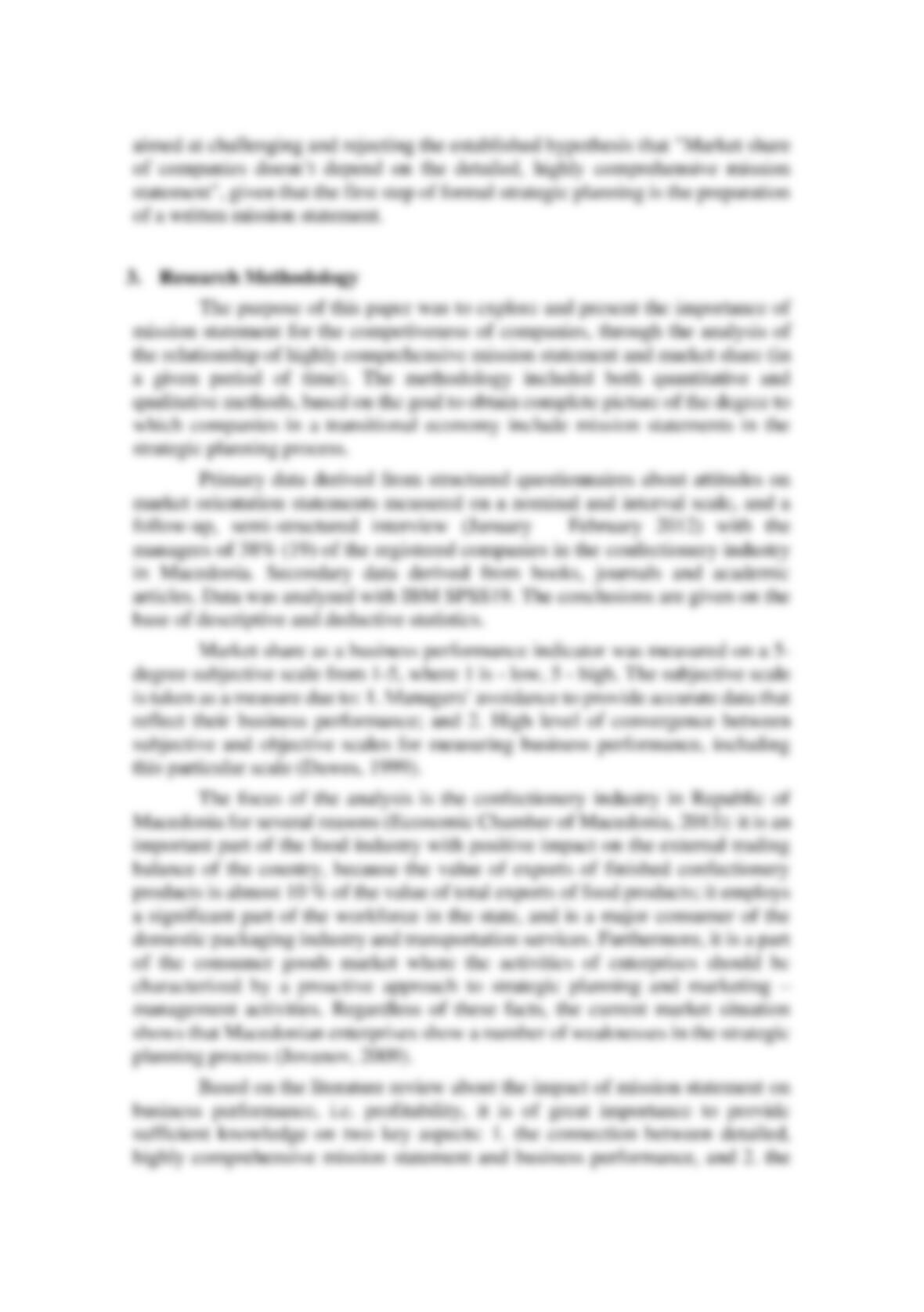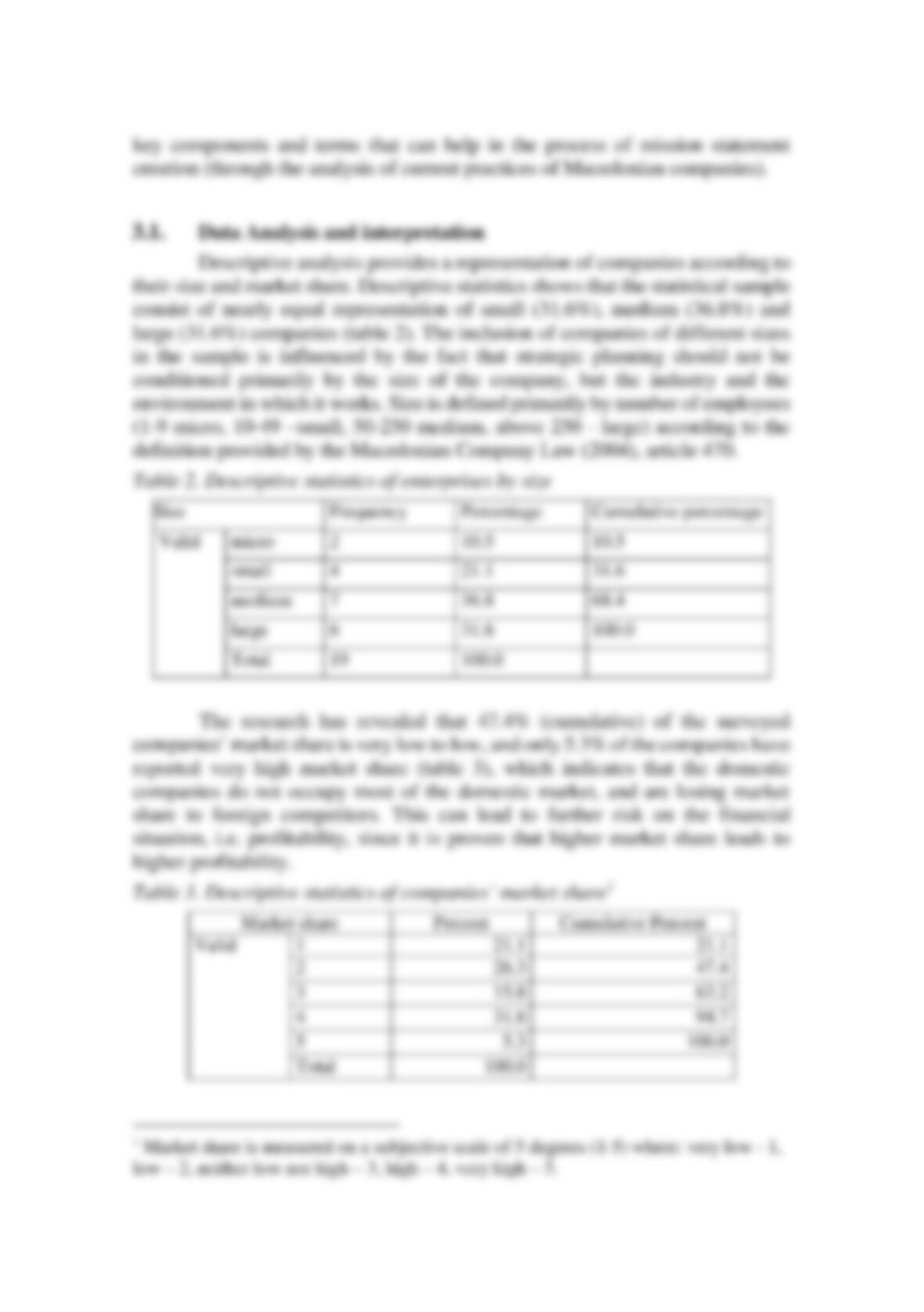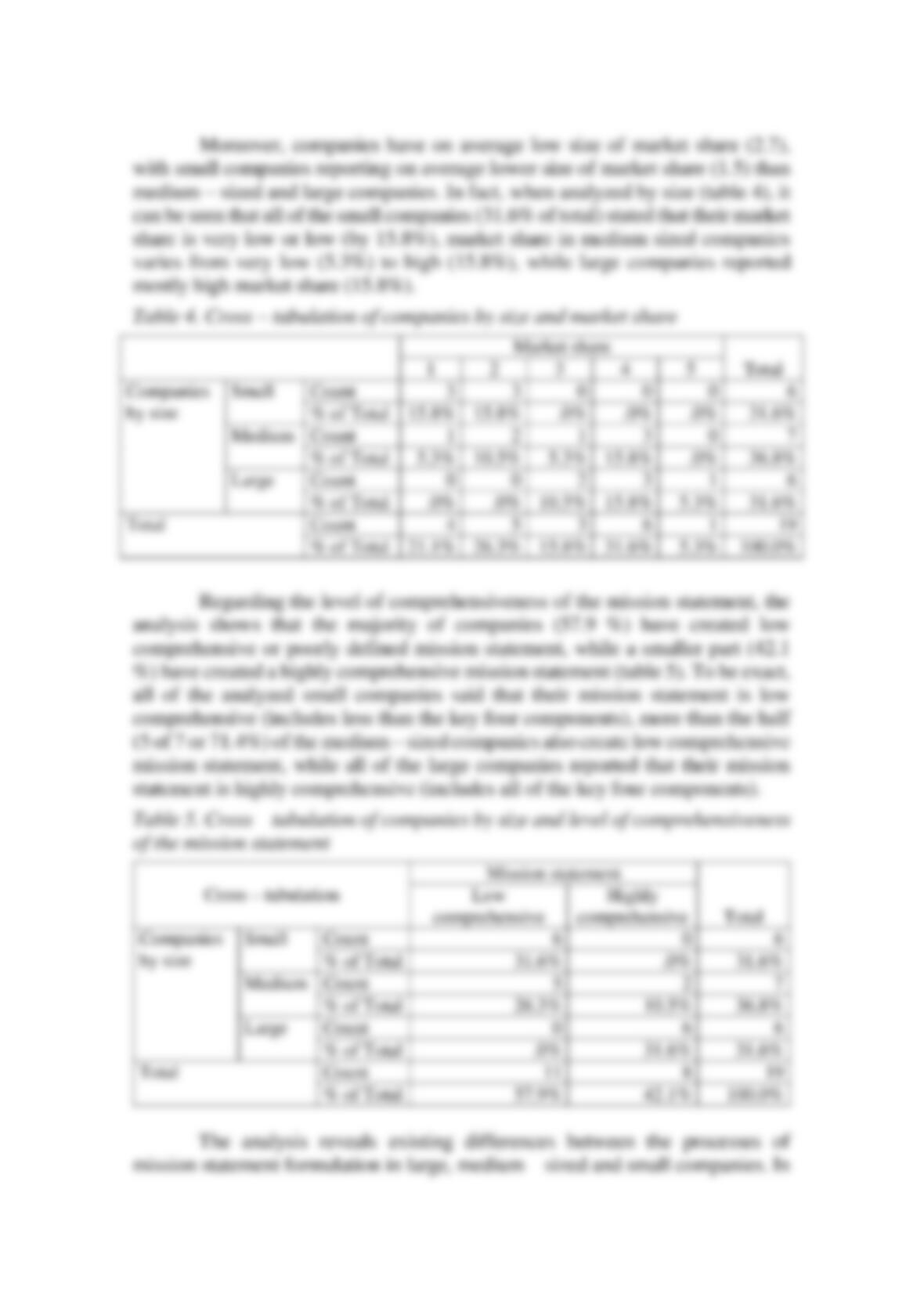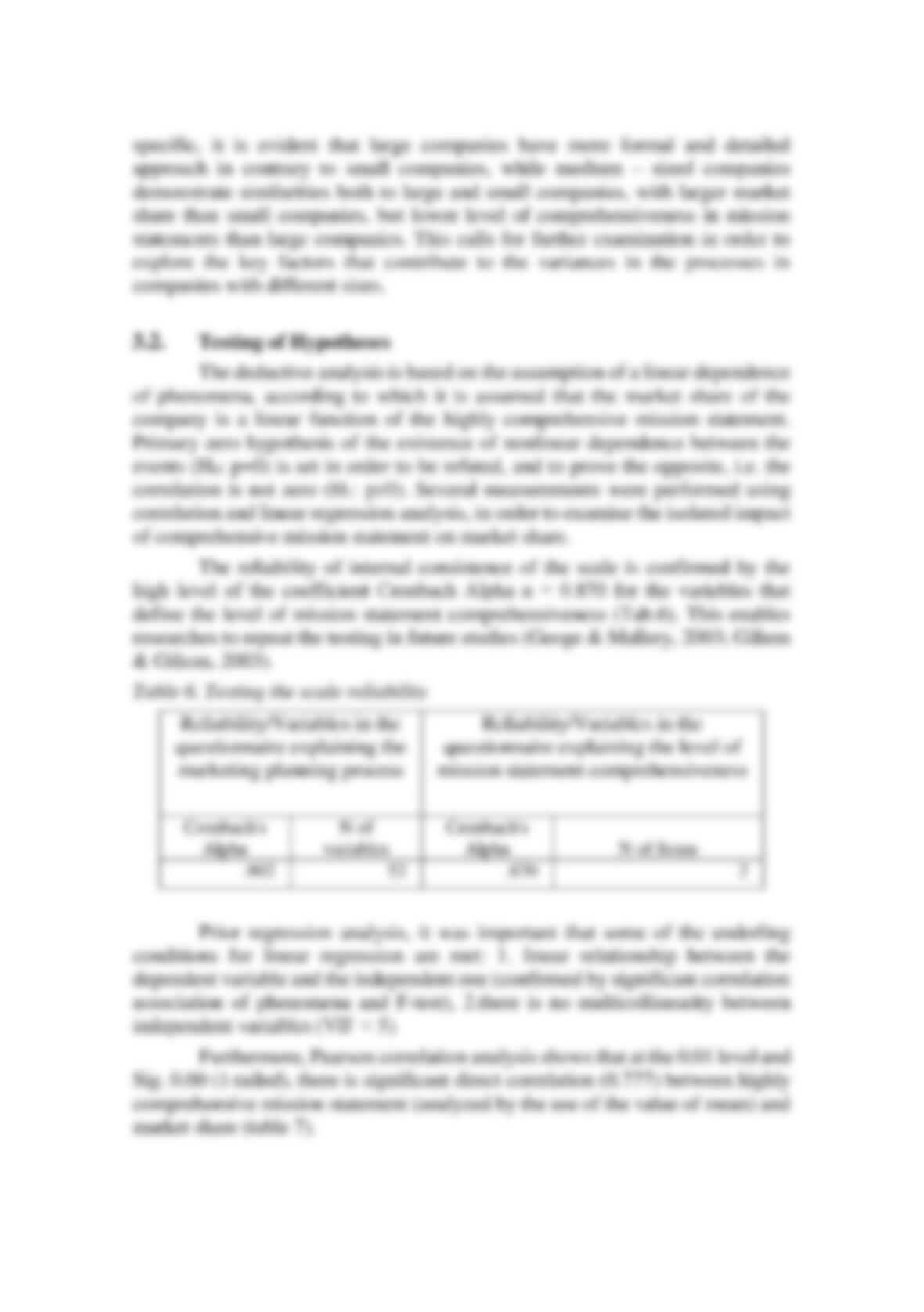
CORPORATE MISSION STATEMENT AND BUSINESS
PERFORMANCE: THROUGH THE PRISM OF
MACEDONIAN COMPANIES
Tamara Jovanov Marjanova, (PhD)
tamara.jovanov@ugd.edu.mk
Teaching Assistant, University “Goce Delcev” – Shtip, Faculty of Economics,
Republic of Macedonia
Elenica Sofijanova, (PhD)
elenica.sofijanova@ugd.edu.mk
Professor, University “Goce Delcev” – Shtip, Faculty of Economics,
Republic of Macedonia
Abstract
This paper analyses the corporate mission statement as an essential step in
the strategic planning process, based on its impact on companies’ business
performance, i.e. market share. We underline the significance of early employment
of mission statement, because it is a technique through which the strategic intention
of a company is defined and sustained. The study addresses two main research
aspects: 1. the key components and terms by which a company can create a mission
statement, and 2. the connection between detailed, highly comprehensive mission
statement and market share. The methodology includes quantitative and qualitative
research that explored the way in which 38% of the registered companies in the
confectionery industry in Macedonia create their mission statements. Primary data
was derived from questionnaires and semi-structured interviews and secondary data
– from books, journals and academic articles. Data was analyzed with IBM
Statistical Package for Social Sciences (SPSS) 19. Results suggest that highly
comprehensive mission statement has significant correlation and directly
influences companies’ market share, i.e. performance. The analysis has also shown
that a model of key components and terms of a mission statement can be used as a
guide in the process of mission statement creation. The limitations of the paper arise
from sample’s size and the (one) chosen industry, but the findings are useful to
entrepreneurs and managers, since they provide a more accurate perspective of the
significance of mission statement and the way that it affects business.
Key words: Mission statement, business performance, market share, key
components and terms.
1. Introduction
At the beginning of the business operation, top management must define
the culture and strategic intent as key aspects in the operation of an enterprise.
The aspirations of the company should have a strategic intent, expressed through
statements about vision, mission and organizational goals. The mission of the
company is often presented in the form of so-called mission statement, which
projects a certain image of the underlying intent of the existence of the company.
The mission is broad description of the intention of the company and the type of
activities it plans to undertake (Campbell, 1997). In fact, the mission statement
defines the business that the company is in, its goals and approach to achieving
those goals (Rigby, 2011).
The motivation for development of a mission statement may arise from
the objectives that are expected to be accomplished with it (Campbell and Yeung,
1991): motivation of employees to achieve higher performance, direction and
consistency in the allocation of resources, a balance between the conflicting
interests of different groups of stakeholders. The mission statement can also
contribute with its impact outside the enterprise (Rigby, 2011): closer ties and
better communication with customers and suppliers, public relations, external
support.
Comprehensive mission statement can contribute significantly to high
performance, hence, it provides numerous benefits that usually translate into high
performance, such as: 1. explanation of the purpose of the organization, 2.
identification of standards for allocation of resources, 3. focus and specification
of organizational purposes into objectives and goals, 4. identification of core
strategic competence and market position, 5. setting priorities, values and
business philosophy, etc. However, regardless of the rationality of the process, it
is proposed that the basic purpose and motivation for the development of the
mission statement should be to enhance the performance of the company (Bart
and Tabone, 1998).
1.1. Key Components and Terms of a Mission Statement
Typically, the mission statement is prepared by the owner and/or the
senior management of the company. Thus, it is important to know that besides
the elements that are positively correlated with the performance of the company
(adopted values, social responsibility), there are elements that are found to be
negatively correlated with performance, such as the presence of financial
statement purposes (Bart and Baetz, 1998). For that reason, the process of
development of a mission statement should be approached with high attention and
managers should be very careful about the certain components they incorporate
into the statement. The way to identify the basic components and terms that
should be included in a mission statement is to create a model consisted of the

key components given by Campbell (1996) and the associated terms provided by
Stevens (1994) that are positively connected to business performance (Table 3).
Table 1. Мission statement model of key components and terms
Components of the mission
statement by the Ashridge Mission
Model (Campbell, 1996)
Key terms in the mission statement
(Stevens, 1994)
Intention
• Why is there a company?
• What is the basic reason for
existence?
• For whose benefit does the company
exists?
Consumers/clients/customers
Investors/shareholders/owners
Community/society
Employees/colleagues
Management
Suppliers
Strategy
• How will the company pursue its
strategic goals?
• The competitive position and key
competencies?
• Identification of the commercial
logic for the business.
Fiscal conservatism
Market share
Financial measures (sales, profit, return)
Domination and competition
Long perspective
Global perspective
Research and development (R&D)
Technology
Values
• What does the company believe in?
• Setting priorities and core beliefs,
aspirations, philosophy.
• Determining of the moral logic of
business.
Awareness of cost (sense of the value of the
product/service versus price)
Social/civic responsibility
Commitment/dedication
Welfare of employees/quality of life
Learning/training/development
Standards of conduct
• How does the company act in the
community?
• Policies and pattern of behavior that
support core competencies and value
system
Ethics/morality/honesty/fair treatment
Professionalism
Aggression/focus on improving
Adaptation/reaction
Innovation/creation
Authorization (transfer of responsibility)
According to this model, the management of the mission statement is a
continuous process that requires constant review and change. With its use, the
present deficiencies in the existing mission can be perceived, and/or these can be
avoided in the formulation of the new mission statement (Campbell, 1996). For
example:
Are the values of the management/owner compatible with the values of
employees (The observed differences can contribute to further
development of corporate culture. Such differences may easily be
perceived through interviews, group discussions and/or questionnaires,
after which the management must face the need to change the mission
statement or change and recruit employees with values compatible with
the values defined in the existing mission statement);
Are the values in the mission in conflict with the values of the
management and/or employees;
Are the strategy and the values mutually supporting and reinforcing or
conflicting, which can be observed through the adopted standards of
conduct (If clear standards of conduct can be identified in the mission
statement, this indicates that there is a close link between strategy and
values).
This model can be used as an analytical framework by which managers
can shape, modify or improve the mission statement of the company.
2. Literature Review and Hypotheses
The vision and mission are considered to be of great importance for the
efficient and effective operation of the enterprise. Many research papers identify
the mission statement as a tool for strategic planning and starting point in building
enterprise’s identity. It is also associated with business performance and survival
(Leuthesser and Kohli, 1997).
According to Medley (1992) and Wilson (1992), the existence of a
detailed mission statement can lead to a 50% increase in the effectiveness of the
company. Research shows that companies with a detailed, highly comprehensive
mission statement have an average return on investment of 26.2%, while
companies with low comprehensive mission statement have an average return of