________________________________________________________________________________________________________________
HBS Professor Dorothy Leonard and writer Sunru Yong prepared this case solely as a basis for class discussion and not as an endorsement, a
source of primary data, or an illustration of effective or ineffective management. This case, though based on real events, is fictionalized, and any
resemblance to actual persons or entities is coincidental. There are occasional references to actual companies in the narration.
Copyright © 2012 President and Fellows of Harvard College. To order copies or request permission to reproduce materials, call 1-800-545-7685,
write Harvard Business Publishing, Boston, MA 02163, or go to http://www.hbsp.harvard.edu. This publication may not be digitized,
photocopied, or otherwise reproduced, posted, or transmitted, without the permission of Harvard Business School.
DOROTHY LEONARD
SUNRU YONG
Bella Healthcare India
Joseph Cherian, country director of Bella Healthcare in India, wondered whether his team was
ready for Project TKO. He listened intently as Jeremy Manning, his director of research and
development, described the pros and cons of the project, a proposal to develop a new portable
electrocardiograph machine (EKG) specifically for the Indian market. Cherian believed the time was
right to tackle the tough, but fast-growing Indian market. The key question was whether Bella
India’s local R&D team, under Manning’s direction, was ready to lead the product development:
My goal has always been to develop products that serve emerging markets and make
healthcare more accessible. I think medical device companies are learning that this can be
done most effectively by those who know these markets best. We should develop our
affordable EKG in India, for India. Bella India has proven itself in manufacturing and cost-
engineering; this is the next logical step.
The endeavor was not without risk. The costly failure of Project Baton, a global product
development effort, was fresh on everyone’s mind. Failure with Project TKO would not only hurt
Bella Healthcare’s overall profitability, it would undermine Cherian’s case that the India operation
was ready for more challenging product development undertakings.
Industry Background: Electrocardiogram Equipment
Electrocardiography, commonly referred to as EKG or ECG, is the measurement and
interpretation of the electrical activity of the heart as it contracts. An EKG enables physicians to
assess cardiac health—the regularity of heartbeats, the size and position of the chambers, the
identification of disorders, and the presence of damage. It is commonly used to diagnose problems
such as heart attacks, arrhythmia, lack of blood flow, birth defects, and enlargement. An EKG is often
the first step taken for patients who fit an at-risk profile and are experiencing chest pains, difficulty
breathing, or irregular heartbeats.
An EKG device consisted of three primary components. Electrodes were attached directly to the
patient’s skin on the arms, legs, and chest. An amplifier received, stabilized, and amplified the
electric signals. The signals were then directed to the output device that recorded and displayed the
4440
APRIL 27, 2012
For the exclusive use of E. Bouvard, 2018.
This document is authorized for use only by Evan Bouvard in EDHEC PACE Spring 2018 taught by Esposito, Pace University from March 2018 to May 2018.

4440 | Bella Healthcare India
2 BRIEFCASES | HARVARD BUSINESS SCHOOL
readings for the physician to interpret. The standard EKG was a 12-channel device consisting of 10
electrodes on the chest and extremities that calculated 12 “leads,” or electric signals, each of which
provided a different view of the heart. This device was also known as a “resting” EKG, referring to
the patient’s resting state during which the reading was taken. Physicians also used single, 3-, and 6-
channel EKGs. These were less accurate for diagnosis and were more likely to be used by general
practitioners, in developing countries with resource constraints, or for continuous monitoring, such
as during surgery or in an ambulance.
Other EKG devices measured heart activity under different circumstances. The Holter monitor,
named for the physicist who invented it in 1949, was worn continuously, enabling the heart to be
monitored over extended periods outside the hospital. Stress test equipment enabled physicians to
diagnose patients by pushing the heart beyond resting state, usually by combining the EKG
equipment with a treadmill or exercise bike. General Electric and Philips were the leading
manufacturers of EKG devices, combining for over 50% market share. Other important
manufacturers included Cardiac Science Corporation, Welch Allyn, Schiller AG, Mortara
Instruments, and Spacelabs Healthcare.
Bella Healthcare in India
Bella Healthcare, founded in 1969 in St. Louis, Missouri, by brothers Todd and Greg Bella, started
as a manufacturer of Holter monitors. The advent of transistors enabled the Holter device to be
miniaturized, and by the early 1960s, it had become widely accepted for clinical use. The Bella
brothers developed their own version of the Holter that was more comfortable for patients and more
reliable than competing devices, and launched their company with this product. In the following
decades, Bella Healthcare expanded is offerings to a range of cardiology equipment, including resting
EKGs, stress test systems, ambulatory blood pressure monitors, and defibrillators. The company’s
approach to product development was unchanged from the one espoused by the founding brothers:
innovation had to be patient-centric and commercially oriented. Bella avoided doing research for its
own sake; rather its innovations tended to be smart, marketable improvements on existing
technologies.
In 1989, the Bella Healthcare sent a team to establish an Asian manufacturing location in addition
to its facility outside St. Louis. After assessing several locations, the team returned with a strong
recommendation to select Bangalore, India, where the company had opened a very small sales office
four years earlier. There were clear precedents that strengthened their case, as other multinational
corporations had successfully established operations there, including Texas Instruments, Siemens,
GE, Motorola, and others. Lena Somerset, CEO at the time, recalled:
The Export Promotion Industrial Park at Whitefield, a suburb of Bangalore, was an
excellent industrial hub with the right supporting infrastructure. In addition, the local labor
force was fantastic. There were very smart, well-trained engineers who were extremely
motivated, and they spoke English, which would help build organizational cohesion.
While Bella had sales offices in Europe and other Asian markets, this would be the first
manufacturing facility outside the United States. Somerset’s immediate goal was to establish a lean,
low-cost manufacturing facility in India. Her longer-term vision was to leverage the local talent and
build a broader set of cost-efficient product development capabilities that would keep Bella
Healthcare as lean and competitive as possible.
Early 1990s In 1990, operations at Bella Healthcare India started with the assembly and testing of
EKG electrodes and amplifiers. Joseph Cherian, then the director of manufacturing, hailed from the
For the exclusive use of E. Bouvard, 2018.
This document is authorized for use only by Evan Bouvard in EDHEC PACE Spring 2018 taught by Esposito, Pace University from March 2018 to May 2018.

Bella Healthcare India | 4440
HARVARD BUSINESS SCHOOL | BRIEFCASES 3
Indian state of Kerala and had studied electrical engineering at the prestigious Indian Institute of
Technology Bombay (Mumbai). After completing an MBA at Washington University in St. Louis,
Missouri, he stayed in the United States for 10 years to work for GE Healthcare. Cherian had
accepted the Bella India position and returned home to be closer to family, and he was committed to
demonstrating that India was a good place for multinational corporations to invest. He was known
for his tough, no-nonsense management style, and kept a very close eye on production schedules and
product quality. He commented:
I was determined to impress senior management with what a strong Indian team could do.
My goal was for us to take on a greater share of responsibility for Bella’s production. For this, I
needed the team to get down the learning curve as quickly as possible and to minimize the
inevitable bumps in the road.
Bella India took the first step toward achieving this goal in early 1992 when the company
introduced the Buhd 612—its newest 12-channel EKG. The manufacturing facilities in St. Louis were
already operating near full-capacity, and the company decided to shift production of the Raddit 601,
its single-channel EKG, to Bangalore. The transition was a smooth one, and by 1996, the Bangalore
facility was also manufacturing 3-channel EKGs, Holter monitors, and ambulatory blood pressure
monitors.
Late 1990s By 1998, the extent of the manufacturing experience and expertise gained by the Bella
India engineers was abundantly clear to senior management in St. Louis. Cherian had achieved his
goal of impressing headquarters. The Bangalore facility’s products were lower-cost than those
produced in the U.S., of course, but also of higher and more consistent quality. As a result, Bella
Healthcare moved partial production of its popular portable 6-channel EKG, the Kawu 606, to India.
Seeing an opportunity for Bella India, Cherian proposed a formal cost engineering program for the
product. He explained:
With previous products, we had relied on lower labor costs and manufacturing overhead to
achieve savings. We decided we were ready to take on the more challenging task of cost
engineering, and while there was no specific cost-savings target, we wanted to see how low we
could go.
The Bella India team believed there were two major savings opportunities for the Kawu 606. First,
they believed that as much as 85% of its components could be sourced within Asia. The physical
proximity of U.S. suppliers was considered crucial by the St. Louis-based R&D team during the
development phase. However, now that the Kawu 606 was in production, the Bella India
manufacturing team was confident it could capture immediate and significant savings by switching
to Asian suppliers.
The second source of potential savings was a redesign of the device’s front-end processing. This
required changing the analog front-end processing from a low-resolution audio-to-digital converter
(ADC) to a higher-resolution ADC. Every EKG used front-end processing to distinguish noise from
the low-amplitude signal required for output. By switching to the higher-resolution ADC, fewer
filters for the signal were required. This cut both unit costs and the Kawu 605’s overall power
consumption, which was an important benefit for a portable device. At the time, the Bella India
engineers had limited experience in front-end processing design. With support from headquarters,
the Bangalore team established a dedicated team to study and work on changing to a higher-
resolution ADC. Within a year, the team had gained enough expertise to enable a fruitful
collaboration with the team in St. Louis. Designers in the U.S. determined the functional
specifications of the analog front end, while the Bella India engineers in Bangalore created the
detailed layout of the printed circuit board and conducted all the requisite testing.
For the exclusive use of E. Bouvard, 2018.
This document is authorized for use only by Evan Bouvard in EDHEC PACE Spring 2018 taught by Esposito, Pace University from March 2018 to May 2018.

4440 | Bella Healthcare India
By early 2000, these and other cost-cutting measures had lowered manufacturing costs by nearly
35%. Cherian and the Bella India team had delivered more than the St. Louis management team had
hoped. Reflecting their growing confidence in Bella India, in 2001 Bella Healthcare shifted the
balance of its Kawu 606 production to India.
Early 2000s In 2003, Joseph Cherian assumed the position of India country director, and he began
discussions with Bella management to expand Bella India’s scope to include some product
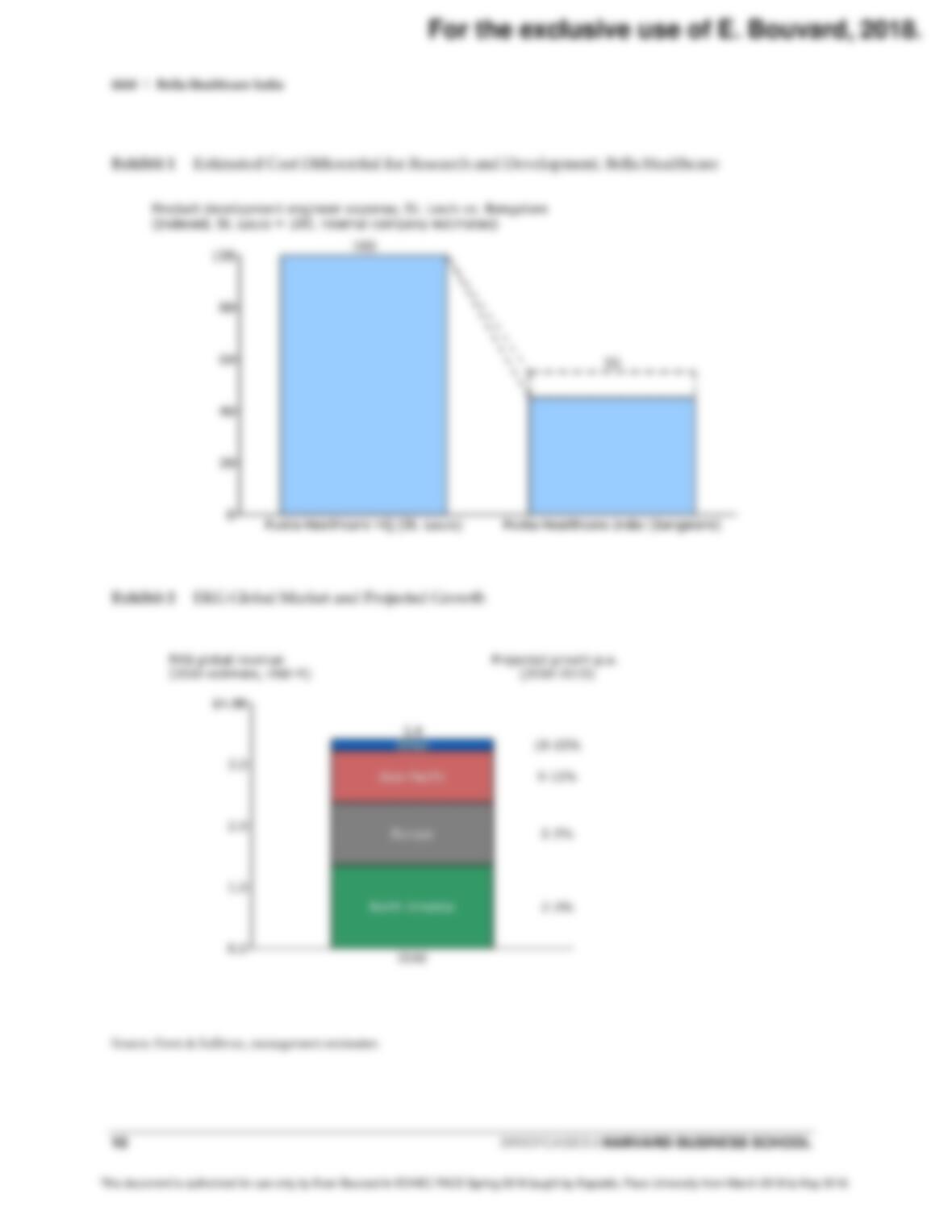
development responsibilities. Headquarters recognized the opportunity to spend its R&D budget
more efficiently and agreed (see Exhibit 1 for estimates of cost differential between Bella India and St.
Louis). Jeremy Manning, an electrical engineer with over 10 years experience in both product
development and manufacturing, moved to Bangalore to help Cherian establish the R&D team.
Although he was initially hesitant about the move to Bangalore, he found himself impressed with the
talent on the team and excited about the potential:
We all knew about the great engineering talent coming out of India, and we had seen what
they could do in manufacturing and incremental cost-cutting. In Bangalore, I found a really
sharp, motivated team with tremendous latent talent. They had proven themselves in
manufacturing and cost engineering. My charter was figuring out how to help Bella India now
develop a world-class R&D capability, starting with the “D” – development.
The first project for Bella India’s fledging R&D team would be to develop the Fiit X17, the next
generation of Bella’s ambulatory blood pressure monitor. Manning and Cherian believed it was an
ideal choice. The device was less complicated than an EKG, reducing the chance of major setbacks,
but it would still give the team a chance to go through the product development experience. Cherian
recalled:
For the exclusive use of E. Bouvard, 2018.