Basic Econometrics – Chapter 2 –
Exercise 2
Chapter 2: Two variable regression analysis: Some basic ideas
Both equations are linear and these equations will be used in the build up to the definition of the
“linear” regression equation.
Exercise 2.1
What is the condition expectation function or the population regression function?
A: It is a function which tells how the mean or average of a population (Y) is related to the
explanatory variables (X).
Exercise 2.2
What is the difference between the population and sample regression functions? Is this a distinction
without difference?
A: The sample is supposed to represent the population.
Exercise 2.3
What is the role of the stochastic error term \(u_i\) in regression analysis? What is the difference
between the stochastic error term and the residual error \(u_i\)?
A: The stochastic error term is supposed to signify the amount of error in the explanatory variables. If
the stochastic error is high it means that there are other terms which must be introduced to explain
the dependent variable. The residual error on the other hand is the error caused by taking a sample
of the population. Higher the residual error means the sample is not truly representitive of the
population.
Exercise 2.4
Why do we need regression analysis? Why not simply use the mean value of the regressand as its
best value?
A: In actual data we never get the mean of the regressand. We rather get samples which may be
close or far away from the mean so it may be uncertain as to the sample value. Regression analysis
is required to estimate to some degree the closeness of the data to the population.
Exercise 2.5
What do we mean by a linear regression model?
A: A model which may be linear or non-linear in variable but strictly linear in parameters is a linear
regression model. It explains the dependent variable using explanatory variables with linear
parameters.
Exercise 2.6
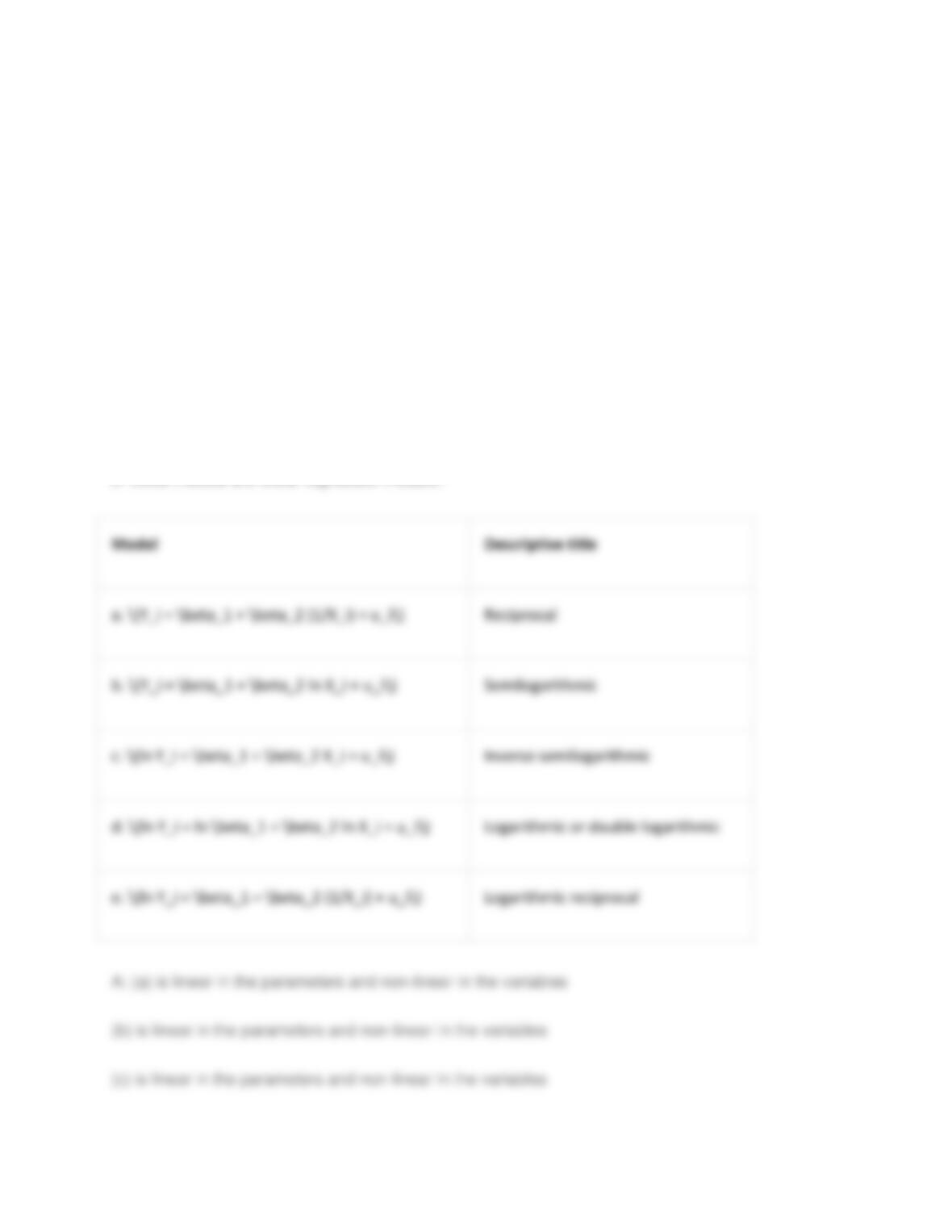
Determine whether the following models are linear in the parameters or the variables or both. Which