Chapter-01: introduction & environment
1. Definition of accounting 1.1*
Ans- Accounting may be defined as the process of recording, classifying, summarizing and
interpreting the financial transactions and communicating the results there of to the persons
interested in such information.
FASB -accounting is the service activity of financial recording and reporting.
2. Functional & operational definition of accounting/ Functional & operational activities
1.14
Ans-
Functional -Recording of transaction. Classific and posting of transaction, summarizing of
financial result, determining financial result. Exhibition of the financial position, communicating
the financial information, analysis of financial position
Operational- policy formulation, preparation of budget, cost control,
Evaluation of performance, prevention of errors of fraud, sources of fund,
A. Give the operational and functional definition of accounting
Functional accounting is a method of accounting that is based on the organization’s major types of activities, primarily (a)
program or mission-based services and (b) supporting services such as administration, governance and fund development.
Functional accounting allows you to identify three key characteristics of every dollar coming into and going out of the
organization:
Dollars coming in (income)
Dollars going out (expense)
Who
Who is providing the dollar (i.e., the specific
funder)
Who is paying for an expense (i.e., the specific
funder)
What
What type of income it is (e.g., grant, contract,
earned, etc.)
What the dollar will be spent on (e.g., payroll,
supplies, etc.)
Why
Why they are providing the dollar (i.e., for which
program or purpose)
Why the dollar is being spent (i.e., for which
program or purpose) Administrative and
Fundraising would be a Why as well.
3. How accounting ensure accountability (qp-43)
Ans-expenditure and success and failure ensure by-
A. Business organization
1. Management
2. Owner, shareholder
B. Non business organization
1.school, hospital, religious organizations
C. govt to public
4. What do mean by Comparability and consistency. Distinguish between them 1.53
Financial statements of one accounting period must be comparable to another in order for
the users to derive meaningful conclusions about the trends in an entity’s financial
performance and position over time
consistency is use of similar accountancy policies over a period of time. Always FIFO or
always LIFO.
If consistency exists then comparability is possible.
Convention of Consistency
According to this convention accounting principles and methods should remain consistent from
one year to another. The rationale for this concept is that changes in accounting treatment
would make the Profit & Loss and Balance Sheet unreliable for end users. This enables
comparison of performance in one accounting period with that in the past. For example there
are several methods of providing depreciation on fixed assets i.e. fixed installment method,
diminishing balance method etc., But it is expected that the business entity should be
consistent to follow accounting method.
Convention of comparability
Comparability is not an accounting principle. Instead, it is just one of several criteria that is
needed in order for accounting information to be useful to various groups.
Comparability implies the ability for users to be able to compare similar companies in the same
industry group and to make comparisons of performance over time. Much of the work that
goes into setting accounting standards is based around the need for comparability.
5. what is GAAP / principles of accounting /Accounting assumptions / constrain of
accounting / constrain of accounting principles 1.18
Ans-
Generally accepted accounting principles refer to the standard framework of guidelines
for financial accounting used in any given jurisdiction; generally known as accounting
standards or standard accounting practice. These include the standards, conventions, and
rules that accountants follow in recording and summarizing and in the preparation of
financial statements.
• Assumptions
– Economic or Business Assumption
-Going concerns Assumption
-Monetary Unit Assumption
– Periodicity Assumption
• Principles
– Historical cost principle
general concept that you should only record an asset, liability, or equity investment at its original acquisition
cost
– Revenue recognition principle
revenue recognition principle (which states that revenues should be recognized when they
are earned, no matter when cash is received
– Matching principle
Matching principle requires that the expenses should be matched with the revenues generated in the relevant
period
– Full disclosure principle (BANGLA 11)
• Constraints
– Cost-Benefit Relationship Constraint (Overall, the costs of providing the information would
exceed the benefits of so doing, thereby violating the cost-effectiveness constraint)
– Materiality Constraint (The accountant should attach importance to material details and ignore
insignificant details.)
– Industry Practice Constraint
Different Industry Use Their Own Accountin Process Ignoring Gaap- Rail, Bank, Insurance Etc
– Conservatism Constraint (According to this convention, in the books of accounts all anticipated losses
should be recorded and all anticipated gains should be ignored.)
6. describe to GAAP that is related to adjusting accounts
– Historical cost principle
– Matching principle
B. ‘Adjusting entries are required by the matching principles of accounting’– do you agree? Explain
Adjusting entries ensure all transactions and events are recorded in compliance with the matching principle.
The matching principle requires revenues and expenses to be properly matched in the same time period.
Once revenue has been recognized in an accounting period, expenses incurred to generate that revenue need to be recorded in
the same accounting period.
Revenue and expense are recorded when events take place, whether cash has been paid/received or not.
C. “Adjusting entries are required by cost principle of accounting”– Do you agree? Explain.
This adjusting entry allocates the historical cost of depreciable assets to depreciation expense, thereby matching the cost of the
asset to revenue over the estimated useful life of the asset.
D. What are principles relating to adjusting journal?B+C
Adjusting Entries are necessary when accrual basis accounting is used.
Adjusting entries allow businesses to adhere to the Matching Principle
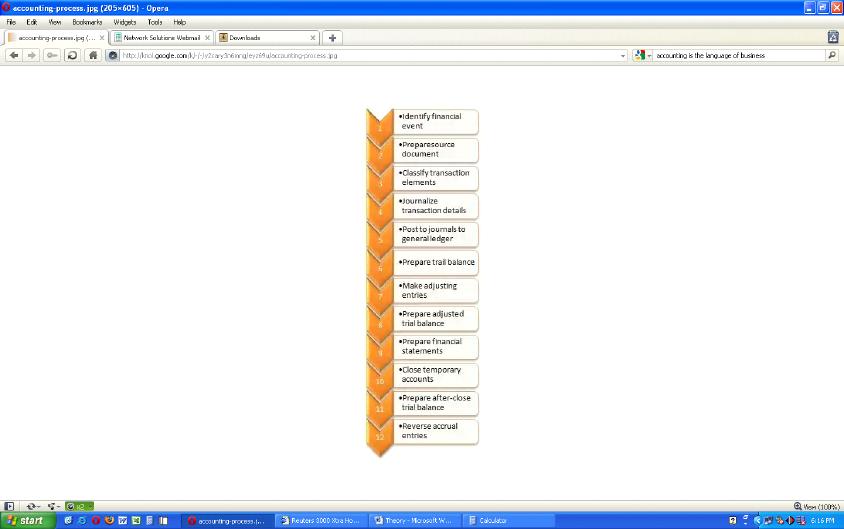
7. what are the basic steps of recording process (পৃ–১৭৮)*p-20
-Determination of debit & credit
-Journalizing
-Posting the ledger
*Asset, liabilities, income, expenditure ledger
-Preparing trial balance
-Preparing adjusted trial balance
– preparing financial statement like-Income Statement, Owner’s Equity
Statement, Balance Sheet Cash Flow Statement
–closing entries
-after close trial balance
-reverse entry
Ans-
8. when going concern does not work (1.44)
For accounting purposes, the going concern assumption states that the financial activities
of a business are assumed to be in operation for an indefinite period of time. This allows
a business to operate with a view towards a long term. This is a very critical assumption
as it provides that there is no short term end point in which all assets need to be sold and
all debt must be paid off. Thus, the going concern assumption makes it possible to
depreciate or amortize assets because we assume that businesses will have a long
life. For example, if the coffee house was going to be sold, its assets would be valued at
their disposal or liquidation value (sales price less expense of disposal). Under the
going concern assumption, the coffee house values its assets at their original cost. As we
can see, the going concern assumption is only inapplicable when business
liquidation is imminent, and it should be used in all other business situations.
General purpose financial statements are prepared on a going concern basis, unless
management either intends to liquidate the entity or to cease operations, or has no
realistic alternative but to do so. Special purpose financial statements may or may not be
prepared in accordance with a financial reporting framework for which the going
concern basis is relevant (for example, the going concern basis is not relevant for some
financial statements prepared on a tax basis in particular jurisdictions). When the use of
the going concern assumption is appropriate, assets and liabilities are recorded on the
basis that the entity will be able to realize its assets and discharge its liabilities in the
normal course of busines
9. Types of account ( ha-3.9)
– Asset, liabilities, income, expenditure account
10. Role of accounting in an organization (p-13)
Ans- (i) Provides Complete and Systematic Record: In business there are so many transactions therefore it is not possible to
remember all transactions. Accounting keeps a systematic record of all the business transactions and summarized into financial
statements.
(ii) Information Regarding Financial Position: Accounting provides information about the financial position of the business by
preparing a balance sheet at the end of each accounting period.
(iii) Helpful in Assessment of Tax Liability: Accounting helps in maintaining proper records. With the help of these records a
firm can assessed income tax of sales tax. Such records are trusted by income tax and sales tax authorities.
(iv) Information Regarding Profit or Loss: Profit & Loss Account is prepared at the end of each accounting period to know the
net profit earned or net loss suffered at the end of each accounting period.
11. Relation of accounting with other discipline. (p-15)
Management, economics, mathematics, statistics, computer science,law, political
science
Ans- Accounting and economics:
There exists an undeniable link between these two disciplines. In fact, many of the basic concepts of economics are derived
from accounting practices and many accounting practices are done in an attempt to answer what are fundamentally economic
questions. They both study the operations of the firms; they both are concerned with such concepts as income, expenditure,
profits, capital, value and prices. Both the subjects are of mutual help. Accounting makes the use of the principles of
economics in solving most of its problems and in its turn helps economics to make its studies realistic by supplying accounting
information for the purpose of generalization.
Accounting and mathematics :
The mathematical orientation of accounting is explicit from this basic fact that accounting practices in double entry or any
other form is impossible without having a number system and the knowledge of counting. The system of counting which is at
the base of mathematics is also a prerequisite for accounting. But mathematics does not comprise counting alone. It is a logical
system that expresses all phenomena within a number system; mathematics provides the necessary logical tool to explain a
given phenomenon. In much the same way accounting also involves expressing the economic phenomena within the number
system of mathematics. Mathematics only provides the tools that is to be used for the purpose of accounting measurement
and reporting of economic events. The tools of mathematics improves the measurement techniques of accounting and its
decision making ability.
Accounting and statistics:
Statistics may be defined as the scientific method of dealing with quantitative information. It’s purpose is the collection,
presentation, analysis and interpretation of numerical data. In much the same way, accounting is a quantitative method that
deals with economic events within a set of previously agreed concepts and postulates to aggregate classify and summaries
information of financial character for the purpose of taking vital economic decisions. Thus, in both cases statistics and
accounting are in agreement with each other since they both aim at measurement and interpretation of quantitative data for
the purpose of analysis and decision-making. Besides, accounting directly uses many statistical techniques. The most
common of statistical techniques that are found in use in solving accounting problems are the ratios, various types of charts
and diagrams in the analysis of published accounts. But the most important statistical technique that is increasingly being used

in accounting now a day is the statistical decision tools for the purpose of cost control and verification and valuation of
inventories.
12. users of accounting information (p-7)*1.6
– Internal users (Primary Users) of accounting information include the following:
▪ Management
▪ Employees
▪ Owners
– External users (Secondary Users) of accounting information include the following:
▪ Creditors
▪ Tax Authorities:
▪ Investors
▪ Customers:
▪ Regulatory Authorities:
13. qualitative characteristics of accounting information /primary and secondary