Important Concepts of Banking
What is a Bank?
Ans – A Bank is a financial institution which accepts deposits from General Public, offering them some
interest and utilizing those deposits to give loans to business customers and other individual customers, at
a higher interest rate, thereby earning a net interest income.
What are functions of a Bank?
Ans – There are many functions of a Bank like:-
a) Accept Deposits from General Public
b) Giving loans to Public and Business Customers
c) Offering Credit Cards and Debit Cards
d) Providing Safe Deposit Lockers
e) Providing Payment Services in the form of RTGS/NEFT/IMPS/Drafts
f) Offering Internet Banking, Mobile Banking, ATM Services
g) Offering third party products like Mutual Funds, Life Insurance, General Insurance
What are functions of RBI?
Ans – RBI performs many functions like:-
a) RBI is the issuer of currency notes in India
b) RBI is the Banker to the Government
c) RBI is Banker of the Banks
d) RBI is the lender of the last resort for the Banks
e) RBI is the issuer of Banking and Branch license
What are the types of Deposits which a Bank can accept?
Ans– A Bank can accept 2 types of Deposits, these are:-
a) Demand Deposits
b) Time Deposits
Demand Deposits are those deposits, which a customer can withdraw from the Bank, without giving a
prior notice. Examples of Demand Deposits are:-
i) Savings Account Deposits
ii) Current Account Deposits
Time Deposits are those deposits which are placed with the Bank for a fixed time period. Examples of
Time Deposits are:-
i) Fixed Deposits
ii) Recurring Deposits
What is a Savings Account?
Ans– A Savings account is the most basic account held by an individual with the Bank, in which he keeps his
savings. The Bank offers some interest to the customer, for keeping his deposit with the Bank. The interest
offered on Savings Account Balances is calculated via Simple Interest Method. This interest is credited to
the customer’s account either quarterly or half-yearly.
A customer normally does less number of transactions in his savings account, in a month.
What is a Current Account?
Ans– A current account is that account, which is opened in the Bank for business purpose. A Bank does not
give any interest on the balances held in current account. In a current account, customers normally do
large number of transactions in a month. A current account is normally opened by Sole Proprietors,
Partnership Firms, Private Limited Companies and Public Limited Companies.
A Bank may even ask an individual to open a current account, if he/she is doing large number of
transactions in his savings account, in a month.
What is a Fixed Deposit Account?
Ans– A Fixed Deposit Account is a type of Term Deposit Account, which is held with a Bank to earn a higher
interest than a savings account. In a Fixed Deposit, a customer will place a certain amount with the Bank
for a Fixed Time Period, earning a Fixed Rate of Interest. The minimum time period of a FD for Retail
Customers is 15 days and for Corporate Customers is 7 days. The maximum time period of a FD is 10 years.
Can a FD be closed prematurely (before the maturity date).
Ans – A FD is a contract between the Bank and the Customer, which a Bank cannot break. The Bank will
have to honor the FD commitment, till the maturity date.
However, the customer is given the option to prematurely close the FD, in-case he wants his funds back,
before the maturity date. If a customer does so, then he will have to give a penalty in the form of interest
of 1-2%.
What is a Recurring Deposit?
Ans – A recurring deposit is the type of time deposit, in which, customer places the money in the bank
fixed intervals like monthly installments. The customer will select the monthly amount and the time
period of the Recurring Deposit. The minimum time period for a RD is 6 months and maximum time period
is 10 years.
The interest rate offered by the Bank in FD and RD is the same.
What is the difference between a FD and RD?
Ans – The Differences between a FD and RD are:-
i) In case of a FD the amount is placed one time whereas in case of RD the amount is placed in
installments.
ii) In case of FD the minimum time period is 7 days for corporate customers and 15 days for retail
customers whereas minimum time period of a RD is 6 months.
iii) A FD can be made for any number of days like 100 days, 200 days, 300 days etc whereas a RD will
always have to be in multiples of 3.
What is a Vault?
Ans – A Vault is a strong room in which money, important documents and customer’s valuables are kept. A
Vault is always inside the Bank’s Branch.
How many parties are involved in a cheque?
Ans – There are 3 parties involved in a cheque:-
i) Drawer – Is a person who has written the cheque, basically he is the account holder
ii) Drawee – Drawee is always the Bank, who pays the cheque amount
iii) Payee – Payee is always the beneficiary of the cheque
What is RBI’s Clean Note Policy?
Ans – RBI’s clean note policy says that clean and good quality notes should be made available to the
general public. For this RBI has issued some guidelines:-
i) Do not staple the notes
ii) Do not write anything on the note, especially on the watermark
iii) Do not put rubber stamp on the note
iv) Do not use the notes to make garlands and use them in social events
What is Bait Money?
Ans – Bait Money is a security feature used in the Bank. It is a bundle of notes which are kept at the cash
counter, whose serial numbers are already noted in a separate register or the photocopies of such notes
are taken. In case there is a robbery in the Bank and the bait money is taken by the robbers, then the
detail of those notes are forwarded to the police, for tracking of the thief’s.
The teller needs to ensure that the bait money is not given to the normal public, as this would defeat the
purpose of the bait money and in-case this is done by mistake then new bundle of notes needs to be kept
as bait money.
What is Fake Note Impounding?
Ans – Fake Note Impounding refers to the steps taken by a Teller, in case a fake note is detected at the
Bank. The various steps are:-
i) Do not return the fake note to the customer
ii) Do not give the credit of the fake note to the customer
iii) Put a “Fake Note” stamp on that note
iv) Make the entry of that note in a Fake Note Register
v) Give an Acknowledgement Receipt to the customer, specifying that a fake note has been detected from
him.
In case 5 or more Fake Notes are detected from a single customer in a day, then a FIR needs to be lodged
with the nearest Police Station.
What are the various Payment Mechanisms in India
Ans – The various payment mechanisms in India are broadly classified into 2 categories
i) Paper Based Payments
ii) Electronic Payments
Paper Based Payments types are Cheque and Draft
Electronic Payment types are RTGS, NEFT, IMPS
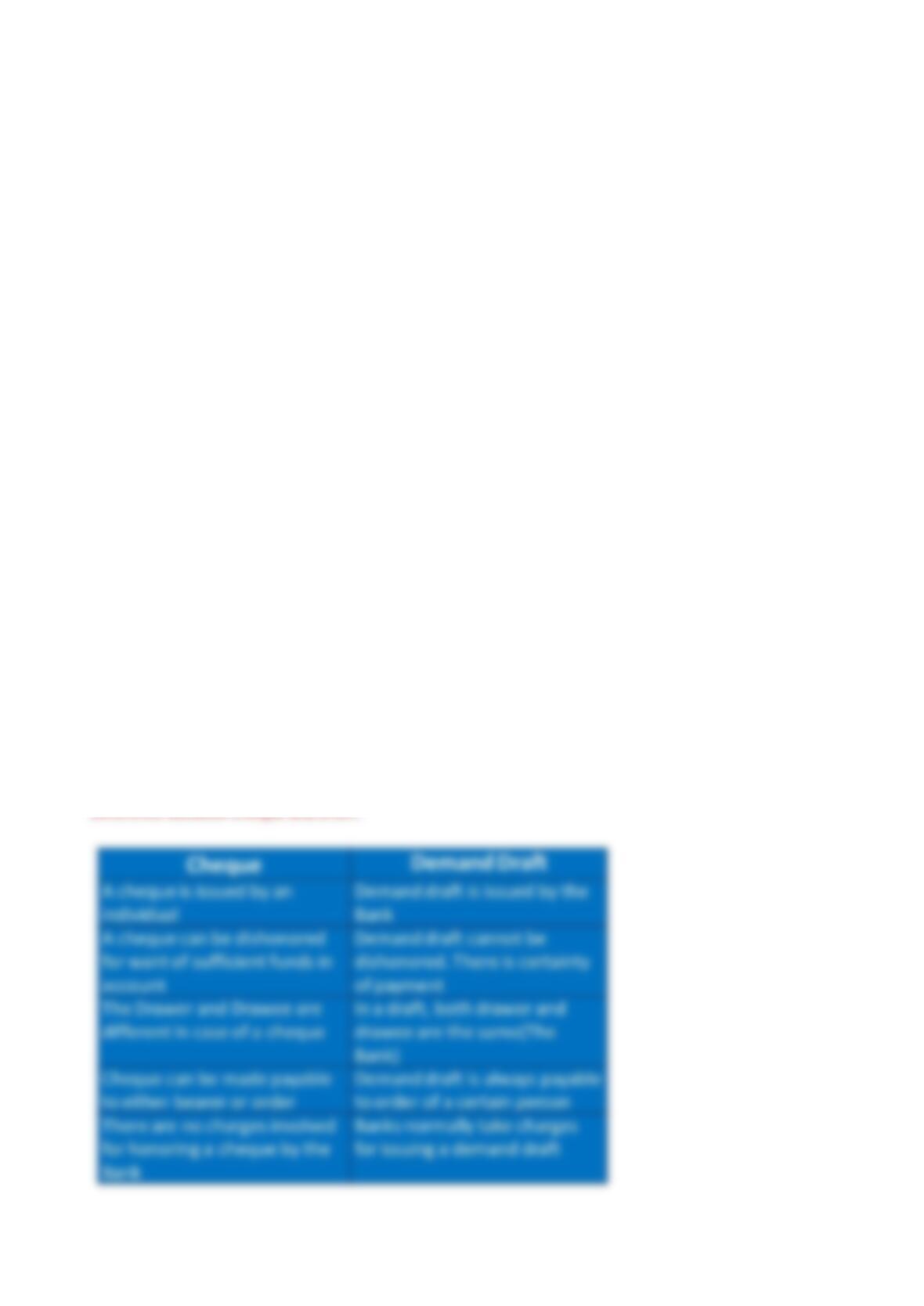
What is a cheque?
Ans – A cheque is a payment instrument that is issued by a bank account holder for making payments to an
individual or company or cash withdrawals from the bank.
A cheque gives an unconditional order to a bank to pay the amount mentioned on the cheque to a person,
who presents the cheque either at cash counter or via clearing.
What is a Draft?
Ans – A Draft is a paper based instrument, similar to a cheque, however a draft assures that the amount
mentioned on the instrument will always be paid, as a draft cannot bounce. A draft is issued by a Bank on
behalf of the customer, which assures payment to the beneficiary.