

Page87
Conservation of wild and cultivated fruits resources of
Bangalore urban
Nandini N1, Shiddamallayya N2҉
1. Survey of Medicinal Plants Unit, National Ayurveda Dietetics Research Institute, G.C.P. Annexe, Ashoka Pillar, Jayanagar 1 st Block, Bangalore
– 560011; Karnataka, India; Email: nandu.swamy87@gmail.com
2. Survey of Medicinal Plants Unit, National Ayurveda Dietetics Research Institute, G.C.P. Annexe, Ashoka Pillar, Jayanagar 1 st Block, Bangalore
– 560011; Karnataka, India; Email: snmathapati@gmail.com
҉Corresponding Author: Survey of Medicinal Plants Unit, National Ayurveda Dietetics Research Institute, G.C.P. Annexe, Ashoka Pillar,
Jayanagar 1st Block, Bangalore – 560011; Karnataka, India; Email: snmathapati@gmail.com
Publication History
Received: 10 November 2014
Accepted: 27 December 2014
Published: 28 January 2015
Citation
Nandini N, Shiddamallayya N. Conservation of wild and cultivated fruits resources of Bangalore urban . Species, 2015, 12(35), 87-91
ABSTRACT
Since beginning of life, plants have been playing a significant role in every activities of an individual to fulfil the basic necessities of life. An
increasing population in poor and under – developed countries were mainly dependent on available food resources to fulfil their regular foo d
requirements. In the diet varieties of fruits were obtained from wild and cultivated resources used since prehistoric civilis ation of humans
which are being contributing basic nutrients to each and every individual to lead healthy life. The present young er generations of urban
populace were highly concentrated towards the traditional low calorie food to prevent stress related disorders, instead of de pending on
Western instant food. The complete literary and field studies have been carried out in the field of wild and cultivated fruits used as raw/boiled
to battle against malnutrition observed in the young and old generation of urban populace of Bangalore. This concept serves t he purpose of
sustainable use of wild and cultivated fruits for proper dietary requirements of young and age old individuals of the city by adding new wild
edible nutrient fruit resources, which are natural, safe and chemical free to the traditional recipes in regular family diet for the benefit of urban
society. The study deals with 50 fruit yielding plants are can be grown in the kitchen and public gardens, amusement parks and barren lands
adopting modern techniques. It also conserves soil erosion, checks pollution and add crown to the city as a Garden city of Ba ngalore. The
present research work gives massive information on wild and cultivated fruits resource plants of Bangalore urban. This is an attempt of
enlisting of 51 wild and cultivated fruits resources plant species belonging to 38 genera of 27 families were conventionally utilised as wild and
cultivated fruits as basic food sources for the benefit of present and future generations of urban populace of Bangalore.
Keywords: Conservation, Wild, Cultivated, Fruit, Bangalore
Species ANALYSIS
International Daily Journal for Species
ISSN 2319 – 5746 EISSN 2319 – 5754

Nandini and Shiddamallayya,
Conservation of wild and cultivated fruits resources of Bangalore urban,
Species, 2015, 12(35), 87-91, www.discovery.org.in
http://www.discovery.org.in/s.htm © 2015 Discovery Publication. All Rights Reserved
Page88
1. INTRODUCTION
Mother nature provided the inestimable, diversity of plants for the benefit of human beings to meet their prerequisitions in the form of food,
shelter and medicine. Food plays an important role for the beginning of every individual for the increased world population. Drastic loss due to
draught and other natural calamities to economically important agricultural crops such as cereals, pulses, vegetables and fruits creates
pressures to wild and cultivated fruits resources plants as an additional food required for the accomplishment of hunger in poor populace of
under developed countries. The native wild and cultivated fruits resource plant species attracted urban people to understand more about the
occurrence, distribution, importance and utilisation to combat food crisis. Some Wild and cultivat ed fruit resources were identified from wild,
cultivated and wild/cultivated habits, which can be traced out by following traditional knowledge to acquires new methodology of food
preparation procedure to widen the family diet for the proper nourishment. Inherent wild and cultivated edible fruit plants offer wide range of
food resources to the ancient and modern rural and urban populace to have healthy diet in day to day life. However, Bangalore urban area is
more pleasant for moderate climate, which favours the distribution of various ornamental, wild and cultivated fruits resource plant species are
observed in historical public parks, gardens, avenues, temples, markets, terrace and kitchen gardens.
Study area
Bangalore city is considered as the third largest city in India located in southern India on the Deccan Plateau. The study area found between
12.97°N 77.56E covers about 741 km of area at an elevation of 3,000 feet above sea level. The average temperature of the city is least about
15.4 °C and reach up to 36 °C and recorded an annual rainfall of 179 mm. Bangalore city has a tropical climate throughout the year and it is
more pleasant than other south Indian cities. The urban people experience more heat waves in summer and cool during the month of
December. The soil found in this zone is red, red laterite, fine loamy and clay. However, the vegetation of the area is dry and mo ist deciduous
trees. There is no rivers due to flat land but water scarcity is solved the river Kaveri and Thippagondanahalli reser voir.
Limited vegetation can be observed such as Bannerghatta National Park, Nandi hills, Lalbagh, Cubbon park, public parks are fo und in and
around Bangalore urban. The official language of the city is Kannada. The highest population observed in urban th an rural areas of Bangalore
with various religious neighbour people of north Karnataka, other states of India and also non-residential Indians for the completion of
academics and occupation. The life style of the city is varied due to the presence of vario us dwelled people. The food and the food habits have
shown drastic changes due to global exchange of food resources in and around Bangalore urban.
2. MATERIALS AND METHODS
Enlisting of Wild and cultivated fruits resource plants:
The enlisting of Wild and cultivated fruits resource plants survey have been conducted in historical public parks, gardens, waste lands, avenues,
temples, markets, terrace, kitchen gardens of residential areas and fruit markets in Bangalore city to gather the data of b otanical name,
family, habit, status, utilisation by interviewing housewives, age olds and fruits marketing people of Bangalore urban.
Authentication of Wild and cultivated fruits resource plants:
The collected data on wild and cultivated fruits resource plant species with Botanical name, family, English name, habit, status and utilisation
were identified by using available regional floristic literatures of Ramaswamy and Razi 1973, Marigowda and Krishnaswamy 1968 , Rao 2008,
Roy et al. 1998, Singh and Kumar 2012, Sharma et al. 1984, Yoganarasimhan 1996, Jain and Rao and Gurudeva 2001.
3. RESULTS AND DISCUSSION
The study shows exceptional distribution of assorted populace, culture, food habits and utilisation of wild and cultivated fr uits resource plant
species for the present and future generation of Bangalore city. The enlisting of wild and cultivated fruits resources plant species is n ecessary to
retrieve the occurrence, distribution, acclimatisation, cultivation and utilisation of commonly available wild and cul tivated fruits resource plant
species to widened the food habits to have micro and macro nutrients in the family diet to overcome malnutrition observed in women, children
and age olds of Bangalore city. Table. No.1 Demonstrated the data of botanical name, family, habit, English name, status and utilisation
observed in populace of Bangalore urban. Enlisting of 51 wild and cultivated fruits resource plant species belonging to 38 ge nera of 27 families
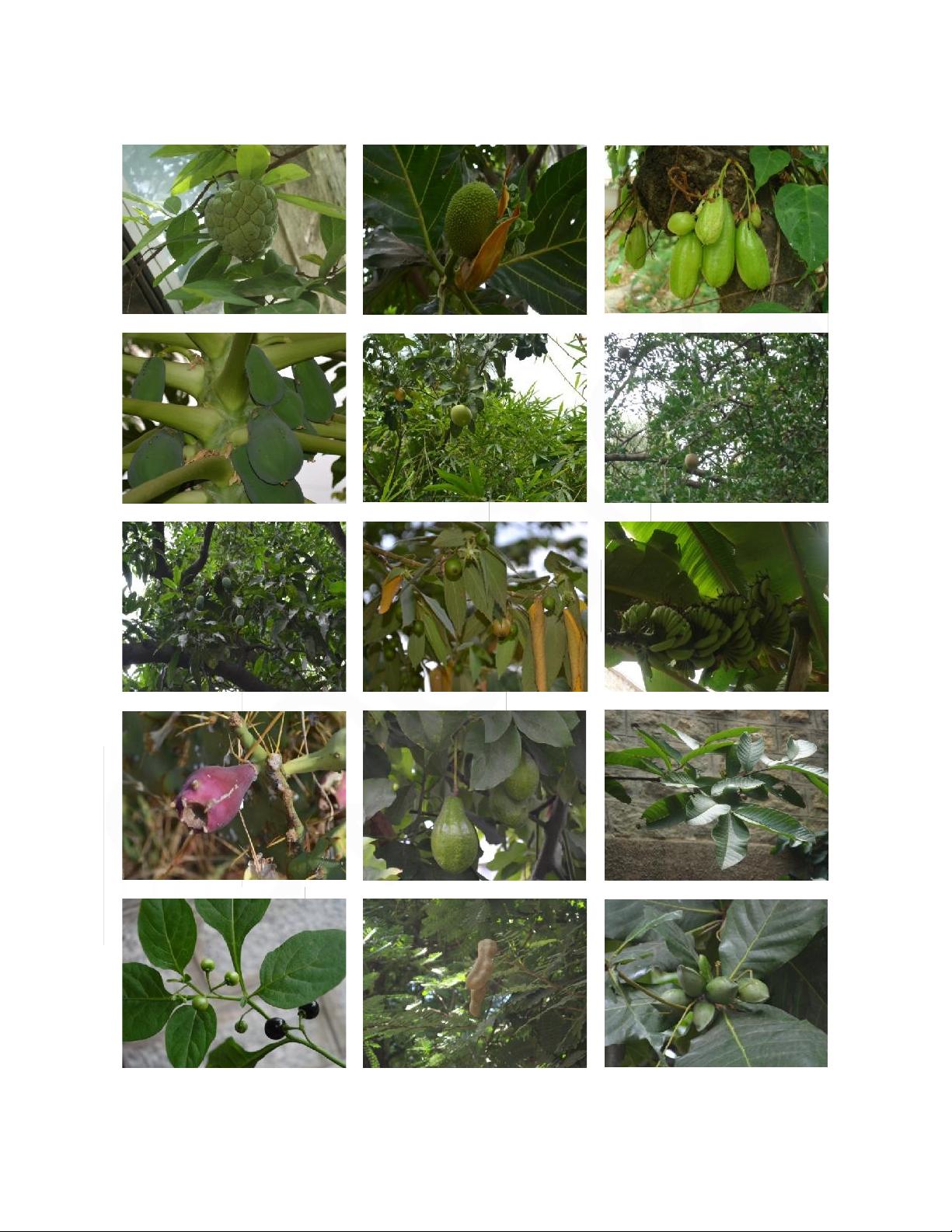
utilised as food preparation (Figure.1). The wild and cultivated fruits resource plant species found in habits such as Herbs (04), Climbers (04),
Shrubs (11) and Trees (32) of Bangalore urban (Figure. No.2). Nearly 29 fruits plant species obtained from wild, 16 from cult ivated and 06 from
wild/cultivated origin. Approximately 48 wild and cultivated fruits plants consumed as raw, 01 boiled and 02 fruits used as raw/boiled forms.
Page89
Figure 1
Wild and cultivated fruits plant resources of Bangalore urban
Annona squamosa L.
Artocarpus gomezianus Wall. ex Trecul
Averrhoa bilimbi L.
Carica papaya L.
Citrus maxima (Burm.) Osbeck
Limonia acidissima L.
Mangifera indica L.
Muntingia calabura L.
Musa paradisiaca L.
Opuntia dillenii (Ker Gawl) Haw.
Persea americana Mill.
Psidium guajava L.
Solanum americanum Mill.
Tamarindus indica L.
Terminalia catappa L.

Page90
Table 1
Conventionally used wild and cultivated fruits resource plants of Bangalore urban
Sl. No
Botanical name
Family
English name
Habit
Status
Utilisation
1.
Aegle marmelos (L.) Correa
Rutaceae
Bael fruit
Tree
Wild
Raw
2.
Anacardium occidentale L.
Anacardiaceae
Cashew nut
Tree
Cultivated
Raw
3.
Annona reticulata L.
Annonaceae
Bullock’s heart
Tree
Wild/Cultivated
Raw
4.
Annona squamosa L.
Annonaceae
Custard apple
Tree
Wild/Cultivated
Raw
5.
Artocarpus gomezianus Wall.
ex Trecul
Moraceae
Monkey jack
Tree
Cultivated
Boiled
6.
Artocarpus heterophyllus Lam.
Moraceae
Jack fruit
Tree
Wild/Cultivated
Raw/Boiled
7.
Averrhoa bilimbi L.
Averrhoaceae
Bilimbi
Tree
Cultivated
Raw
8.
Averrhoa carambola L.
Averrhoaceae
Kamaranga
Tree
Cultivated
Raw
9.
Azadirachta indica A.Juss
Meliaceae
Neem
Tree
Wild
Raw
10.
Borassus flabellifer L.
Arecaceae
Palmyra palm
Tree
Wild
Raw
11.
Carica papaya L.
Caricaceae
Papaya
Tree
Wild/Cultivated
Raw/Boiled
12.
Carissa carandas L.
Apocynaceae
Bengal currant
Shrub
Wild
Raw
13.
Citrus limon (L.) Burm.f.
Rutaceae
Lemon
Shrub
Cultivated
Raw
14.
Citrus medica L.
Rutaceae
Citron
Shrub
Cultivated
Raw
15.
Citrus reticulata Blanco
Rutaceae
Common orange
Shrub
Cultivated
Raw
16.
Citrus sinensis (L.) Osbeck
Rutaceae
Sweet orange
Shrub
Cultivated
Raw
17.
Cocos nucifera L.
Arecaceae
Coconut
Tree
Wild
Raw
18.
Cordia dichotoma G.Forst
Cordiaceae
Sebesten plum
Tree
Wild
Raw
19.
Cucumis callosus (Rottler)
Cogn.
Cucurbitaceae
Sweet melon
Climber
Wild
Raw
20.
Cucumis melo L.var. melo
Cucurbitaceae
Musk melon
Climber
Wild
Raw
21.
Dillenia indica L.
Dilleniaceae
Elephant apple
Tree
Cultivated
Raw
22.
Ficus racemosa L.
Moraceae
Cluster fig
Tree
Wild
Raw
23.
Ficus religiosa L.
Moraceae
Peepul
Tree
Wild
Raw
24.
Flueggea virosa (Roxb.ex
Willd.) Royle
Euphorbiaceae
Bush weed
Shrub
Wild
Raw
25.
Lantana camara L.
Verbenaceae
Wild sage
Shrub
Wild
Raw
26.
Limonia acidissima L.
Rutaceae
Wood apple
Tree
Wild
Raw
27.
Mangifera indica L.
Anacardiaceae
Mango
Tree
Wild/Cultivated
Raw
28.
Manilkara zapota (L.) P.Royen
Sapotaceae
Sapota
Tree
Cultivated
Raw
29.
Morus alba L.
Moraceae
Mulberry
Tree
Wild
Raw
30.
Muntingia calabura L.
Elaeocarpaceae
Jamaican cherry
Tree
Wild
Raw
31.
Musa paradisiaca L.
Musaceae
Banana
Herb
Cultivated
Raw
32.
Opuntia dillenii (Ker Gawl)
Haw.
Cactaceae
Prickly pear
Herb
Wild
Raw
33.
Passiflora edulis Sims
Passifloraceae
Passion fruit
Climber
Cultivated
Raw
34.
Passiflora foetida L.
Passifloraceae
Foetid passion
flower
Climber
Wild
Raw
35.
Persea americana Mill.
Lauraceae
West Indian
Tree
Cultivated
Raw

Page91
avocado
36.
Phoenix sylvestris (L.) Roxb.
Arecaceae
Wild date palm
Tree
Wild
Raw
37.
Phyllanthus acidus (L.) Skeels
Euphorbiaceae
Star gooseberry
Tree
Wild
Raw
38.
Phyllanthus emblica L.
Euphorbiaceae
Indian
gooseberry
Tree
Wild
Raw
39.
Phyllanthus reticulatus Poir
Euphorbiaceae
Black honey
Shrub
Wild
Raw
40.
Physalis angulata var. angulata
Solanaceae
Native
gooseberry
Herb
Wild
Raw
41.
Pithecellobium dulce (Roxb.)
Benth.
Mimosaceae
Manila tamarind
Tree
Wild
Raw
42.
Psidium guajava L.
Myrtaceae
Guava
Tree
Cultivated
Raw
43.
Punica granatum L.
Lythraceae
Pomegranate
Tree
Cultivated
Raw
44.
Solanum americanum Mill.
Solanaceae
Black night
shade
Herb
Wild
Raw
45.
Solanum rudepannum Dunal
Solanaceae
Turkey berry
Shrub
Wild
Raw
46.
Syzygium jambos (L.) Alston
Myrtaceae
Malay apple
Tree
Cultivated
Raw
47.
Syzygium cumini (L.) Skeels
Myrtaceae
Black plum
Tree
Wild
Raw
48.
Tamarindus indica L.
Caesalpiniaceae
Tamarind
Tree
Wild
Raw
49.
Terminalia catappa L.
Combretaceae
Indian almond
Tree
Wild/Cultivated
Raw
50.
Ziziphus jujuba Mill.
Rhamnaceae
Red date
Shrub
Wild
Raw
51.
Ziziphus nummularia (Burm.f.)
Wight & Arn.
Rhamnaceae
Wild jujube
Shrub
Wild
Raw
Credibility of Family:
Enlisted information of wild and cultivated fruits resource plants revealed highest number of plants f rom the family 06 from Rutaceae, 05 from
Moraceae, 04 from Euphorbiaceae, 03 from Arecaceae, Solanaceae, Myrtaceae, 02 plants from Anacardiaceae, Annonaceae, Averrho aceae,
Cucurbitaceae, Passifloraceae, Rhamnaceae and 01 plants from Apocynaceae, Cactaceae , Caesalpiniaceae, Caricaceae, Combretaceae,
Cordiaceae, Dilleniaceae, Elaeocarpaceae, Lauraceae, Meliaceae, Mimosaceae, Musaceae, Lythraceae, Sapotaceae, and Verbenaceae.
4. CONCLUSION
The wild and cultivated fruits can be used as traditional food recipes for transformation of traditional knowledge of elder generation. Few wild
fruits can be used in the preparation of jams, jellies and juice to attract present younger generation. Wild and cultivated fruits plants can be
conserved through cultivation in historical parks, gardens, avenues, temples, barren lands, terrace and kitchen gardens to obtain fresh fruits for
the day to day requirements. The proper utilisation of commonly available seasonal wild and cultivated fruits promotes health by increasing
immune system and avoids seasonal diseases. The various wild fruits from herbs and climbers can be selected for cultivation by f ollowing
scientific methods for the conservation of wild and cultivated fruits plant species for future generation.
ACKNOWLEDGEMENT
Authors are thankful for support and encouragement from SMPU incharge, Research Officer (S-3) in-charge, National Ayurveda Dietetics
Research Institute, Bangalore; Director General, CCRAS, New Delhi and Rajiv Gandhi National Fellowship funding agency, Ne w Delhi for the
financial assistance.
REFERENCES
1. M.R. Gurudev. Botanical and Vernacular names of South Indian Plants.
Bangalore, Divyaprakashana, 2001, pp: 1000,
2. S.K. Jain and R.R. Rao, A handbook of field and herbarium methods. New
Delhi, Today and Tomorrow’s Printers and Publishers, 1977. pp: 157.
3. M.H. Marigowda and Krishnaswamy. Plant wealth of Lal-Bagh, Bangalore,
Horticulture department, Lalbagh, 1968, pp: 203.
4. S.V. Ramaswamy and B. A. Razi. Flora of Bangalore district. Mysore,
Prasaranga, University of Mysore, 1973, pp: 739.
5. S.K. Rao, Indian Institute of Science Campus: A Botanist’s Delight,
Bangalore, IISC Press, 2008. pp: 244.
6. B. Roy, A.C. Halder and D.C. Pal. Plants for human consumption in India.
Flora of India, Series-4, Calcutta, Botanical Survey of India, 1988, pp: 188.
7. B.D. Sharma, N.P. Singh, R.S. Raghavan and U.R. Deshpande, Flora of
Karnataka analysis. Flora of India, Series-2, New Delhi, Botanical Survey of
India, 1984. pp: 395.
8. B. Singh and S.S. Kumar. A Textbook of Fruit Production. Uttar Pradesh,
Aman Publishing House, Meerut, 2012, pp: 203.
9. S.N. Yoganarasimhan. Medicinal Plants of India, Karnataka, Volume-I,
Dehradun, Interline Publishing Private Limited, 1996, pp: 645.