Balance of trade can be defined as the difference between what a country exports as
opposed to what they import. It can be considered a good and/ or a bad thing as the pro’s
and con’s presents themselves based on the country’s current economic situation, example
a recession or expansion. Let take Jamaica a for example, “Jamaica recorded a trade deficit
of 975800 USD Thousand in the third quarter of 2013. Balance of Trade in Jamaica is
reported by the Bank of Jamaica. Balance of Trade in Jamaica averaged -971706.72 USD
Thousand from 2003 until 2013, reaching an all time high of -496609 USD Thousand in
the first quarter of 2003 and a record low of -1764428 USD Thousand in the third quarter
of 2008. In Jamaica, trade accounts for around 50 percent of GDP. Yet, Jamaica imports
most of the goods it consumes, leading to consistent trade deficits of around 20 percent of
GDP. Jamaica is a major exporter of bauxite used for aluminum production. Other exports
include ethanol, cane sugar, alcoholic beverages, coffee, scrap metal, cyclic compounds
and manioc. Jamaica’s main trading partner is the United States (52 percent of total trade).
Others include Venezuela, Trinidad & Tobago, Canada, China, the United Kingdom, Brazil
and Japan.”
In economic the exchange of physically intangible items between countries is called
Invisible trade which can be distinguished from visible trade, which involves the export,
import, and re-export of physically tangible goods. Basic categories of invisible trade
include services (receipts and payments arising from activities such as customer service or
shipping); income from foreign investment in the form of interest, profits, and dividends;
private or government transfers of monies from one country to another; and intellectual
property and patents
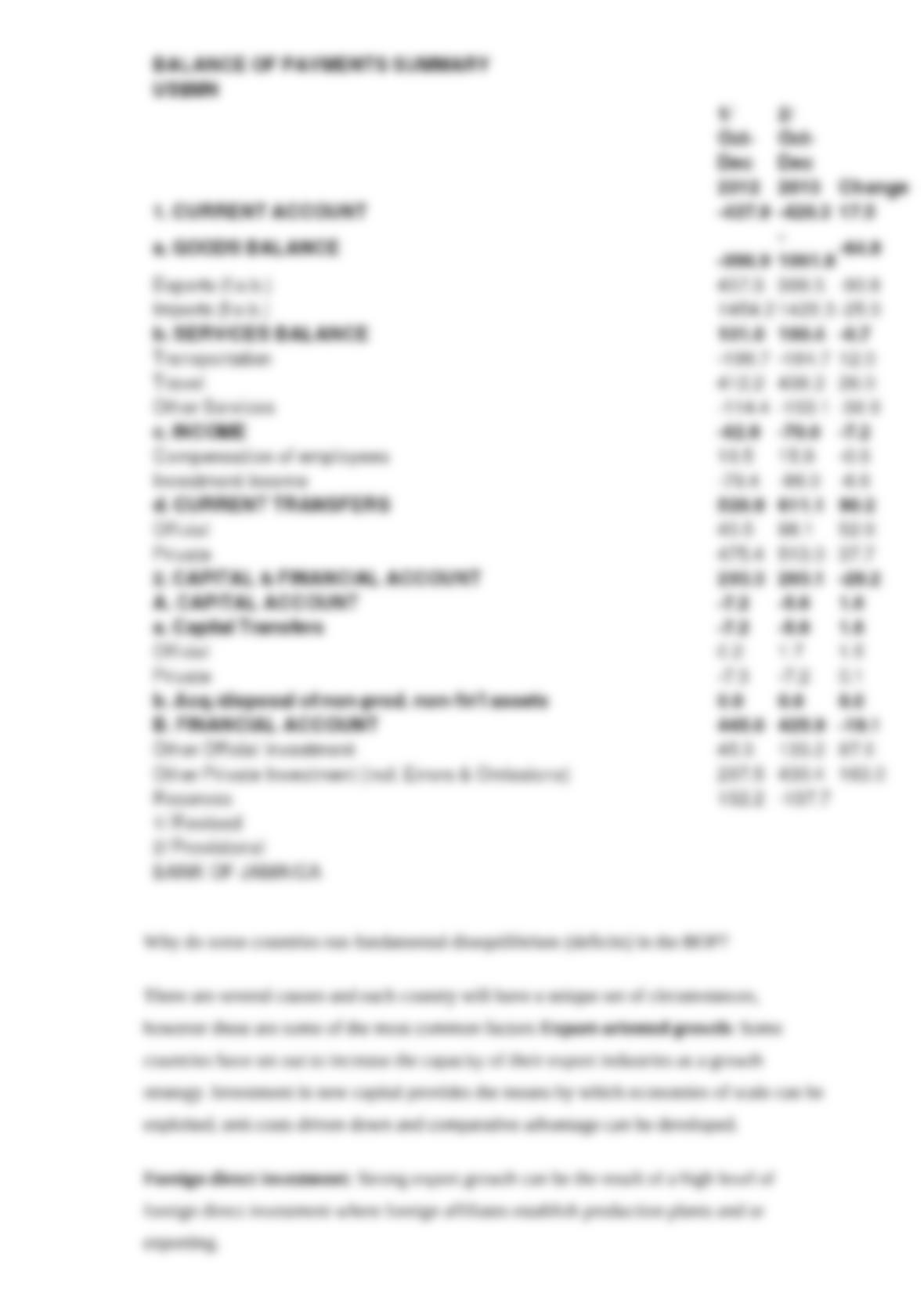
Balance of payments (BOP) is the method countries use to monitor all international
monetary transactions at a specific period of time. Usually, the BOP is calculated every
quarter and every calendar year. All trades conducted by both the private and public sectors
are accounted for in the BOP in order to determine how much money is going in and out of
a country. If a country has received money, this is known as a credit, and if a country has
paid or given money, the transaction is counted as a debit. Theoretically, the BOP should
be zero, meaning that assets (credits) and liabilities (debits) should balance, but in practice
this is rarely the case. Thus, the BOP can tell the observer if a country has a deficit or a