Bloomberg Assignment
Financial Accounting and Reporting (FAR)
MBA 1st year (2019-20)
Instructions:
1. Work on the company allotted to your group (NSE 500 Company)
2. Use Bloomberg Terminal to obtain the requisite information.
Assignment Questions:
Company Name: Hindustan Unilever Ltd.
Industry: Personal Products
Section A
Obtain the last 3 years annual financial data and answer the following questions:
i) What is the total revenue from sales/services? What is the percentage of growth/loss in
revenue from sales/services? What does this indicate about the company?
This indicates that the annual revenue of the company has increased every year since year
ending 2017. In other words, the company has been operating efficiently when it comes to
maximizing sales.
ii) What is the net profit? Compute the net profit margin over the years?
What does it indicate about the company? Does positive net profit
necessarily reflect that the company is doing well and how do we check
it? (hint: operating income)
Net Income is the profit earned by the company after deducting expenses,
Interest and taxes from the revenue earned. The net profit margin
The net profit is generally a parameter of judging how efficiently a business
is being carried out. But, this should not be the sole parameter, the profit
should mainly come from the core business of the company. In case, the
company shows any “other income” component comparable or more than
the operating income from sales/operations, then something is wrong going
within the company and with its corporate governance structure.
31–03–2017
31–03–2018
31–03–2019
Revenue from
Sales & Services
3,23,670
3,47,810
3,86,840
Y-o-Y % Growth
7.46%
11.22%
31–03–2017
31–03–2018
31–03–2019
Net Profit
44,900
52,270
60,600
Net Profit Margin (%)
13.87%
15.03%
15.67%
iii) What are the Earnings per share of the company? What does it measure?
EPS shows how much money a company makes for each share of its stock. Earnings
per share (EPS) is calculated as a company’s profit divided by the outstanding shares
of its common stock. The resulting number serves as an indicator of a company’s
profitability. he higher a company’s EPS, the more profitable it is considered.
iv) What is the difference between basic and diluted EPS?
The Basic EPS is calculated as the net income (also known as profits or earnings)
divided by the available shares. Basic EPS does not factor in the dilutive effect of
shares that could be issued by the company. When the capital structure of a company
includes items such as stock options, warrants, restricted stock units (RSU), these
investments—if exercised—could increase the total number of shares outstanding in
the market. So, companies also report the diluted EPS, which assumes that all shares
that could be outstanding have been issued.
Here, the basic and diluted EPS are equal for the 3-year period considered. This
implies that there are no shares outstanding that are convertible.
31–03–2017
31–03–2018
31–03–2019
Basic EPS
20.62
24.09
27.97
Diluted EPS
20.62
24.09
27.97
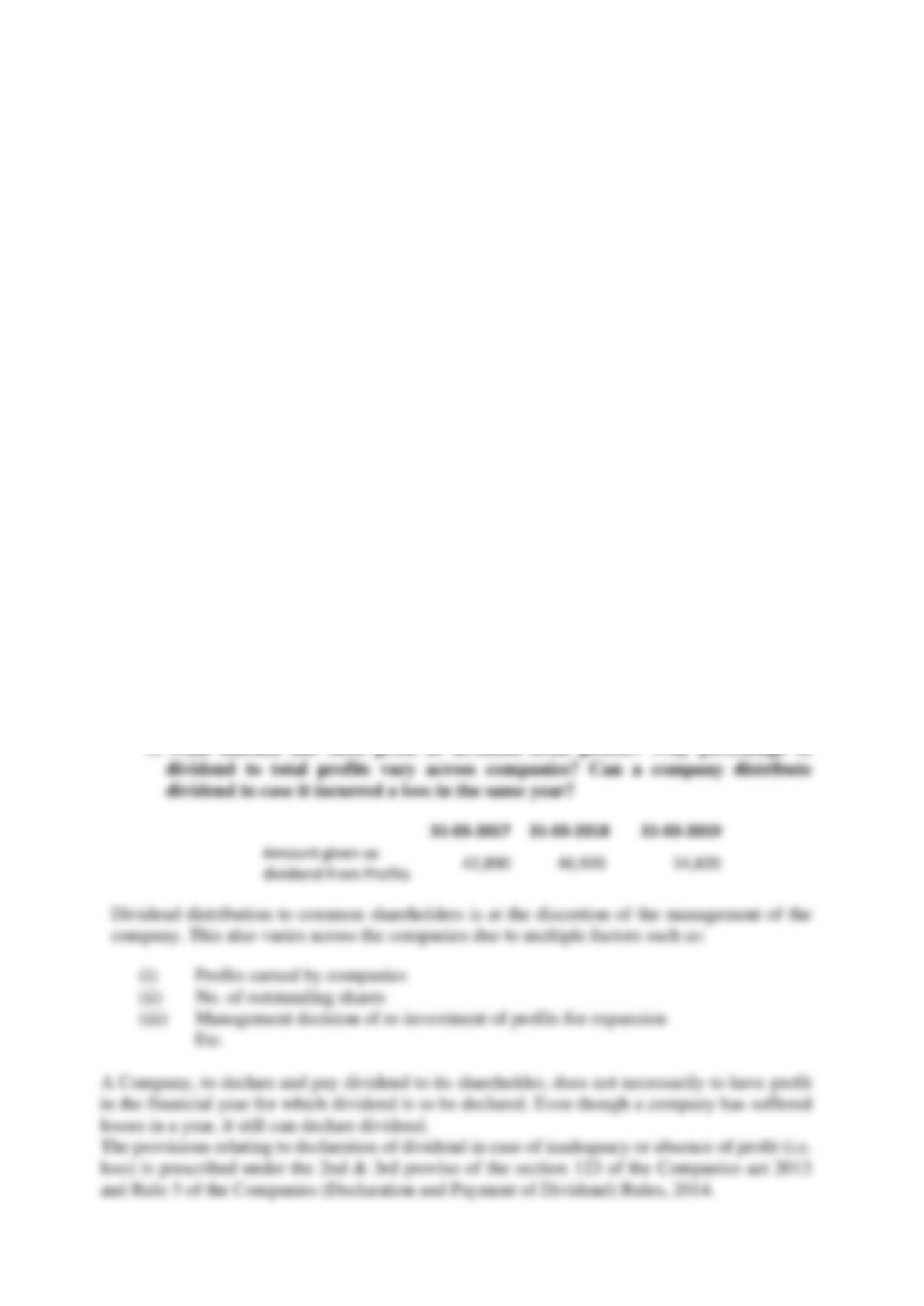
dividend from Profits