THE STUDIES OF READINESS
OF AUTONOMOUS VEHICLES
BY
MS. APHIRADEE JUNLASEVEE 6022781650
MS. KWANTANYA WONGBANDU 6022791774
MS. NUCHVARA WARASIT 6022792806
A PROPOSAL SUBNITTED IN PARTIAL FULFILLMENT OF THE
REQUIREMENTS FOR THE DEGREE OF BECHELOR OF SCIENCES
(MANAGEMENT TECHNOLOGY)
SIRINDHORN INTERNATIONAL INSTITUE OF TECHNOLOGY
THAMMASAT UNIVERSITY
ACADEMIC YEAR 2020
TABLE OF CONTENTS
Page
CHAPTER 1 INTRODUCTION 1
1.1 Problem Statement 2
1.2 Research Objectives 3
CHAPTER 2 LITERATURE REVIEWS 4
2.1 Autonomous Vehicles (AVs) 4
2.2 Four factors of readiness in Autonomous Vehicles 5
2.2.1 Infrastructure 5
2.2.2 Technology and Innovation 6-8
2.2.3 Policies and Legistration 8-9
2.2.4 Human Perception 9-10
CHAPTER 3 METHODOLOGY 11
3.1 Survey 11
3.1.1 Sample Selection 11
3.1.2 Sample Size 11
3.1.3 Questionnaires 12
3.2 Interview 12
3.2.1 Interview Format 12
3.2.2 Steps in Conducting the Interview 12-14
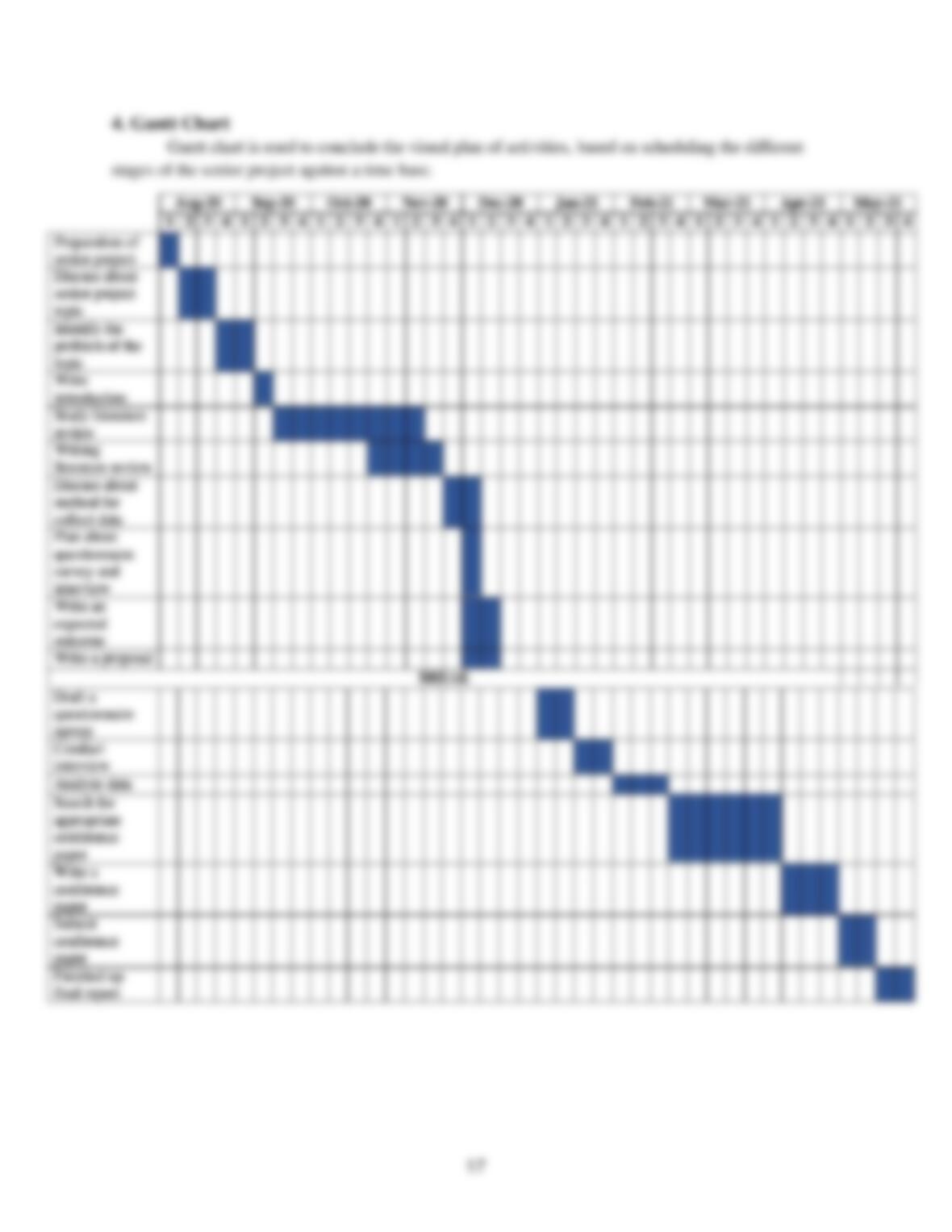
3.3 Activity Plan 15-17
3.4 Gantt Chart 17
CHAPTER 4 EXPECTED OUTCOME 18
REFERENCES 19-21
1
Chapter 1
Introduction
Autonomous Vehicles (AVs) is technology that provides the ability to radically change
transportation. Equipping cars and light vehicles with this technology will likely reduce crashes, energy
consumption, and pollution—and reduce the costs of congestion (James M. Anderson, AVs., 2016).
Autonomous Vehicle was originally envisaged as early as 1918 (Pendleton et al., 2017), and General
Motors (GM) introduced the first AVs concept in 1939 (Shladover, 2018). In the early 1950s, General
Motors ( GM) began to take attention in the areas, and a collaboration between GM and the Radio
Corporation of America (RCA) led to the development of the first autonomous full-size car in 1953. By
using a vehicle scale model and road segment, they examined how electronics could be used to steer
vehicles and maintain a safe distance from the front of the vehicle, forming the basis for autonomous driving
systems.
Behind that in 2006, Volvo began its path to autonomous driving, launching its complete
autonomous test vehicle in 2017. TESLA announced in 2014 that its car will be capable of driving on its
own about 90 percent of the time. In 2014, TESLA announced that its car will be capable of self-driving
about 90% of the time. Today, all TESLA models are equipped with self-driving capability. By 2020, Audi,
BMW, Mercedes-Benz and Nissan are expecting to have their AVs in the market. (Asif Faisal, Tan
Yigitcanlar, Md Kamruzzaman, and Graham Currie, January 28 2019)
The US National Highway Traffic Safety Administration (NHTSA) has divided the development of
self-driving cars in five levels. Firstly is Driver Assistance, Second is Occasional Self-Driving, Third is
Limited Self-Driving, Forth is Semi-autonomous Vehicles and The last is Full-autonomous Vehicles.
The World Economic Forum estimates that there will be “The Silent Revolution” on the road of the
world. In addition to electric cars becoming more prevalent by 2025, self-driving cars will increase for 2%,
and go up to 8% by 2030. If the government has implemented policies more quickly, the number of full–
autonomous cars would rise to 30% by the year 2030. (Consultancy.eu “Autonomous vehicles to drive half
of kilometres travelled in EU by 2030”,.. 2017).
Autonomous Vehicles have expanded worldwide including Thailand. Mostly involving people to
control AVs since level development of AVs is at 0 to 2. To sum up, humans still need to control vehicles
themselves along with technology for driver comfort such as adaptive cruise control, Lane Keeping and
Parking Assistance.
To conclude, Autonomous vehicles are not ready to use in Thailand due to four factors which are
infrastructure, policies and legal, technology and innovation, and consumer perception. This report will
gather information to see possibilities of AVs in Thailand. Nevertheless, Thailand needs cooperation from
every department to make AVs functional.
2
Problem Statement
Recently, In term of developing Autonomous Vehicles for use in Thailand, AVs is not very
successful due to four main factors which are infrastructure, policies and legalize, technology and
innovation, and consumer perception
First, Infrastructure, too many electric charging stations are needed for AVs. For instance, there
are approximately 19 stations for every 100 km which have a charging vehicles station in the Netherlands.
On the other hand, Thailand does not provide enough electric charging stations, they are only seen in some
shopping malls and big organizations. Furthermore, AVs technology needs good quality pavement, traffic
lights, signs, and internet speed to be activated. In particular, road roughness and clarification of lines
painted on the road including white line, broken line, and yellow lines. Sharpness of signs and extensive
traffic lights are also considered as well as the speed of internet since navigation and some functions in AVs
need steady internet connection to achieve its best performance.
Second, Policies and legal part, part one focusing on government support on using AVs in Thailand.
Readiness of Thai government to invest in AVs technology which are regulations, AVs department,
infrastructure, number of government funded AV pilots. For part two focusing on 3 branches of legal.
Third, Technology and innovation, in Thailand the development is not good because the driver is
unable to let the car drive without human intervention. To develop and study the possibilities of AVs, there
are 9 main factors which are Safety, Engineering, Computer Hardware, Software, Robotics, Security,
Testing, Human Computer Interaction, social acceptance and legal that can make a traditional car to be a
Full-autonomous vehicle in level 5. However, Thailand lacks these components.
Last, Human Perception is about how Thai people impression, awareness and consciousness about
AVs. Also includes how they are prepared for autonomous vehicles.
3
Research Objectives
In this paper, the objective is to identify readiness of autonomous vehicles in Thailand. The reader
should have gained an insight into why autonomous vehicles are going to change the world profoundly after
reading this article.
● To study autonomous vehicles from literature, journals, news , and websites.
● To collect data by questionnaire survey and interview about readiness of autonomous
vehicles in Thailand.
● To analyze the readiness of autonomous vehicles in Thailand under four factors including
infrastructure, policies and legal, technology and innovation, and human perception.
● To determine barriers and suggest policy recommendations.
4
Chapter 2
Literature Reviews
In this chapter indicated the past studies, journals, and articles from several reliable resources had
to be researched. The following report will first present the questions we want to solve in a clear and concise
manner, why we ask these questions, and why this survey and interview are beneficial. Then conduct a
literature review as a group to find the best summarization for Readiness for Autonomous Vehicles of Thai
people. It contains a comprehensive background of Autonomous Vehicles, the impact of Safety,
Technology, Social, Economic, and Current Legal structure related to the vehicles.
2.1 Autonomous Vehicles (AVs)
There is a brief survey of opportunities, barriers and policy recommendations for preparing a nation
for autonomous vehicles (Fagnant, D. J., & Kockelman, K, 2015). Moreover, the impacts and interactions
with the transportation system. They researched these areas and gave some recommendations about
nationally recognized licensing frameworks for autonomous vehicles , determining appropriate standards
for liability, security, and data protection.
The numerous technologies have been integrated to develop vehicles capable of driving in a
realistic environment. The chance for future research provides many opportunities for work in robotics,
controls, artificial intelligence and many systems. The technology give the opportunities as they develop
the next generation of robotic navigation system (Campbell, Mark ,2010)
Driver can set a destination and the car’s software calculates a route and starts the car on its way.
A rotating, roof- mounted LIDAR sensor monitors a 60-meter range around the car and creates a dynamic
3-D map of the car’s current environment. A sensor on the left rear wheel monitors sideways movement to
detect the car’s position relative to the 3-D map. Radar systems in the front and rear bumpers calculate
distances to obstacles. (Kubov and Kubaskov, 2018). In the vehicle, artificial intelligence software is
linked to all sensors and has Google Street View input and video cameras. The AI simulates mechanisms
of human vision and decision-making and monitors driving systems including steering and acceleration.
Autonomous Vehicles can classify into six different levels (ranging from none to fully automated
systems) was published in 2014 by SAE International (Society of Automotive Engineers), an automotive
standardization body, as J3016. This standard corresponds to levels defined by Germany Federal Highway
Research Institute (BASt) and roughly corresponds to National Highway Traffic Safety Administration
(NHTSA). (National Highway Traffic and Safety Administration, 2014). So here are the six levels:
Level 0 (No automation): This is where the vast majority of cars and trucks are today. The driver
handles steering, throttle, and braking (ST&B)monitoring the surroundings, as well as navigating,
and determining when to use turn signals, change lanes, and turn. But there can be some warning
systems (blind-spot and collision warnings).
Level 1 (Driver assistance): Vehicles in this level can handle S or T&B, but not in all
circumstances, and the driver must be ready to take over those functions if called upon by the
vehicle. That means the driver must remain aware of what the car is doing and be ready to step in
if needed.
Level 2 (Partial assistance): The car handles ST&B, but immediately lets the driver takeover if
he detects objects and events the car is not responding to. In these first three levels, the driver is
responsible for monitoring the surroundings, traffic, weather, and road conditions.
Level 3 (Conditional assistance): The car monitors surroundings and takes care of all ST&B in
certain environments, such as freeways. But the driver must be ready to intervene if the car requests
it.
Level 4 (High automation): The car handles ST&B and monitors the surroundings in a wider
range of environments, but not all, such as severe weather. The driver switches on the automatic
driving only when it is safe to do so. After that, the driver is not required.
Level 5 (Full automation): Driver only has to set the destination and start the car, the car handles
all other tasks. The car can drive to any legal destination and make its own decisions on the way.
(Standard SAE J3016, 2016)
2.2 Four factors of readiness in Autonomous Vehicles
Nowadays, artificial intelligence has an important role in human’s life. Whether it is the financial
industry, or even vehicles, artificial intelligence systems are used to analyze the automation of the system.
Automation systems have many advantages, including human resource management, high precision, but
automation is necessary. Through learning various functions, make the automation system as perfect as
possible.
In the year 2020, the KPMG group has been conducting studies on its availability in countries
around the world. It is based on the same criteria for assessing availability of key factors: policies and
legal, infrastructure, technology and public acceptance.
Based on assessment, the top five are Singapore, the Netherlands, Norway, the United States and
Finland from 30 countries in which autonomous vehicles are available. Most countries that are ready to