Auditing and Assurance Services, 15e (Arens)
Chapter 1 The Demand for Audit and Other Assurance Services
Learning Objective 1-1
1) The Sarbanes-Oxley Act applies to which of the following companies?
A) All companies
B) Privately held companies
C) Public companies
D) All public companies and privately held companies with assets greater than $500
million
Answer: C
Terms: Sarbanes-Oxley Act
Diff: Easy
Objective: LO 1-1
AACSB: Reflective thinking skills
Topic: SOX
2) Which of the following is considered audit evidence?
A)
B)
C)
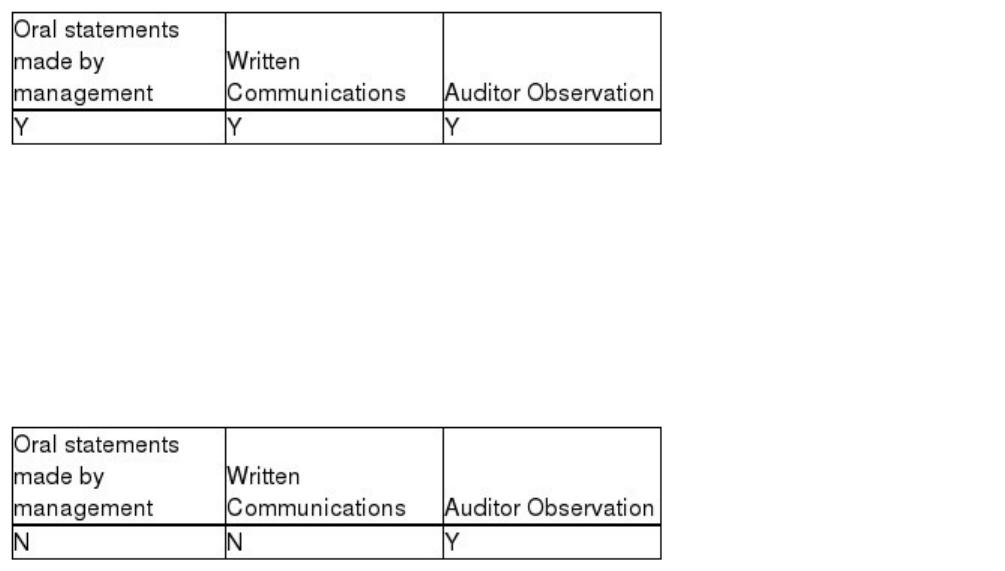
D)
Answer: C
Terms: Audit evidence
Diff: Moderate
Objective: LO 1-1
AACSB: Reflective thinking skills
3) Evidence is paramount to audit and attestation engagements. List the four basic types of
audit evidence.
Answer: The four types of audit and attestation evidence include:
1. Electronic and documentary data about transactions
2. Written and electronic communications with outsiders
3. Observations by the auditor
4. Oral testimony of the auditee (client)
Terms: Basic types of audit evidence
Diff: Easy
Objective: LO 1-1
AACSB: Reflective thinking skills
4) The criteria by which an auditor evaluates the information under audit may vary with
the information being audited.
A) True
B) False
Answer: A
Terms: Criteria which an auditor evaluates information
Diff: Easy
Objective: LO 1-1
AACSB: Reflective thinking skills
5) The criteria used by an external auditor to evaluate published financial statements are
known as generally accepted auditing standards.
A) True
B) False
Answer: B
Terms: Criteria used by external auditor to evaluate published financial statements
Diff: Easy
Objective: LO 1-1
AACSB: Reflective thinking skills
6) The Sarbanes-Oxley Act establishes standards related to the audits of privately held
companies.
A) True
B) False
Answer: B
Terms: Sarbanes-Oxley Act
Diff: Easy
Objective: LO 1-1
AACSB: Reflective thinking skills
Topic: SOX
7) The Sarbanes-Oxley Act is widely viewed as having ushered in sweeping changes to
auditing and financial reporting.
A) True
B) False
Answer: A
Terms: Sarbanes-Oxley Act
Diff: Easy
Objective: LO 1-1
AACSB: Reflective thinking skills
Topic: SOX
8) An auditor must be competent and have an independent mental attitude.
A) True
B) False
Answer: A
Terms: Competence and independent mental attitude
Diff: Easy
Objective: LO 1-1
AACSB: Reflective thinking skills
Learning Objective 1-2
1) Recording, classifying, and summarizing economic events in a logical manner for the
purpose of providing financial information for decision making is commonly called:
A) finance.
B) auditing.
C) accounting.
D) economics.
Answer: C
Terms: Recording, classifying, and summarizing economic events
Diff: Easy
Objective: LO 1-2
AACSB: Reflective thinking skills
2) An accountant:
A) must possess expertise in the accumulation of audit evidence.
B) must decide the number and types of items to test.
C) must have an understanding of the principles and rules that provide the basis for
preparing the accounting information.
D) must be a CPA.
Answer: C
Terms: Distinguishes auditors from accountants
Diff: Moderate
Objective: LO 1-2
AACSB: Reflective thinking skills
3) In “auditing” financial accounting data, the primary concern is with:
A) determining whether recorded information properly reflects the economic events that
occurred during the accounting period.
B) determining if fraud has occurred.
C) determining if taxable income has been calculated correctly.
D) analyzing the financial information to be sure that it complies with government
requirements.
Answer: A
Terms: Auditing financial accounting data primary concern
Diff: Moderate
Objective: LO 1-2
AACSB: Reflective thinking skills
4) The trait that distinguishes auditors from accountants is the:
A) auditor’s ability to interpret accounting principles generally accepted in the United
States.
B) auditor’s education beyond the Bachelor’s degree.
C) auditor’s ability to interpret FASB Statements.
D) auditor’s accumulation and interpretation of evidence related to a company’s financial
statements.
Answer: D
Terms: Distinguishes auditors from accountants
Diff: Challenging
Objective: LO 1-2
AACSB: Reflective thinking skills
5) Discuss the differences and similarities between the roles of accountants and auditors.
What additional expertise must an auditor possess beyond that of an accountant?
Answer: The role of accountants is to record, classify, and summarize economic events in a
logical manner for the purpose of providing financial information for decision making. To
provide relevant information, accountants must have a thorough understanding of the
principles and rules that provide the basis for preparing the accounting information. In
addition, accountants must develop a system to ensure that the entity’s economic events are
properly recorded on a timely basis and at a reasonable cost.
The role of auditors is to determine whether the recorded information prepared by
accountants properly reflects the economic events that occurred during the accounting
period. Because U.S. or international standards provide the criteria for evaluating whether
financial information is properly recorded, auditors must thoroughly understand those
accounting standards. In addition to understanding accounting, the auditor must possess
expertise in the accumulation and interpretation of audit evidence. It is this expertise that
distinguishes auditors from accountants. Determining the proper audit procedures,
deciding the number and types of items to test, and evaluating the results are unique to the
auditor.
Terms: Roles of accountants and auditors
Diff: Moderate
Objective: LO 1-2
AACSB: Reflective thinking skills
Learning Objective 1-3
1) ________ risk reflects the possibility that the information upon which the business
decision was made was inaccurate.

A) Client acceptance
B) Information
C) Business
D) Control
Answer: B
Terms: Risk that reflects the possibility that information upon which business risk decision
was made
Diff: Moderate
Objective: LO 1-3
AACSB: Reflective thinking skills
Learning Objective 1-4
1) A correct relationship among the auditor, the client, and the external users is:
A) management of a public company hires the independent auditor.
B) the audit committee of a private company hires the independent auditor.
C) the client provides capital to the external users.
D) the external users can rely upon the auditor’s report to reduce information risk.
Answer: D
Terms: Relationships among auditor, client, and external users
Diff: Moderate
Objective: LO 1-4
AACSB: Reflective thinking skills
2) The most common way for users to obtain reliable information is to:
A) have an internal audit.
B) have an independent audit.
C) verify all information individually.
D) verify the information with management.
Answer: B
Terms: Reducing information risk
Diff: Moderate
Objective: LO 1-4
AACSB: Reflective thinking skills
3) Explain what is meant by information risk, and list the four causes of this risk.
Answer: Information risk reflects the possibility that the information upon which the
business risk decision was made was inaccurate. Four causes of information risk are:
• remoteness of information,