QUESTION 1
A) Audit Report
1. Principle channel of communication
• It communicates the audit findings to the shareholders of the company.
• but may also be used by other users of financial statement
2. Review and evaluation report
• Audit report is the review and evaluation report resulted from the test of control
and substantive procedures that auditor has performed.
• Before issuing an audit report, auditor should access the types of audit reports to
be issued.
3. Enhance the reliability of the financial statements.
• It enhances the reliability of the financial statement because of the auditor’s
objective and independent audit opinion on truth and fairness of the financial
statements.
B) External users/Stakeholders of audit report
1. Potential investor
• To evaluate the performance of company before investing.
2. Bankers
• To evaluate the credit worthiness of the borrower before lending.
3. Shareholders
• To know the profitability of the company they owned for dividend purposes.
4. Suppliers
• To evaluate the liquidity of the company before supplying goods→ granting
credit.
5. Customer
• To evaluate the performance of the company to ensure stable supply of goods.
6. IRB
• To ensure the company pays the correct taxes.
Additional question: 2 internal users of audit report
1. Employee
• To know the performance of the company, i.e. to work in stable company with
salary and good bonus.
2. Managers
• To know the performance of the company for improvement of operation and
maximize profits.
C) Types of audit opinions
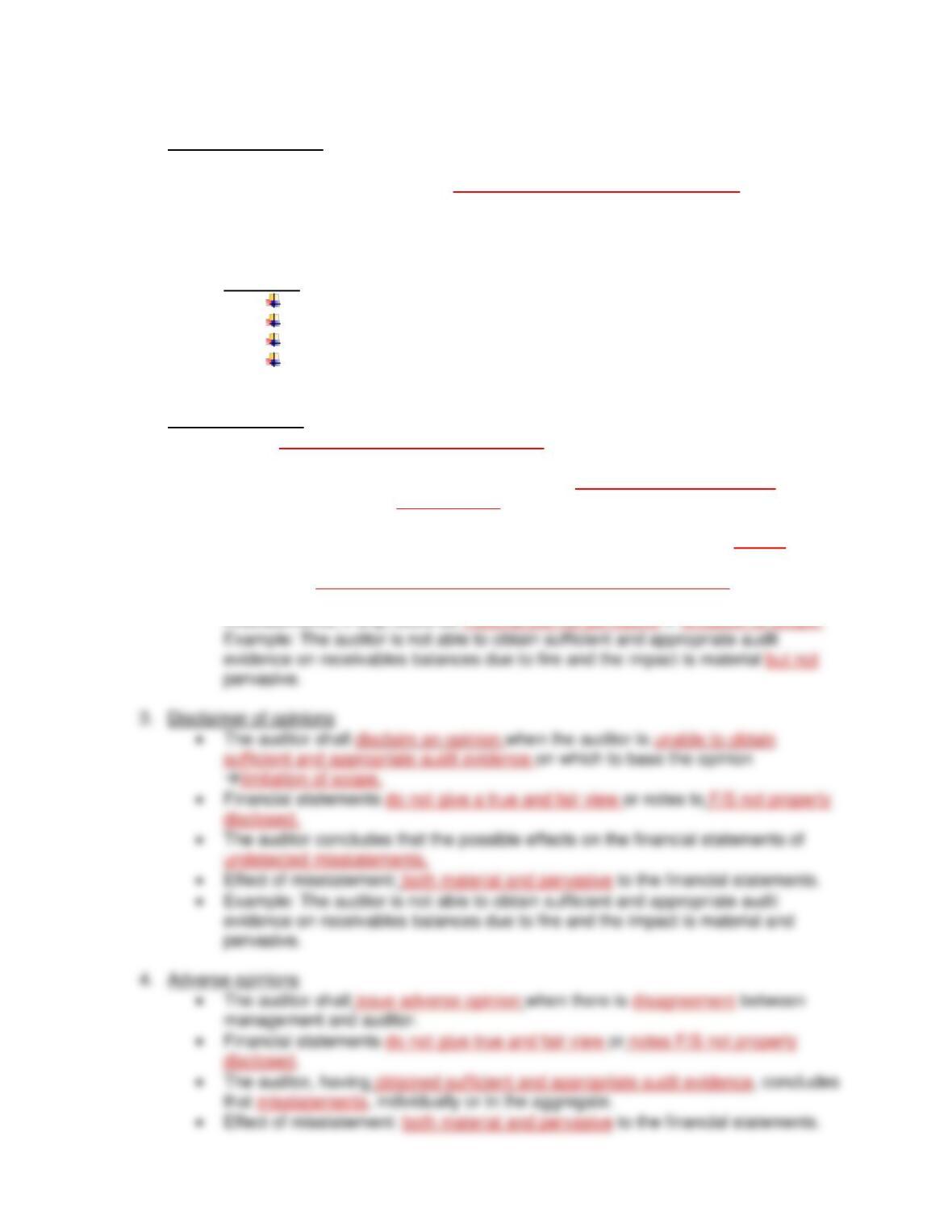
1. Unmodified opinions
• F/S show true and fair view and notes to F/S have been properly disclosed.
• Effect of misstatement of F/S: Do not contain material misstatement.
In the event the auditors wish to highlights some material matters, auditor needs
to add one paragraph, namely “Going concern” or “Emphasis of matters”. This
paragraph appears after “Independence and other ethical responsibilities”
paragraph before “Key audit matters” paragraph.
Example:
Going concern issue.
Significant related party transactions.
Major lawsuit cases.
Non-compliance with standards, but you are satisfied with the
non-compliance to the nature of business.
2. Qualified opinions
• Due to disagreement or limitation of scope and financial statements do not give a
true and fair view or no proper disclosure.
• The auditor concludes that misstatements are material, but not pervasive, to the
financial statements→ disagreement.
Example: Not agreed with accounting treatment such as depreciation, provision
for bad debts, disagreed with the lawsuit and the impact is material but not
pervasive.
• The auditor cannot obtain sufficient and appropriate audit evidence on which to
base the opinion but concludes that the possible effects of undetected