Audit Report
Global Fund Treasury Management
GF-OIG-17-01
18 January 2017
Geneva, Switzerland
18 January 2017
Geneva, Switzerland
Page 2
Table of Contents
I. Executive Summary …………………………………………………………………………………………………….. 3
II. Background …………………………..……………………………………………………………………………………. 7
III. Scope and Rating ………………………………………………………………………………………………………. 10
01 Scope …………………………..…………………………………………………………………………………………… 10
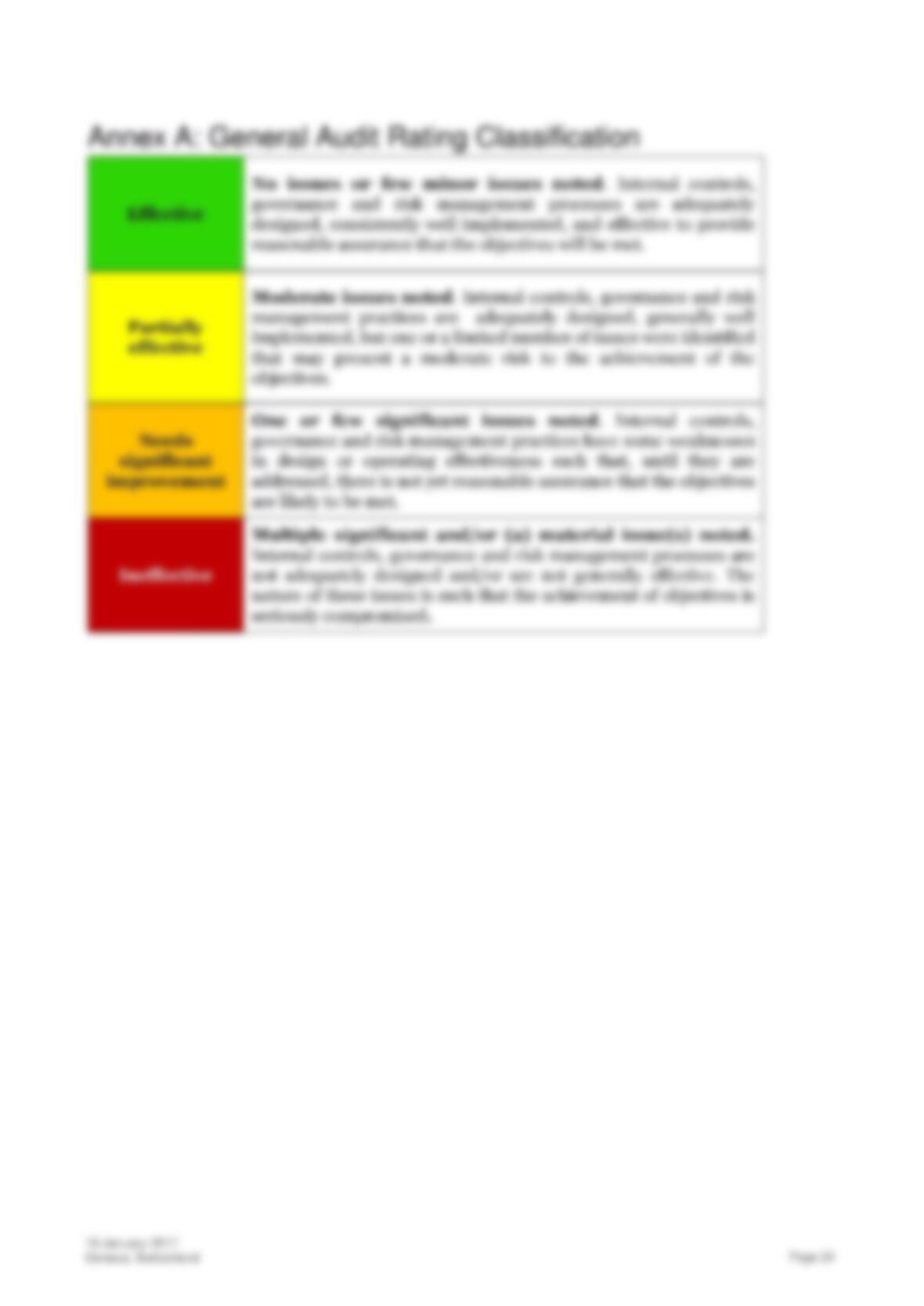
02 Rating ………………………………………………………………………………………………………………………. 11
IV. Findings and Agreed Management Actions ………………………………………………………………….. 12
01 Governance and Risk Management ……………………………………………………………………………… 12
02 Foreign Exchange Management ………………………………………………………………………………….. 16
03 Asset and Liability Management ……………………………………………………….………………………… 20
04 Cash and Liquidity Management ………………………………………………………………………………… 22
05 Investments ……………………………………………………………………………………………………………… 23
Annex A: General Audit Rating Classification ……………………………………………………………………….. 24
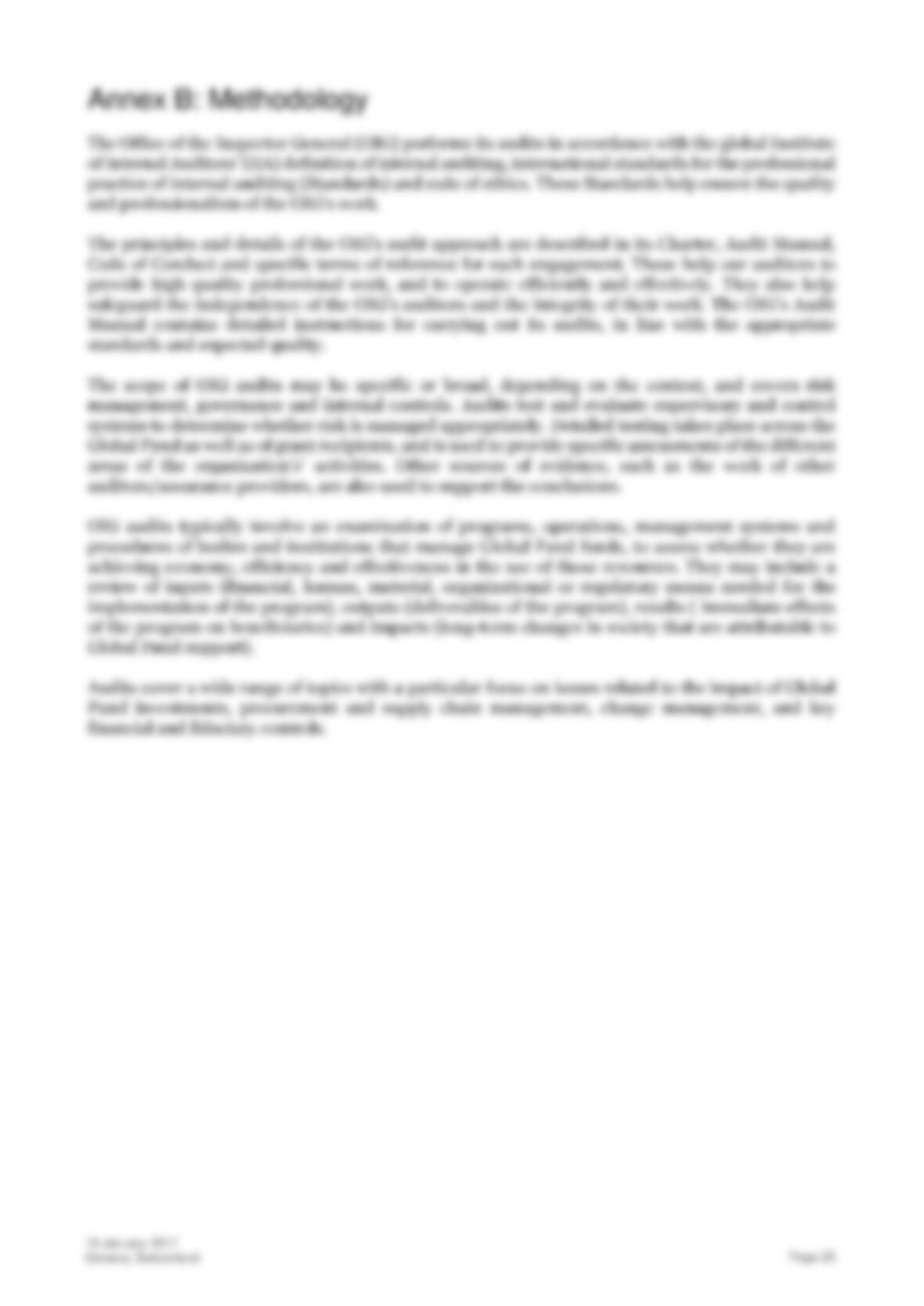
Annex B: Methodology ……………………………………………………………………………………………………….. 25
18 January 2017
Geneva, Switzerland
Page 3
I. Executive Summary
Treasury covers the management of cash and liquidity, asset and liability, foreign exchange and
investments. These activities are critical given the nature of the Global Fund multi-currency funding
model. Adequate and effective treasury management processes and controls ensure that the
organization’s financial asset are safeguarded and sufficient cash is available to disburse to
recipients. Treasury activities are therefore an essential element in mitigating the Global Fund’s
financial risks. At the same time, these activities also involve complex processes and transactions
that, if not managed adequately, can have material adverse consequences on the organization’s
financial position.
Before 2014, treasury activities at the Global Fund were mostly non-existent. Since the approval in
2014 of the amended Comprehensive Funding Policy (CFP), the Secretariat has made significant
progress in the development and implementation of a fully established and operational treasury
function with an appropriate level of people, processes and systems. Coming from a zero base, the
treasury function is fully staffed with professionals that have extensive qualifications and experience
in treasury management. The Secretariat has also significantly enhanced its ability to manage its own
grant and operational expenditure payments, with the establishment of five commercial banking
relationships. Two additional relationships are expected to be finalized by the end of 2016.
The Secretariat has ensured that the increase in its treasury activities is supported by adequate
technology such as the use of a payment processing system, which interfaces directly with the
commercial banks. Most recently, an online trading platform, which gives it access to the most
competitive prices when performing its trading activities has been introduced. The Secretariat has
also been proactive on the implementation of security controls to ensure that payments are executed
in the most secure manner.
Comprehensive frameworks have been developed to support the CFP. In particular, risk limits for
the execution of foreign exchange transactions have been defined in line with best practice through
the Global Foreign Exchange Framework. Those limits and broader portfolio monitoring are
supported by appropriate statistical tools to reduce the foreign exchange risk faced by the
organization. Within three months of the framework being approved in June 2016, the treasury team
operationalized all aspects of the framework into foreign exchange activities conducted by the Global
Fund. The treasury function is also supported by a financial services team and accounting team who
work closely to ensure that effective controls exist across the full treasury lifecycle, from trade
initiation to recording and reconciliation.
Overall, the Global Fund has established, in a relatively short timeframe, a well-functioning treasury
function. The audit did not identify any material weaknesses or process failures. Whilst some
significant risks and process improvement points which require management attention have been
identified in this report, these should be evaluated in the context of a relatively new function built
almost from scratch and still evolving.
This audit of Treasury Management sought to provide independent assurance to the Board on the
adequacy and effectiveness of the governance, risk management and internal controls over the
treasury activities. In the context of an evolving Treasury function at the Global Fund, with no
exceptions identified in the detailed audit testing performed, the OIG concludes that the governance,
risk management practices and internal controls are adequately designed and generally well
implemented.
Notwithstanding this, various issues have been identified around governance and risk management,
foreign exchange management and asset and liability management. These issues related, in
particular, to independent oversight over trading activities for foreign exchange management,
documentation of key controls, and formalization of processes. In forming its overall assessment, the
18 January 2017
Geneva, Switzerland
Page 4
OIG has considered a combination of factors, including: the nature of these issues and the risks they
present, the current level and complexity of trading activity, and the evolving nature of the treasury
function. In a different context involving a mature financial institution with more significant trading
volume using complex financial instruments, the combination of issues identified in this report (lack
of trading limits, undefined counterparty exposure limits, and non-formalized independent
oversight processes) would have been considered a significant deficiency.
However, in the specific context of the Global Fund, the OIG took into account the following factors
in its overall assessment: firstly, the treasury function, which was non-existent until recently, is still
being developed and the formalization of all processes requires time; secondly, the volume of trading
activity at the Global Fund is relatively limited and non-complex in relation to other financial
institutions. This is despite a peak of fundraising activities during a short window following the
Global Fund’s 5th replenishment in September 2016. Thirdly, OIG detailed testing of a significant
sample of transactions, representing over 20% of the value of trades, identified no material
exceptions, suggesting that controls are operating although they may not always be formalized.
Whilst the overall audit ratings reflect these factors, it is critical that the Secretariat address the
issues identified in this report and mitigate all the identified risks, as the consequences of risks
materializing in this area would most likely be material.
Governance and Risk Management
All key treasury activities are conducted within an overarching framework that has been reviewed
and approved by the Audit and Finance Committee. The framework includes appropriate financial
safeguards to protect the assets of the Global Fund. The OIG review did not identify any departures
from those safeguards and testing of controls did not result in any material exceptions. Governance
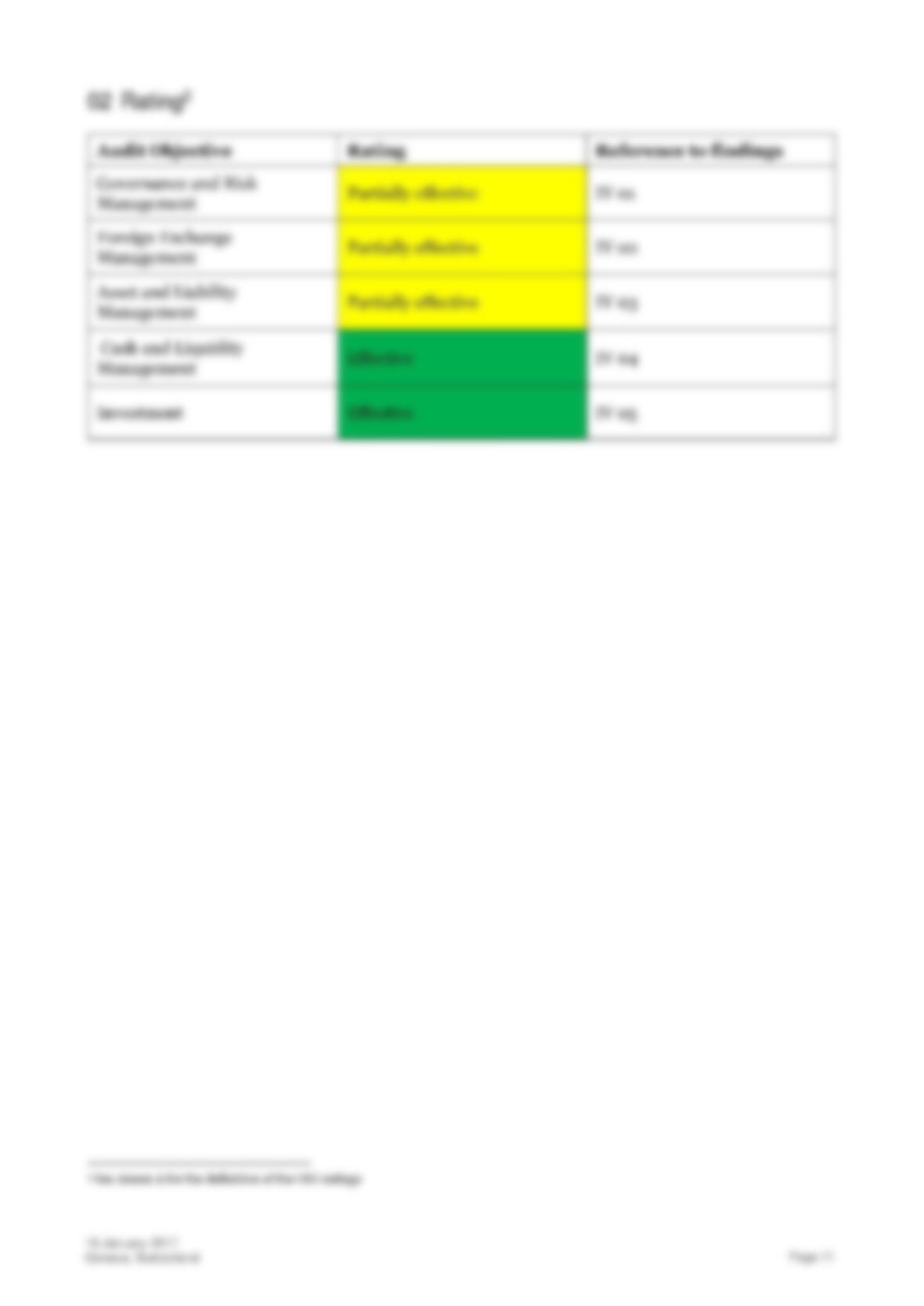
and risk management were therefore found to be partially effective with the following issues
identified that may present a moderate risk to the achievement of key treasury management
objectives:
There is limited formalization of independent oversight over treasury activities. Since July
2016, the Recoveries Officer acts as a risk control officer. He currently reports to the Head of
Treasury and not to the Risk Management Department which would ensure independent monitoring
and oversight. In addition, he does not have independent access to the relevant information to
perform monitoring over the risk limits, called Value at risk (VaR), set by the organization to guide
the execution of the foreign exchange transactions conducted by the Secretariat. The Secretariat has
indicated that independent access to this information has now been provided to the risk control
officer after the audit. Although he monitors the VaR limit breaches and counterparty limits, his
duties do not include checks of trades completed against the approved hedging strategy, which is a
typical control performed by a risk control officer. Finally, his terms of reference have also not been
formalized to ensure accountability for the required checks performed.
Similarly the Chief Risk Officer, who also has a role of risk manager to the treasury function,
plays a key oversight part in monitoring the VaR limits; however, he is fully reliant on the
information provided by the treasury function without having independent access to it. There is also
a risk of key person dependency as the Chief Risk Officer is currently the only member in the risk
management function with sufficient knowledge and experience to review treasury activities. The
OIG also noted that current processes and controls for the execution of currency swaps performed
for cash management purposes are not separately documented in the Treasury Management
Procedure document. These transactions accounted for more than half of the trading value (54%)
between October 2015 and September 2016, amounting to US$2.99 billion. However, the OIG did
not identify any control exceptions in the way these transactions were executed.
Foreign Exchange Management
The Global Fund uses US Dollars as its functional and reporting currency. As a result, foreign
exchange risk arises due to some of the Global Fund’s financial transactions. For example, donor
18 January 2017
Geneva, Switzerland
Page 5
contributions and grant liabilities are denominated in currencies other than US Dollars which may
fluctuate on the markets. The Global Fund started managing this risk in 2015 with hedging activities
performed over its on-balance sheet exposures (committed assets and liabilities) to mitigate the risk
of losses arising from foreign exchange fluctuations. In June 2016, the Audit and Finance Committee
approved foreign exchange hedging over off-balance sheet exposures (uncommitted assets and
liabilities) in anticipation of the 5th replenishment.
The OIG tested in detail hedging transactions conducted by the Secretariat in 2016. No exceptions
were noted from the initiation of the hedge and the appropriate approval of the hedging strategy to
the execution of the trade in the trading platform and final recording and settlement of the hedge in
the treasury system. The OIG concludes that foreign exchange management is partially effective due
to the following risks and controls identified that require the attention and action of the Secretariat:
Trading limits for traders have not been defined and built into the system as a preventative
control to safeguard and protect the organization’s assets. Although the OIG did not identify any
unauthorized trading, the absence of limits reduces management’s ability to mitigate the risk of such
unauthorized trading.
The policy requires counterparty limits to be in place; however, no such limits have been
defined by the Secretariat. In the past year, around 70% of all trades executed were with only two
counterparties. In this context, the OIG noted counterparty limits have been difficult to define in the
past years as limited commercial banking opportunities existed. However, the Secretariat has
recently expanded its commercial banking base, resulting in counterparty split ranging between 15%
and 25% by gross exposure across five counterparties as of 30 November 2016.
The need for multi-currency disbursements (MCDs) to countries was identified by the Secretariat as
a mechanism to mitigate the foreign exchange risk faced by grant countries by matching the
disbursements with the currency of the incurred expenses of Global Fund programs. Although
approved by the Global Fund Board in June 2014, MCDs are yet to be operationalized. Whilst
treasury, financial services and accounting teams have developed, tested and are ready to implement
the solution to disburse in local currency, much work is needed at the functional and operational
level before MCDs can be rolled out across the Global Fund portfolio. Significant change
management processes have not started around internal grant management processes as well as
dialogue with in-country implementers and country coordinating mechanisms in recipient countries.
MCD’s needs to be prioritized by the Secretariat in order to operationalize the Global Fund Board
decision. This should include updates to key systems and processes supported by sufficient change
management initiatives. In addition, the Global Fund will need to evaluate the current hedging policy
and limits to ensure that it remains fit-for-purpose as it moves towards full implementation of MCDs.
If this is not performed, foreign exchange risk will remain with the implementers for the 2017 – 2019
implementation period as the current window for change is very short with the next phase of grant
making starting in Spring 2017.
Asset and Liability Management
Asset and Liability Management (ALM) is the mechanism by which the Secretariat matches the
notional Sources and Uses of Funds on an aggregated portfolio basis for an Allocation Period.
Historically ALM was not performed by the Secretariat as there were no tools in place. Nearing the
end of the current allocation period (2014 – 2017), the Secretariat has developed processes and
systems for active ALM, including defining and operationalizing the methodology to calculate both
sources and uses of funds. The OIG concludes that ALM is partially effective with the following
moderate risks identified:
Whilst processes and controls are in place to calculate sources of funds, these have not been
formalized and documented sufficiently. The forecasting and budgeting process for grant
expenditure is a key input for determining the uses of funds or liabilities amount in ALM. The
18 January 2017
Geneva, Switzerland
Page 6
processes and controls are adequate in design, but are not operationally efficient and effective
as forecasted amounts are consistently and materially different from the actual expenditures.
This forecasting process is critical to ALM. It results in key decisions being taken about the
allocation of funds to countries over the implementation period. In this context, the OIG noted
that the effectiveness of this process is limited by the accuracy of data provided by Principal
Recipients and country teams in grant management. However the trend has improved over the
past year and the position taken by the Secretariat is a conservative one with the risk of over
commitment of funds being low, which is the primary objective of ALM.
Cash, Liquidity and Investment Management
Key objectives and financial safeguards set out in the CFP include preserving asset value and
maintaining adequate liquidity to ensure that funds are available to disburse to recipient countries
and maintain the operations of the Global Fund. The Secretariat executes this objective through cash,
liquidity and investment management activities.
The OIG concluded that cash, liquidity and investment management processes and controls are
adequately designed, consistently well implemented, and effective to provide reasonable assurance
that the objectives will be met. The OIG did not identify any significant issues in these areas.
II. Background
The Global Fund to Fight AIDS, Tuberculosis and Malaria (the “Global Fund”) is an international
organization formed under the laws of Switzerland in 2002. The purpose of the Global Fund is to
attract and disburse additional financial resources to prevent and treat AIDS, tuberculosis and
malaria. The Global Fund receives pledges from donors (mainly national governments and private
foundations) in various currencies; however, the functional and reporting currency is United States
Dollars. As a result, the Global Fund is exposed to the variations in the market values of the various
currencies. Therefore, careful and prudent management of its financial assets and liabilities is
integral to the successful mission of the organization.
In March 2014, the Board approved an amended CFP. This amendment marked a fundamental shift
in treasury oversight at the Global Fund, and mandated the Secretariat to transfer selected treasury
management activities from the World Bank, its Trustee, to a treasury team within the Secretariat.
A treasury function was established along with the development and implementation of a clear set
of policies and procedures to guide, direct and reduce risks inherent to treasury activities.
The CFP includes three specific financial safeguards which aim at promoting robust financial
management practices. These are:
i. the maintenance of an optimum balance between notional assets and notional liabilities over
a fixed three-year period for the purposes of ALM;
ii. the matching of eligible assets and eligible liabilities, in value and over a rolling one-year
period, for purposes of Cash Management; and
iii. a minimum liquidity reserve to enable full and timely payment of liabilities for purposes of
Liquidity Management.
The areas of focus of the CFP that fall within the scope of the Treasury Management function include:
Asset and Liability Management
Every three years, donors convene at a replenishment conference to pledge financial resources to the