Organizational Behavior
Eighteenth Edition, Global Edition
Chapter 3
Attitudes and Job
Satisfaction
Copyright © 2019 Pearson Education, Ltd. All Rights Reserved.


Copyright © 2019 Pearson Education, Ltd. All Rights Reserved.
Learning Objectives
3.1 Contrast the three components of an attitude.
3.2 Summarize the relationship between attitudes and
behavior.
3.3 Compare the major job attitudes.
3.4 Define job satisfaction.
3.5 Summarize the main causes of job satisfaction.
3.6 Identify three outcomes of job satisfaction.
3.7 Identify four employee responses to dissatisfaction.

Copyright © 2019 Pearson Education, Ltd. All Rights Reserved.
Contrast the Three Components of an
Attitude (1 of 2)
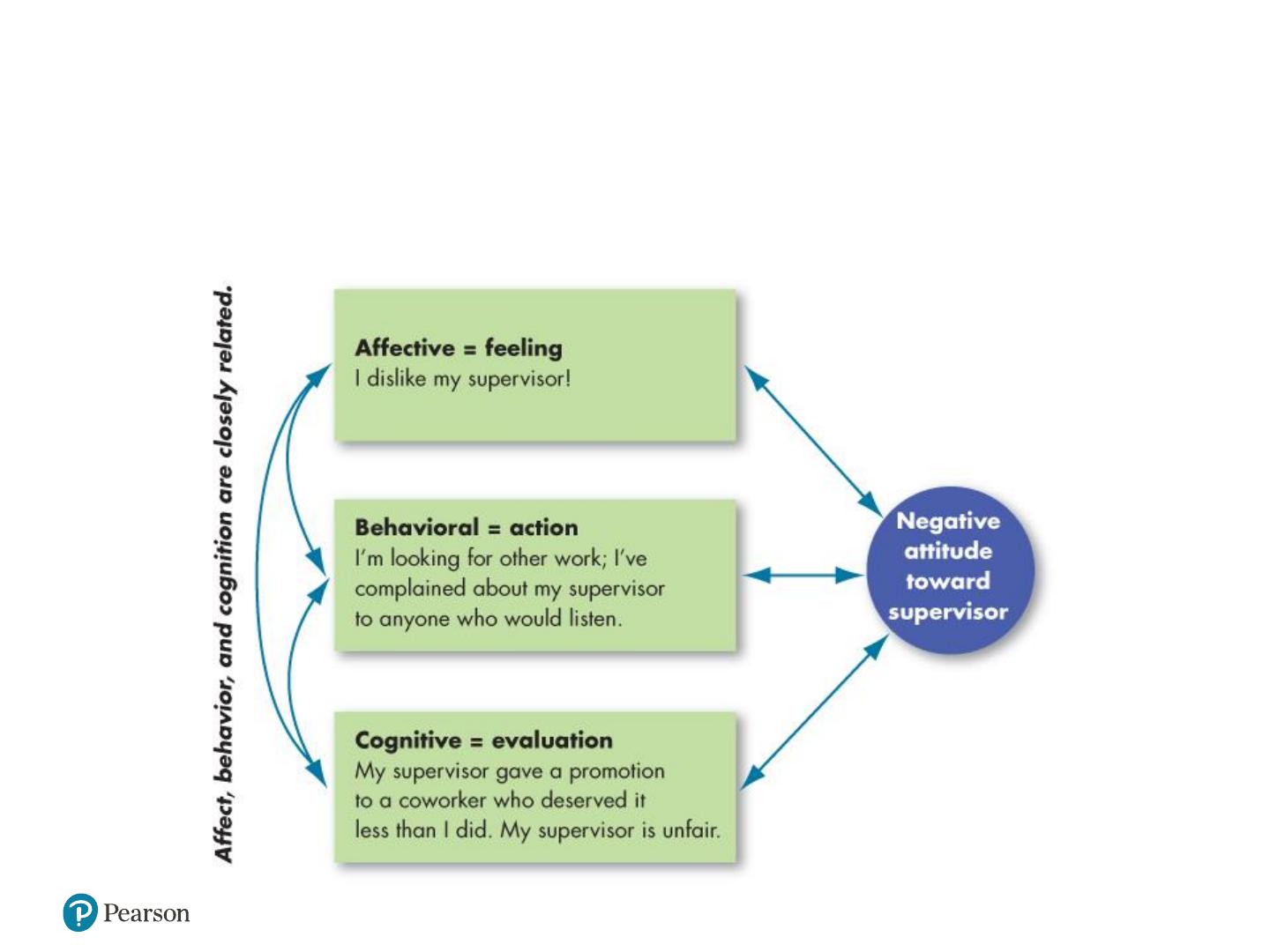
•Attitudes are evaluative statements—either favorable or
unfavorable—about objects, people, or events.
–They reflect how we feel about something.
Copyright © 2019 Pearson Education, Ltd. All Rights Reserved.
Contrast the Three Components of an
Attitude (2 of 2)
Exhibit 3-1 The Components of an Attitude

Copyright © 2019 Pearson Education, Ltd. All Rights Reserved.
Summarize the Relationship Between
Attitudes and Behavior (1 of 2)
•The attitudes that people hold determine what they do.
–Festinger: cases of attitude following behavior
illustrate the effects of cognitive dissonance.
–Cognitive dissonance is any incompatibility an
individual might perceive between two or more
attitudes or between behavior and attitudes.
•Research has generally concluded that people seek
consistency among their attitudes and between their
attitudes and their behavior.

Copyright © 2019 Pearson Education, Ltd. All Rights Reserved.
Summarize the Relationship Between
Attitudes and Behavior (2 of 2)
•Moderating Variables:
–Attitude’s importance
–Correspondence to behavior
–Accessibility
–Presence of social pressures