StuDocu is not sponsored or endorsed by any college or university
MKT101-Final – assignment
Principles of Marketing (HELP University)
StuDocu is not sponsored or endorsed by any college or university
MKT101-Final – assignment
Principles of Marketing (HELP University)
Downloaded by Mai Anhh (buithitan2310@yahoo.com.vn)
lOMoARcPSD|5366398

1. Customer-Driven Marketing Strategy
Market Segmentation: Dividing a market into distinct groups of buyers who have
different needs, characteristics or behaviors and who might require separate marketing
strategies or mixes.
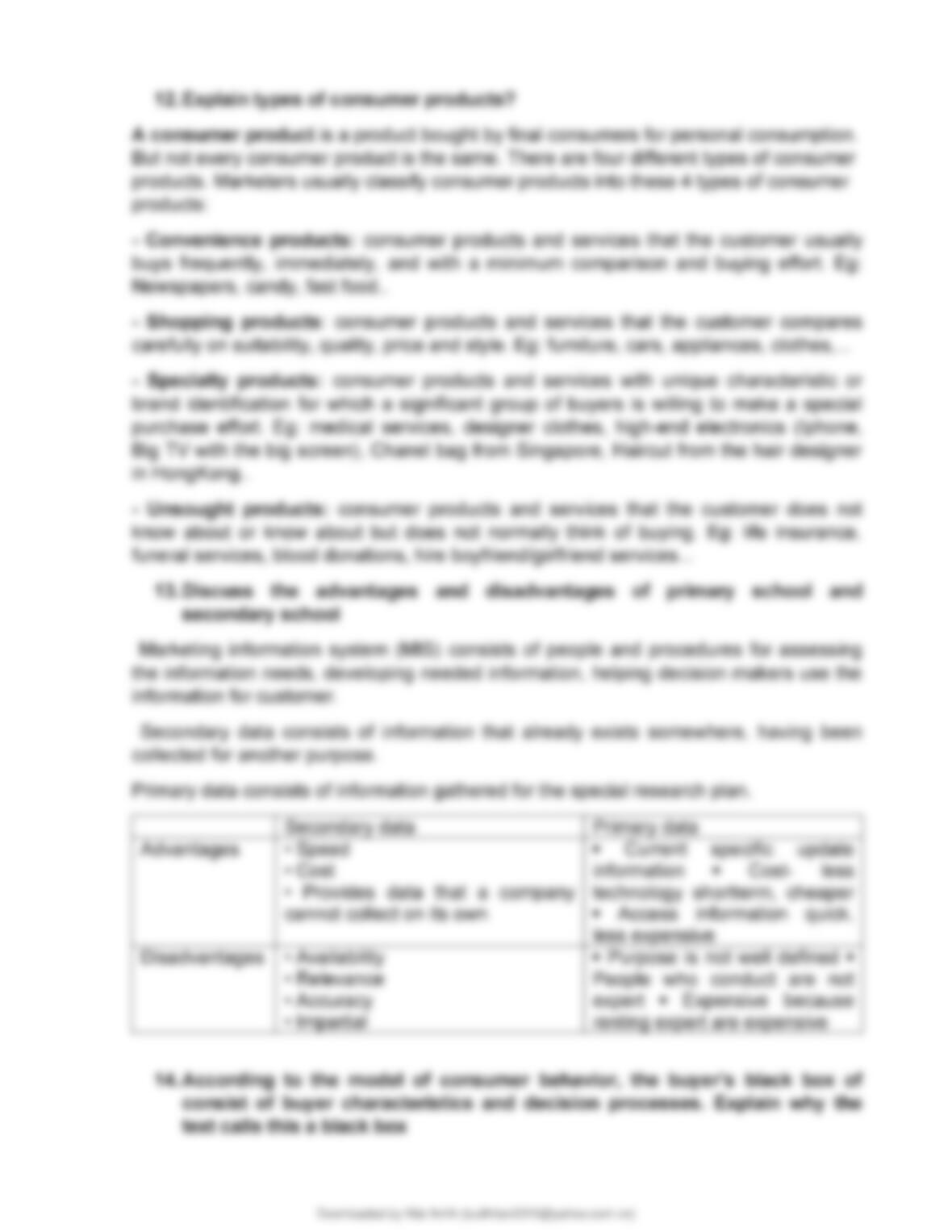
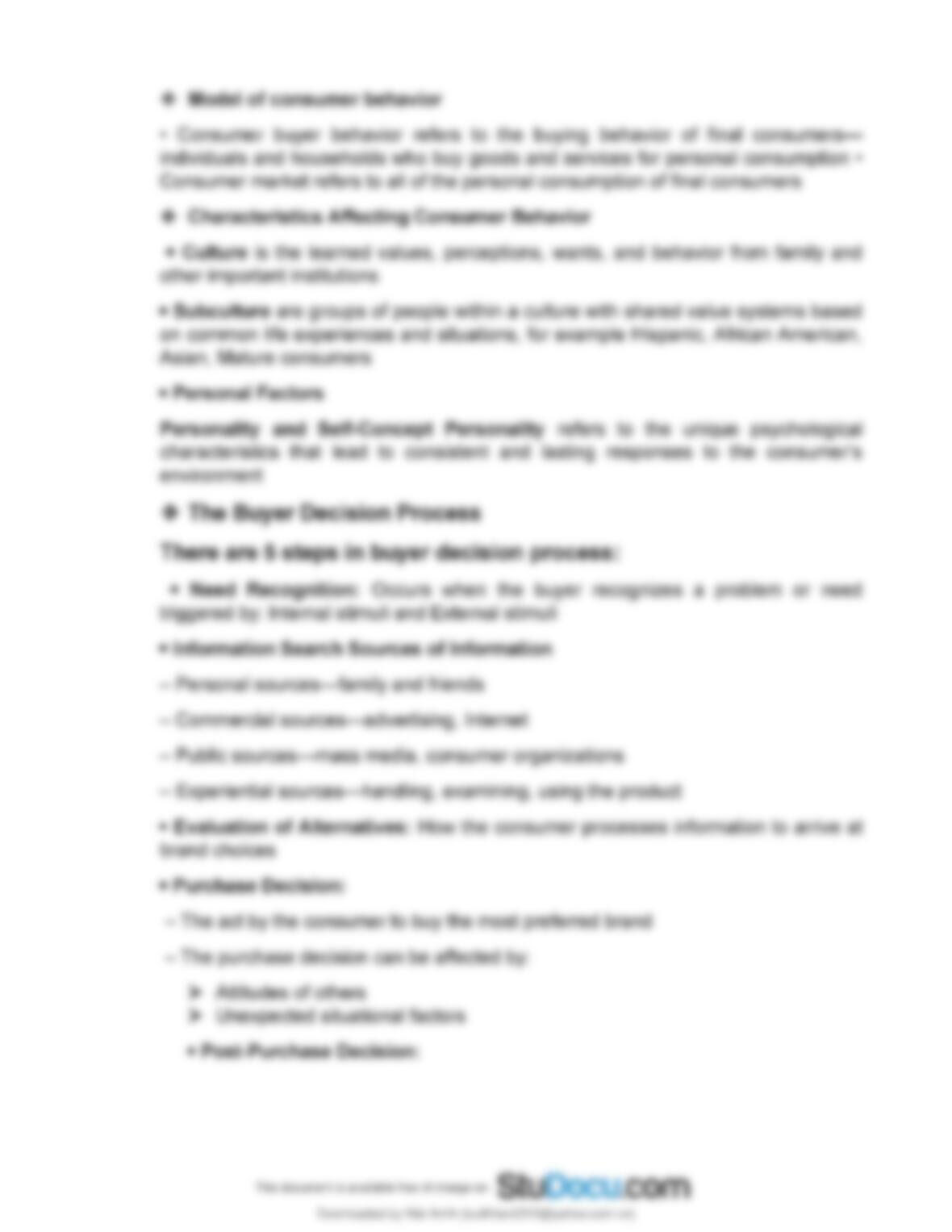
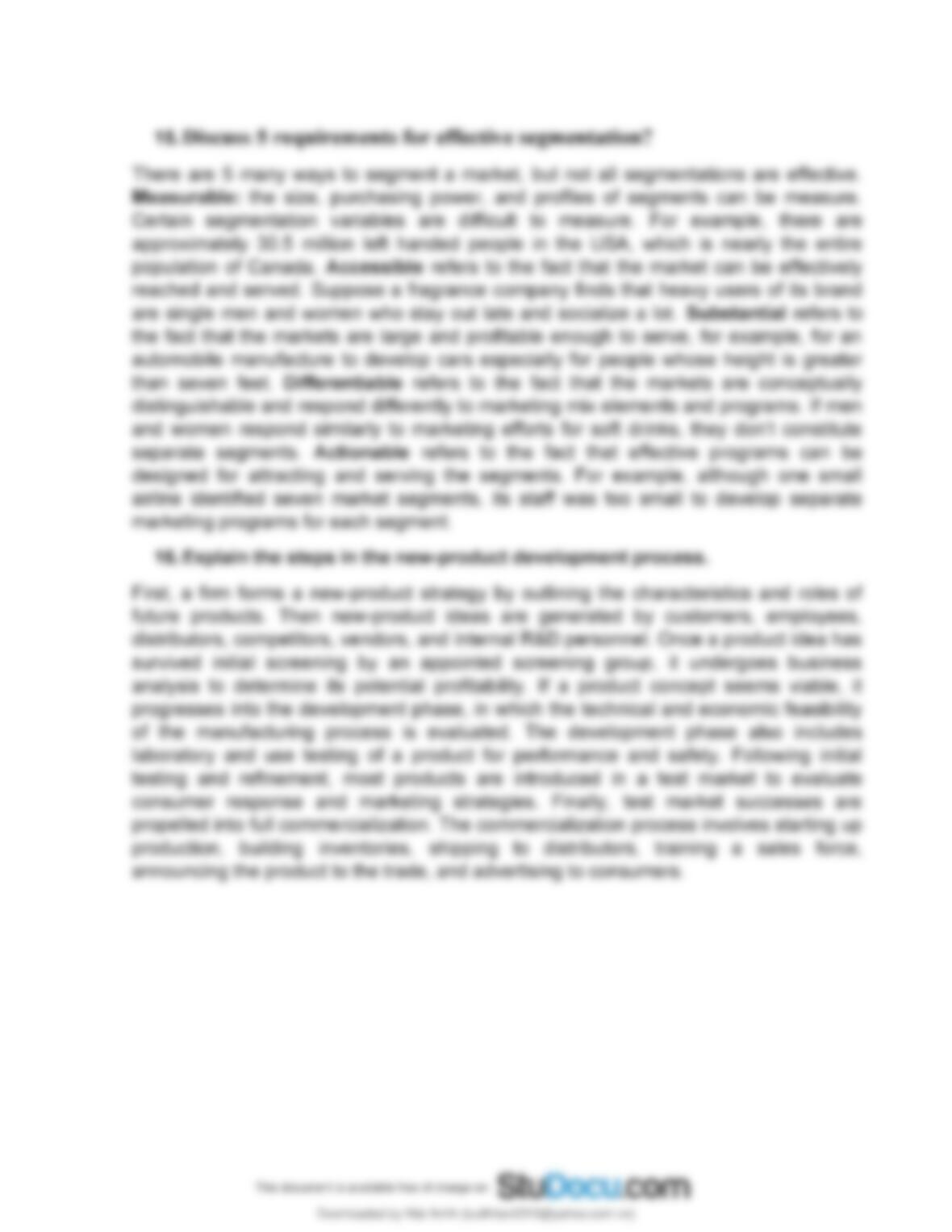
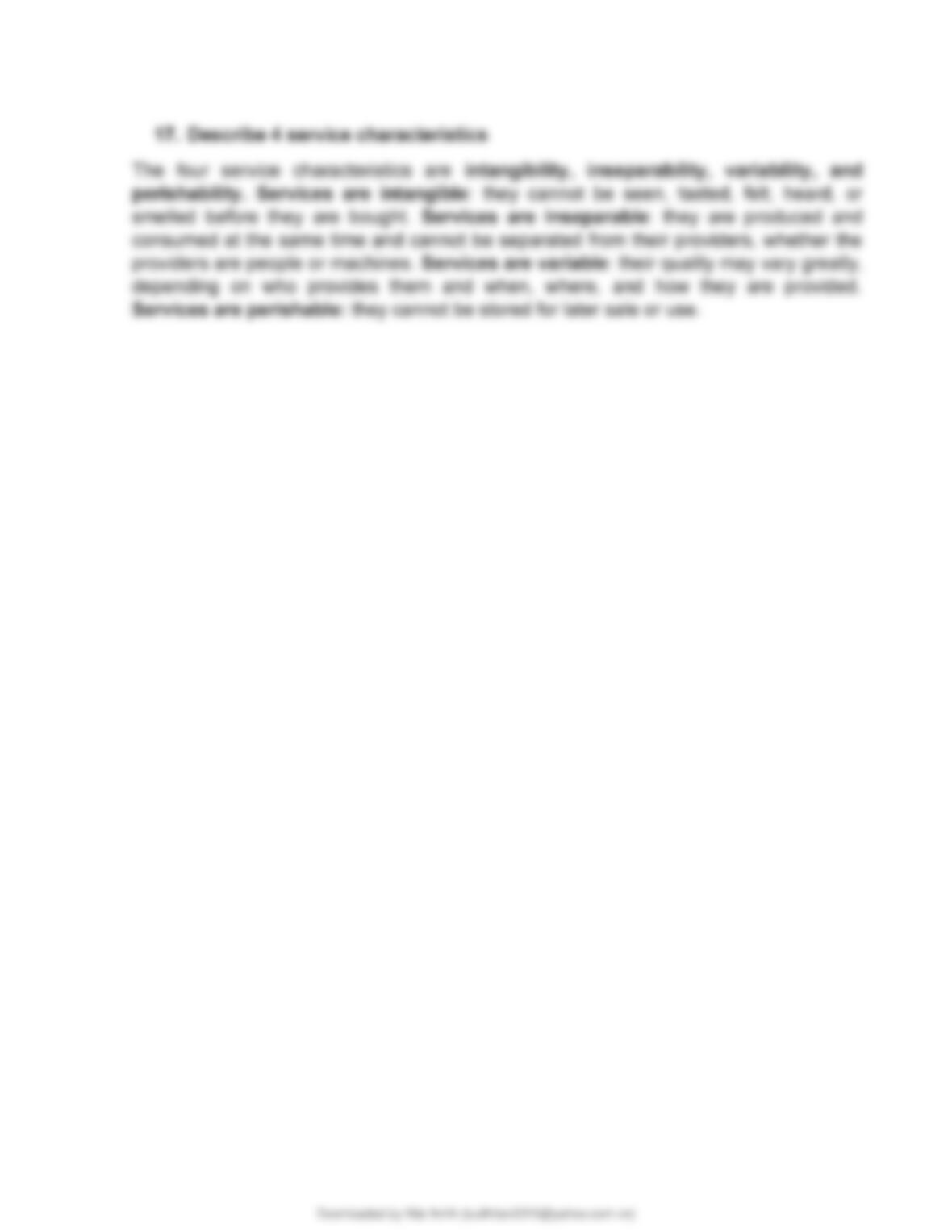
Market Targeting: Most marketers have moved away from mass marketing, towards
this technique. Evaluation each market segment’s attractiveness and selecting one or
more segments to serve.
Differentiation: Actually differentiating the market offering to create superior customer
value.
Positioning: Arranging for a market offering to occupy a clear, distinctive, and desirable
place relative to competing products in the minds of target consumers.
2. Explain customer value-driven marketing strategy?(What are the 5 different
marketing management orientations? Which orientation do you believe your
college follows when marketing its undergraduate program?)
There are five alternative concepts under which organizations design and carry out their
marketing strategies: the production, product, selling, marketing, and societal
marketing concepts.
Firstly, the production concept is the idea that consumers will favor products that are
highly affordable and available and that organization should therefore focus on
improving production and distribution efficiency. For example, computer maker Lenovo
dominates the highly competitive, price-sensitive Chinese PC market through low labor
costs, high production efficiency, and mass distribution.
Secondly, the product concepts is the idea that consumers will favor products that
offer the most quality, performance, and features and that the organization should
therefore devote its energy to making continuous product improvements. For example,
some manufactures believe that if they can ―build a better mousetrap, the world will
beat a path to their doors‖ buyer and may be looking for better solution to a mouse
problem but not necessarily for a better mousetrap
Thirdly, the selling concept is the idea that consumers will not buy enough of the firm’s
products unless it undertakes a large-scale selling and promotion effort. The selling
concept is typically practice with unsought goods – those that buyers do not normally
think of buying, such as insurance and blood donations.
Fourthly, the marketing concept holds that achieving organization goals depend on
knowing the needs and wants of target markets and delivering the desired satisfactions
better than competitors do. For example, even 20 years ago, how many customers
would have thought to ask for now-commonplace products such as notebook
computers, cell phone, digital camera, etc?
Finally, the societal marketing concept is the principle of enlightened marketing that
holds that a company should make good marketing decisions by considering
Downloaded by Mai Anhh (buithitan2310@yahoo.com.vn)
lOMoARcPSD|5366398
consumers’ wants, the company’s requirement, consumer’s long-run interests, and
society’s long-run interests.
My college follows the product concept because students can have the good
education environment with many knowledge teachers. And it also upgrades new
teaching methods and recruits new young teacher
3. Steps strategic Planning (Explain company-wide strategic planning and its
four steps.)
Strategic Planning: the process of developing and maintaining a strategic fit between
the organization’s goals and capabilities, and its changing marketing opportunities.
Steps in Strategic Planning (Corporate Level):
1.) Defining the company mission.
2.) Setting company objectives and goals
3.) Designing the business portfolio
4.) Planning marketing and other functional strategies.
Strategic planning sets the stage for the rest of the company’s planning. Marketing
contributes to strategic planning, and the overall plan defines marketing’s role in the
company Strategic planning involves developing a strategy for long-run survival and
growth. It consists of four steps: (1) defining the company’s mission, (2) setting
objectives and goals, (3) designing the business portfolio, and (4) developing functional
plans. The company‘s mission should be market oriented, realistic, specific, motivating,
and consistent with the market environment. The mission is then transformed into
detailed supporting goals and objectives, which in turn guide decisions about the
business portfolio. Then each business and product unit must develop detailed
marketing plans in line with the company-wide plan.
4. Explain BCG growth-share matrix
What is BCG matrix: Is a matrix with a marketing planning tool which helps
managers to plan for a balances product portfolio. It looks at two dimensions, market
share and market growth, in order to assess new and existing products in terms of
their market potential.
How it works: A business would place each individual product in its product portfolio
(or product range) onto one of the quadrants of the Boston matrix based on the
product’s relative market share and the product’s market growth in the industry.
There are four possible results from using the Boston matrix.
Dogs – Dogs have low market share and a low growth rate and thus neither
generate nor consume a large amount of cash. However, dogs are cash traps
because of the money tied up in a business that has little potential. Such
businesses are candidates for divestiture.
Question marks – Question marks are growing rapidly and thus consume
large amounts of cash, but because they have low market shares they do not
generate much cash. The result is a large net cash comsumption. A question
Downloaded by Mai Anhh (buithitan2310@yahoo.com.vn)
lOMoARcPSD|5366398
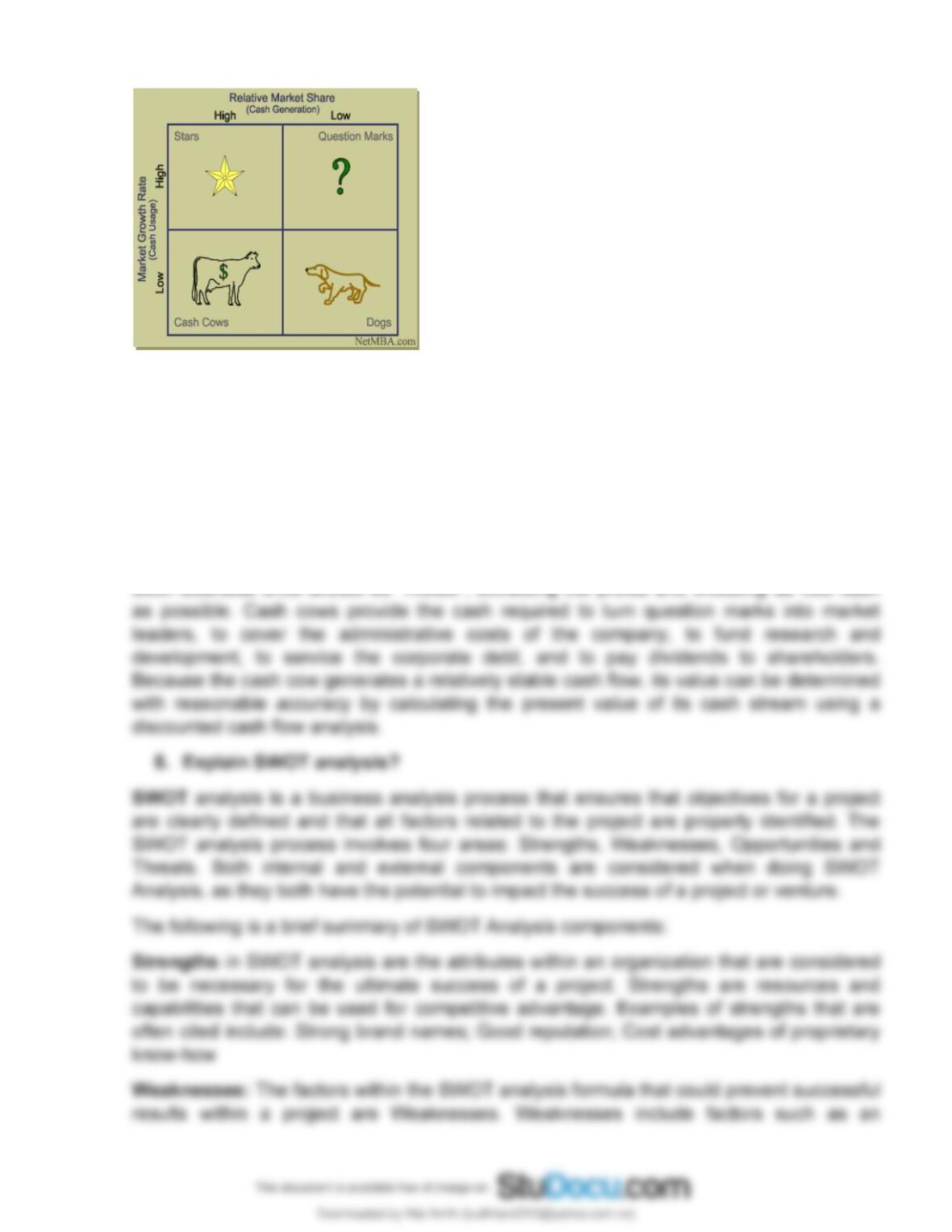
mark (also known as a “problem child”)
has the potential to gain market share
and become a star, and eventually a cash
cow when the market growth slows. If the
question mark does not succeed in
becoming the market leader, then after
perhaps years of cash consumption it will
degenerate into a dog when the market
growth declines. Question marks must be
analyzed carefully in order to determine
whether they are worth the investment
required to grow market share.
Stars – Stars generate large amounts of cash because of their strong relative market
share, but also consume large amounts of cash because of their high growth rate;
therefore the cash in each direction approximately nets out. If a star can maintain its
large market share, it will become a cash cow when the market growth rate declines.
The portfolio of a diversified company always should have stars that will become the
next cash cows and ensure future cash generation.
Cash cows – As leaders in a mature market, cash cows exhibit a return on assets that is
greater than the market growth rate, and thus generate more cash than they consume.
lOMoARcPSD|5366398