Page 1 of 10
Evelyn T. Stone College of Professional Studies
Criminal Justice Leadership Program
CJ250 Criminal Law — Fall 2019
Professor: Andrew Fox, JD, Adjunct Professor
Phone: 312–771–5425 (cell)
Office: Auditorium Building, CJL Offices
Office Hours: By Appointment
Email: afox10@roosevelt.edu
Classroom: Online in Blackboard
Catalog Description:
CJL250 CRIMINAL LAW
The course presents a study of the nature of criminal law including the historical and philosophical
developments of substantive and procedural law. Students will learn to define and apply terms of law and
concepts that accompany them; discuss the classifications of crime; discuss and relate the elements of
crimes and the penalties attached thereto according to the model penal code; and discuss the criminal
responsibilities of persons. This course will focus on criminal law using the Penal Code. The course will
also examine and analyze the structure and function of substantive criminal law and the principles of
criminal law, including the acts, mental state, and attendant circumstances that are necessary elements
of crime.
Prerequisites: None
Description of Course:
The purpose of this course is to provide students with a comprehensive introduction to criminal law. The
first section of the course will cover the general part of criminal law, which includes principles and
doctrines common to most crimes, and then the special part of criminal law, which includes the
application of general principles to elements of specific crimes.
READINGS
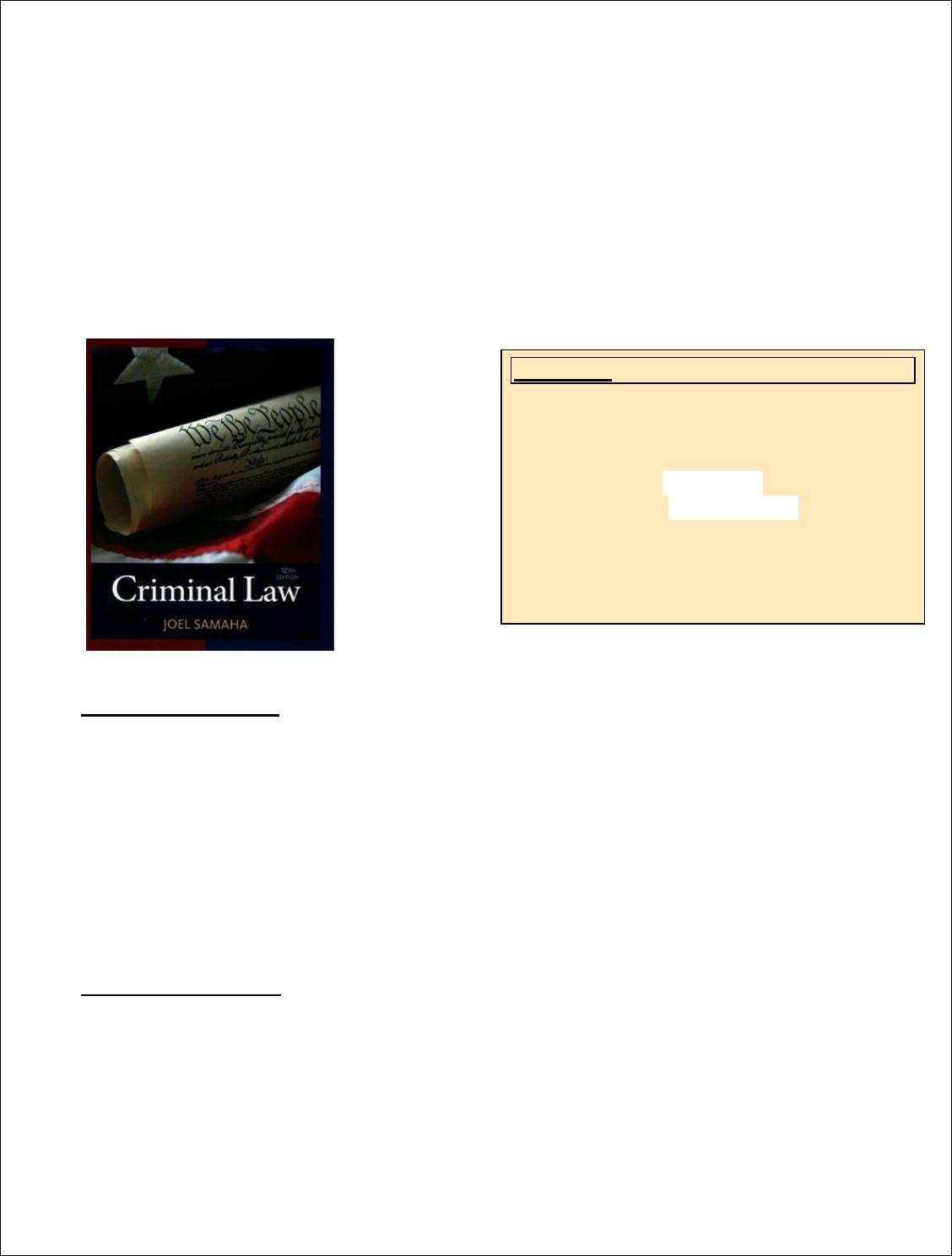
Criminal Law
Joel Samaha, University of Minnesota
12th Edition
• ISBN-10: 1-305-57738-8
• ISBN-13: 978-1-305-57738-1
• 576 Pages Hardcover
• ©2017 Published

Page 2 of 10
In the first section regarding the general part of criminal law we cover: the nature, origins, structure,
sources, and purposes of criminal law and criminal punishment; the constitutional limits on the criminal
law; the general principles of criminal liability; the defenses of justification and excuse; parties to crime
and vicarious liability; and incomplete crimes. When we move to the special part of criminal law we will
study: the major crimes against persons; crimes against homes and property; crimes against public order
and morals; and crimes against the state. Criminal law focuses on a three-tiered analysis of criminal
liability through review of criminal conduct, justification and excuse.
The course contains both the foundational requirements for analysis of criminal law as well as the specific
application of those principles to crimes. The course will incorporate cases and law from local, state and
federal jurisdictions to breathe life into the theoretical components of the course and give students context
on how to apply the materials to real world examples. The practical component will require students to
use the materials and online research to bring in relevant and reliable academic level information to the
course to enhance the learning opportunities provided in the online format of the course. Ultimately, this
course will provide students a foundation for studying criminal law and criminal justice and applying that
information to a multitude of career options one may encounter as a criminal justice professional.
Learning experiences will include: weekly readings and assignments; weekly in class participation,
quizzes, examinations and writing assignments. There will be opportunities for exploration; lesson
enhancements; web “field trips;” case study analyses; and, examinations. The course is designed to
allow for debate, discussion and interaction between professor and students, as well as among students,
in a mature forum of understanding the importance of criminal law for criminal justice toward the
improvement of decision making and public policy.
Further, the Introduction to Criminal Law explores both the foundations of criminal law and the application
of specific principles in specific crimes. The class will define both the elements of particular crimes and
the areas where emerging principles and crimes will go in the coming years.
The readings will enable students to delve deeply into the study of criminal law and see cases that relate
to each learning unit. Special attention will focus on helping students identifying the legal issues in
criminal law and translate those positions and issues to the practical side through real world examples in
the Discussion Board and the Writing Assignments.
Course Objectives:
After completing this course, the student should be able to:
• Explain Criminal Law and Criminal Punishment
• Articulate the Constitutional Limits on Criminal Law
• Compare and contrast the Actus Reus and the Mens Rea Principles of Criminal Law
• Describe Defenses to Criminal Liability: Affirmative Defenses and other Defenses
• Explain Parties to Crime and Vicarious Liability
• Define Inchoate Crimes of Attempt, Conspiracy and Solicitation
• Define Crimes Against Persons, including Murder, Manslaughter, Criminal Sexual Conduct,
Bodily Injury and Personal Restraint
• Articulate and define Crimes Against Property, Crimes Against Public Order and Morals,
and Crimes Against the State
• Discuss the examples that support or oppose each major area of study in criminal law and
criminal justice
• Identify principles of criminal law and apply them to concrete practical cases and fact
patterns throughout the course
• Discuss current events in criminal law and criminal justice and identify specific issues within
each event
• Develop formal writing and verbal skills.
Course Requirements and Grade Weighting
CJ250 Criminal Law
I. Summary of Weekly Assignments
A. Weekly In Class Participation ~30% Overall Grade
300 points
Each week in class all students will have an opportunity to participate during the Seminar portion
of the class and in the group presentations. The mere volume of participation will not govern the
overall review, as there are many ways that participation and learning happen in the class. There
will be a grading rubric to provide additional information on the review process for your in-class
participation during group work as well as during the lecture portion of each class. Of the ways
that students can demonstrate participation, the list includes, but is not limited to:
• Participation in the Seminar that demonstrates mastery of the materials we have covered
during the week
• Questions and answers during the Seminar that demonstrate various levels of thinking,
analyzing, questioning, grappling with issues, trying to master the materials, or merely
asking for help with an issue that is not fully mastered yet
• Participation in the group work, including but not limited to: taking on a leadership role in
the group, bringing in articles or information for use by the group presentation, presenting
or having the spokesperson develop a nuanced argument for or against the topic of the
presentation
• Participation in Seminar or group work that demonstrates appreciation and sensitivity of
diverse academic viewpoints
• Other participation that merits favorable review of participation in either Seminar or group