
CE 361
Mid-Term Exam
(Open Book)
Name
25 points
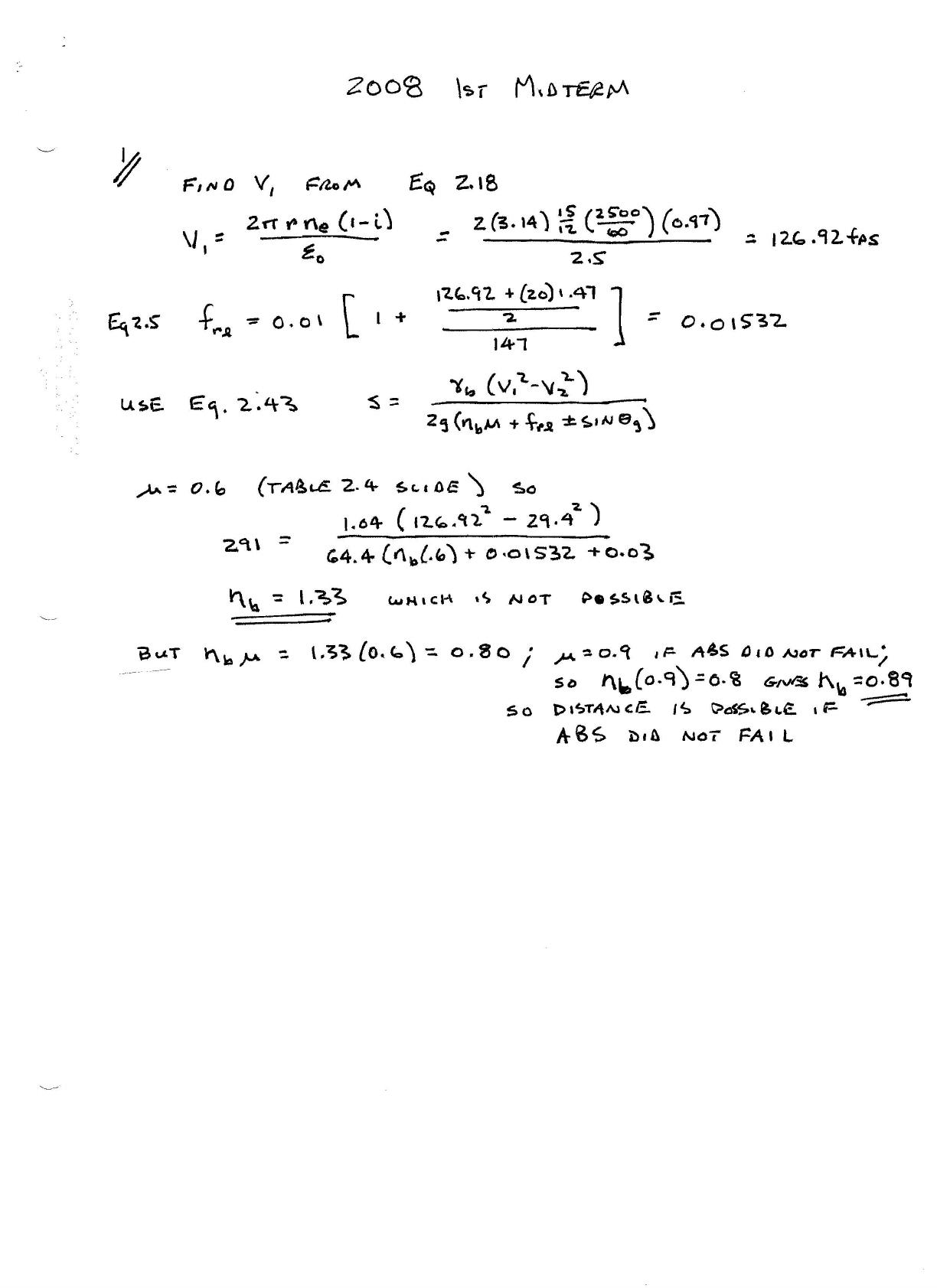
1. A car is traveling up a 3% grade on a road that has good, wet pavement. The engine is
running at 2500 revolutions per minute. The radius of the wheels is 15 inches, the driveline
slippage is 3%, and the overall gear reduction ratio is 2.5 to 1. A deer jumps out onto the
road and the driver applies the brakes 291 feet from a deer. The car’s antilock braking
system fails, the brakes immediately lock and the driver hits the deer at a speed of 20mi/h. If
aerodynamic resistance is ignored, what was the vehicle’s braking efficiency?
30 points
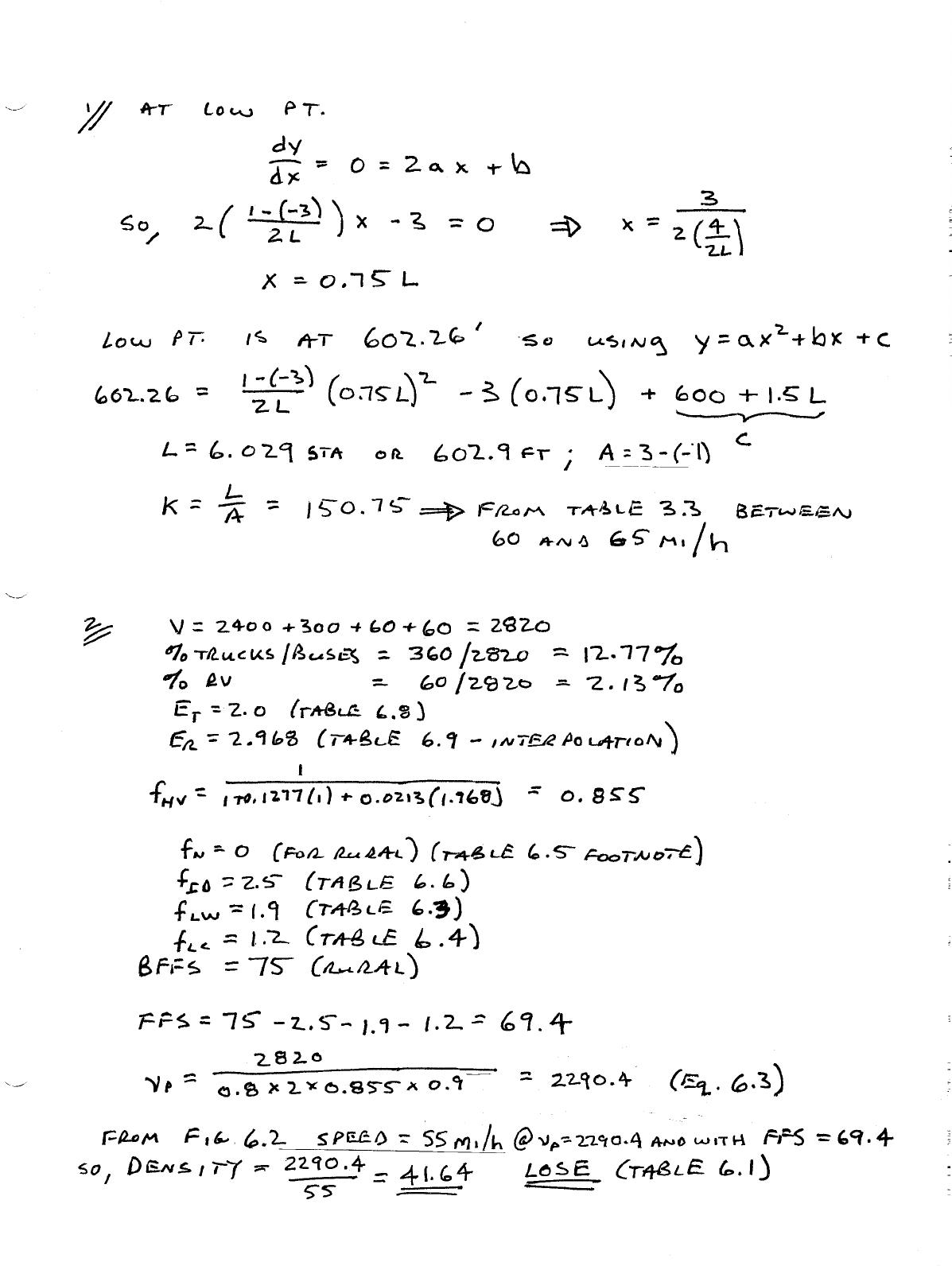
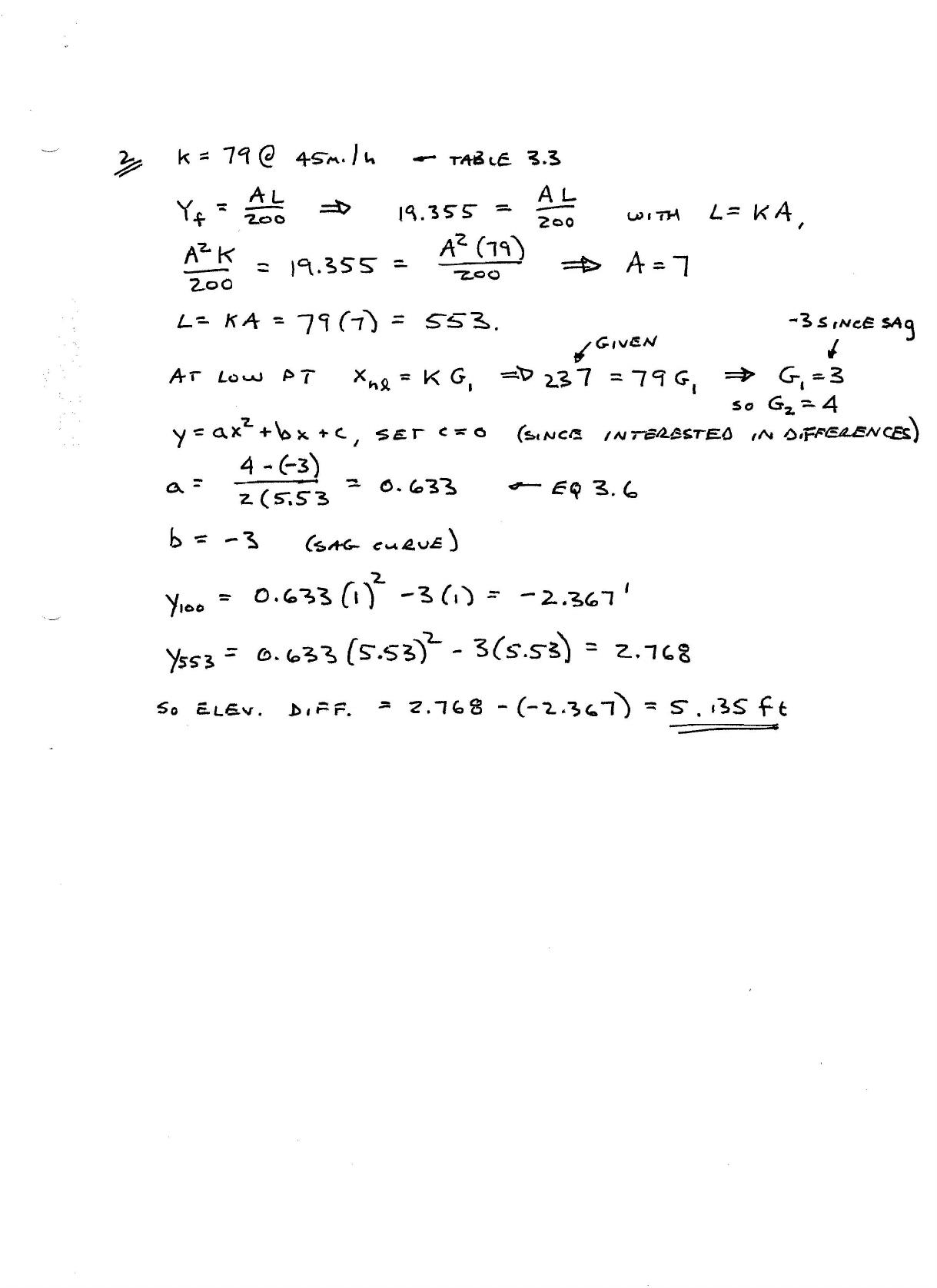
2. A sag equal tangent vertical curve is designed for 45mi/h. The low point is 237ft from the
PVC at station 112+37 and the final offset at the PVT is 19.355ft. If the PVC is at station
110+00, what is the elevation difference between the PVT and a point on the curve at station
111+00?
25 points
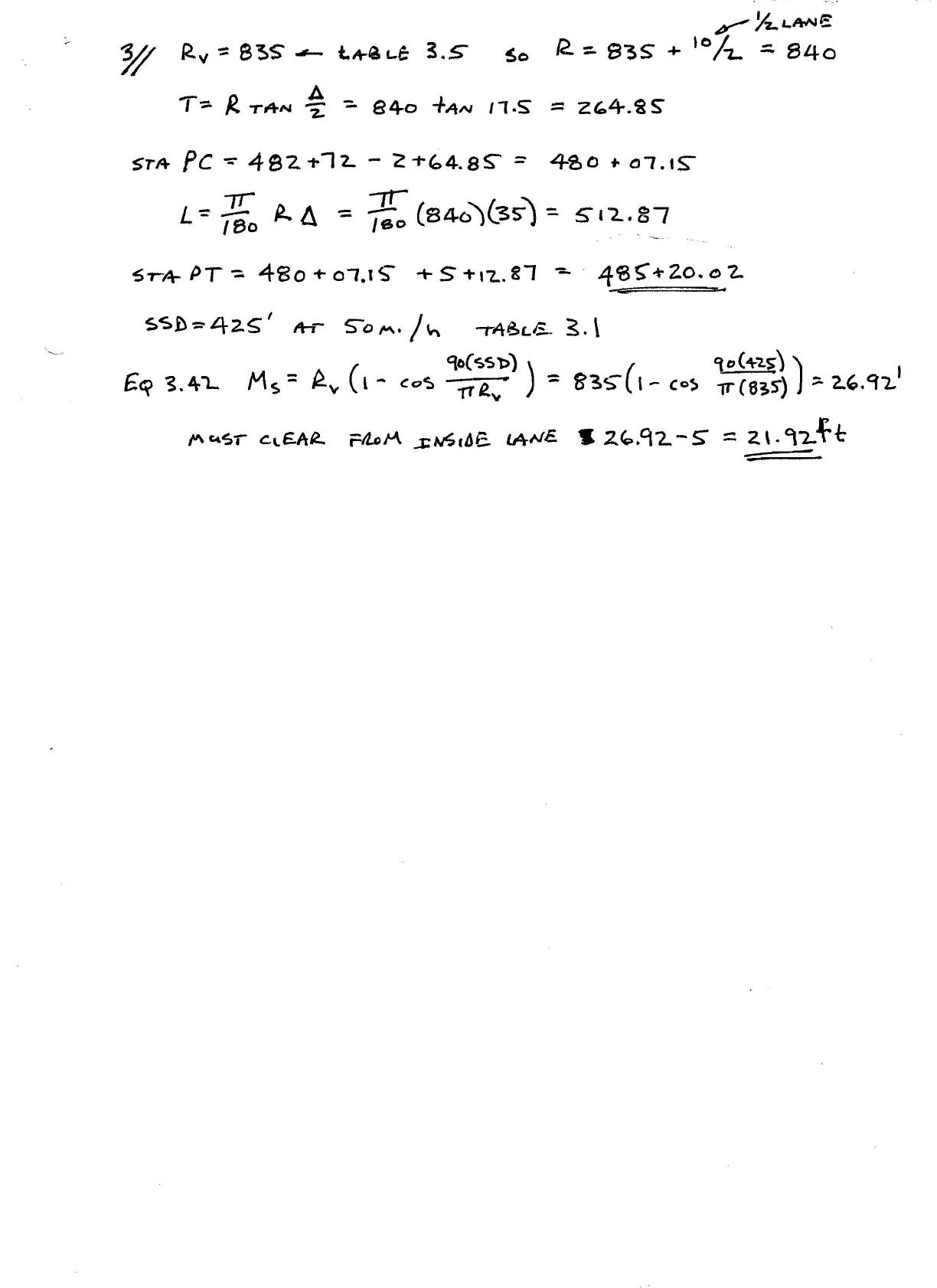
3. A horizontal curve on a two-lane highway (10ft lanes) is designed for 50mi/h with a 6%
superelevation. The central angle of the curve is 35 degrees and the PI is at station 482+72.
What is the station of the PT and how many feet have to be cleared from the lane’s shoulder
edge to provide adequate stopping sight distance?
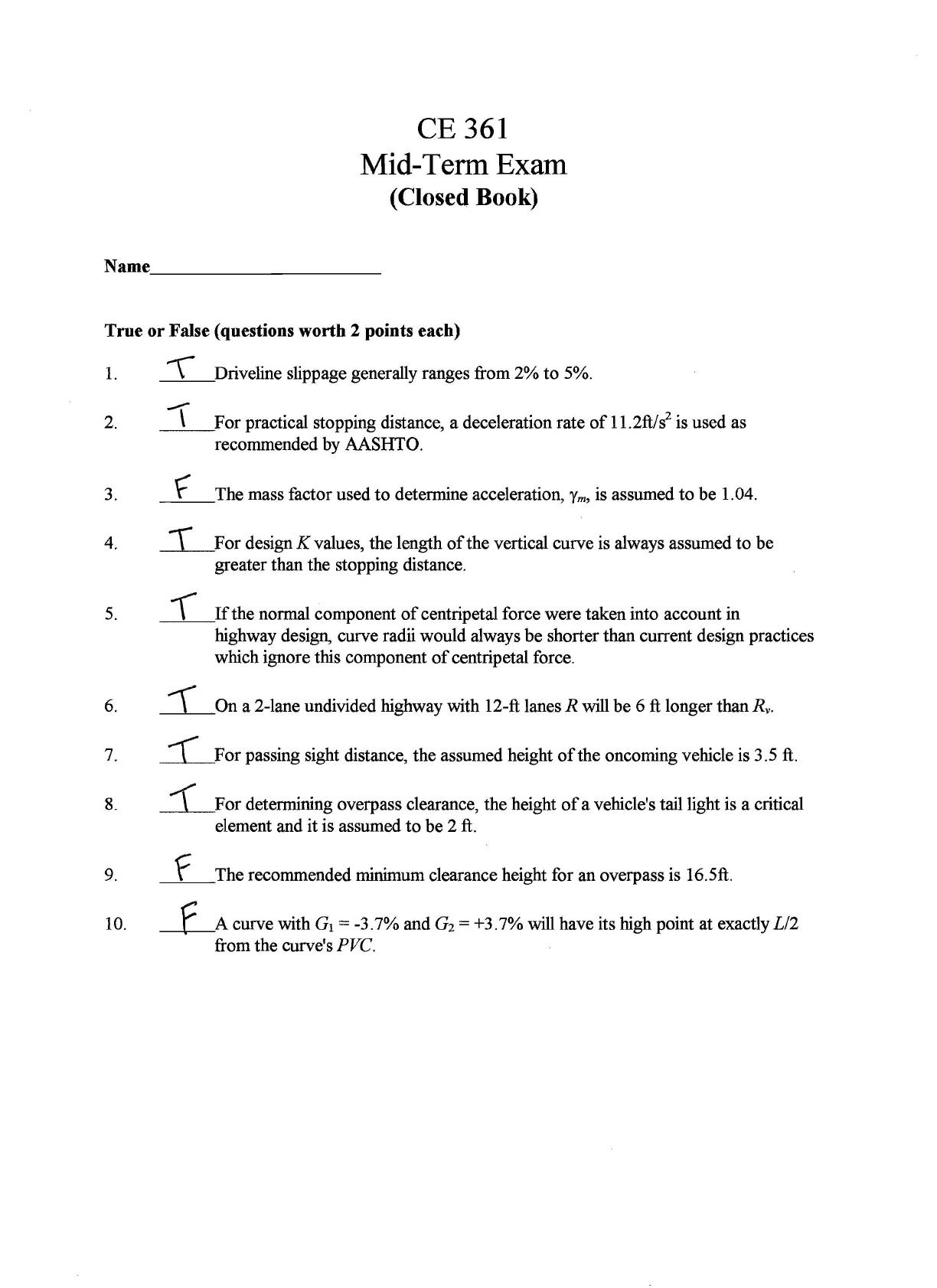
GI
=
-2.5% and
G2
=
-1.5% will have its low point at the
PYT.
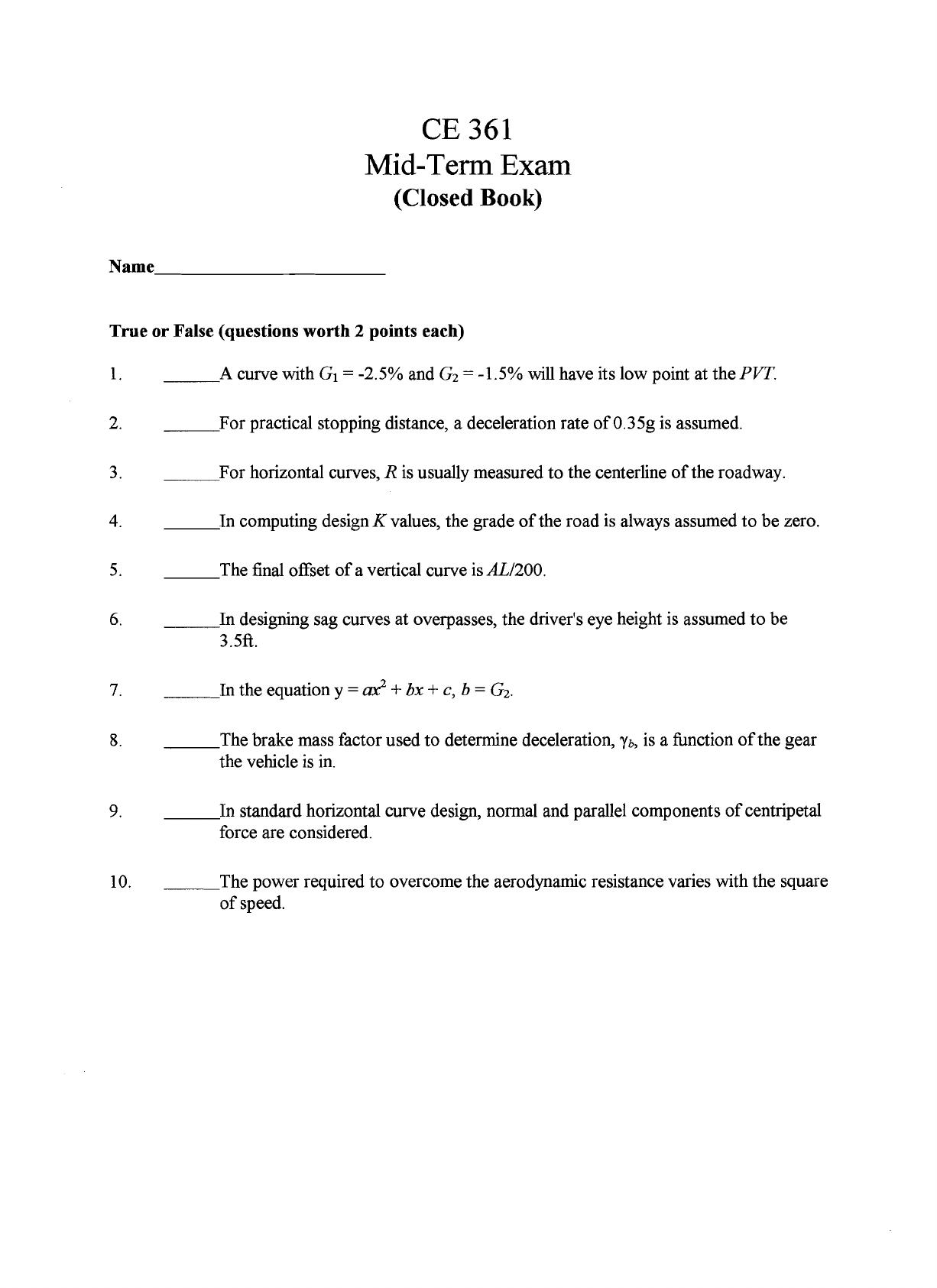
2. For practical stopping distance, a deceleration rate of 0.35g is assumed.
3. For horizontal curves,
R
is usually measured to the centerline of the roadway.
4. In computing design K values, the grade of the road is always assumed to be zero.
5. The final offset of a vertical curve is ALl200.
6.
In
designing sag curves at overpasses, the driver’s eye height is assumed to be
3.5R.
7.
In the equation y
=
ax?
+
bx
+
c,
b
=
G2.
8.
The brake mass factor used to determine deceleration,
yb,
is a fbnction of the gear
the vehicle is in.
9.
In standard horizontal curve design, normal and parallel components of centripetal
force are considered.
10. The power required to overcome the aerodynamic resistance varies with the square
of speed.
F
T
T
T
T
F
F
F
F
F
CE
361
Mid-Term
Exam
(Open
Book)
25 points
1.
A
car is traveling at 70miIh on a level section of road with good, wet pavement. Its antilock
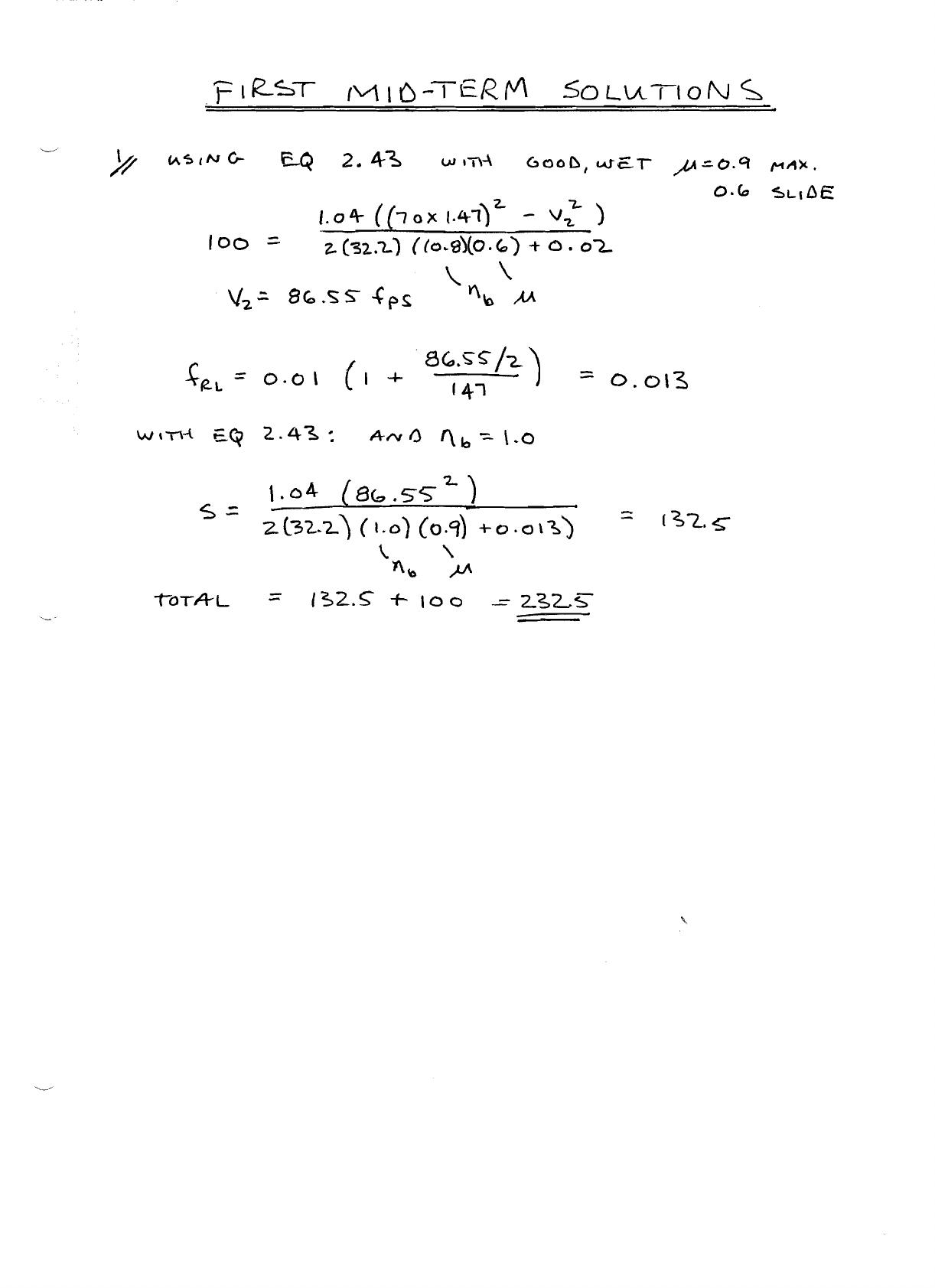
braking system (ABS) only starts to work after the brakes have been locked for 100R. If the
driver holds the brake pedal down completely, immediately locking the wheels, and keeps the
pedal down during the entire process, how many feet will it take the car to stop from the point
of initial brake application? (Given the braking efficiency is 80% with the ABS not working
and 100% with the ABS working. Use theoretical stopping distance and ignore air resistance.
Let51
=
0.02 when the brakes are locked, but compute theJl once the ABS becomes active).
25 points
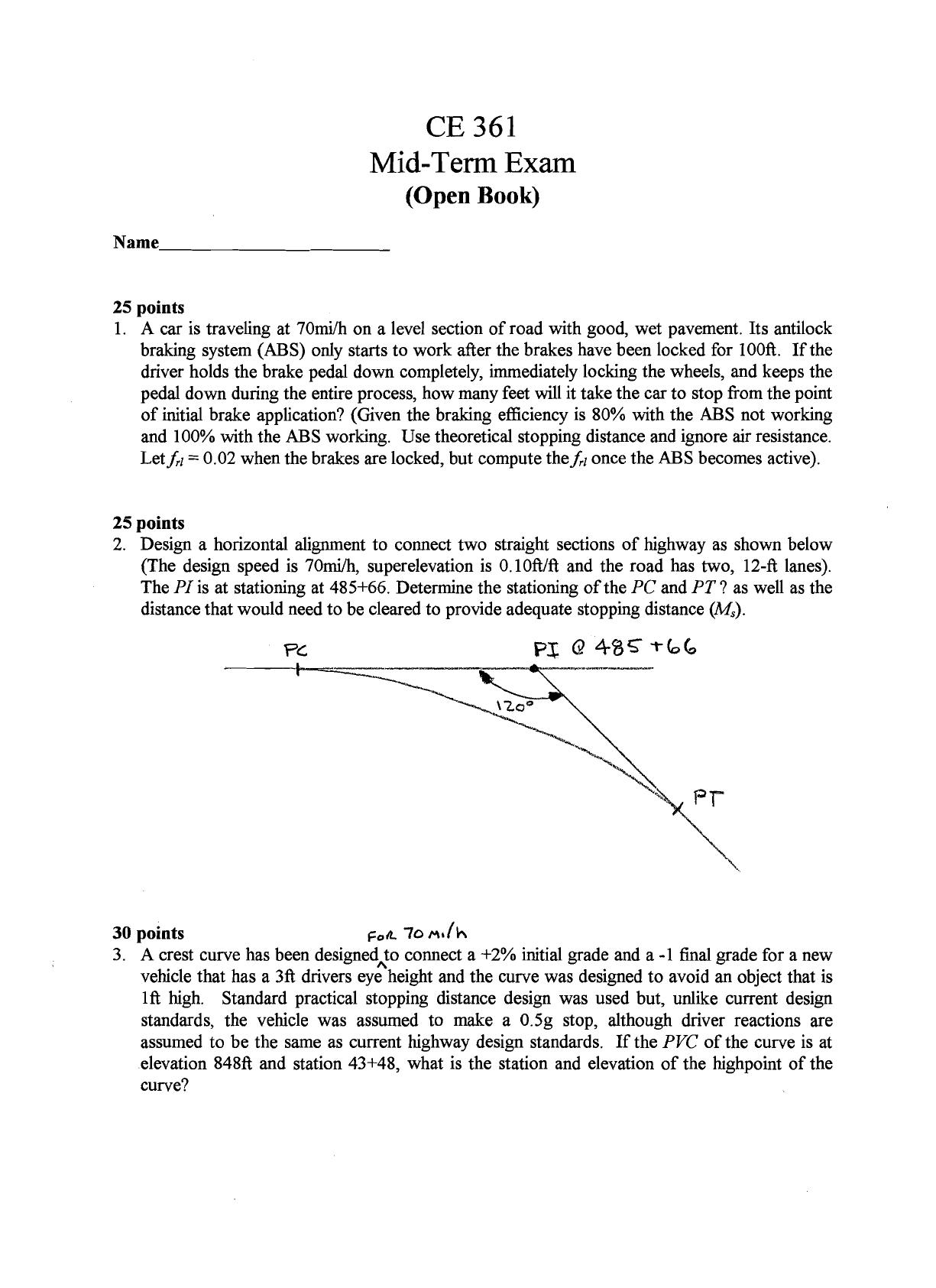
2.
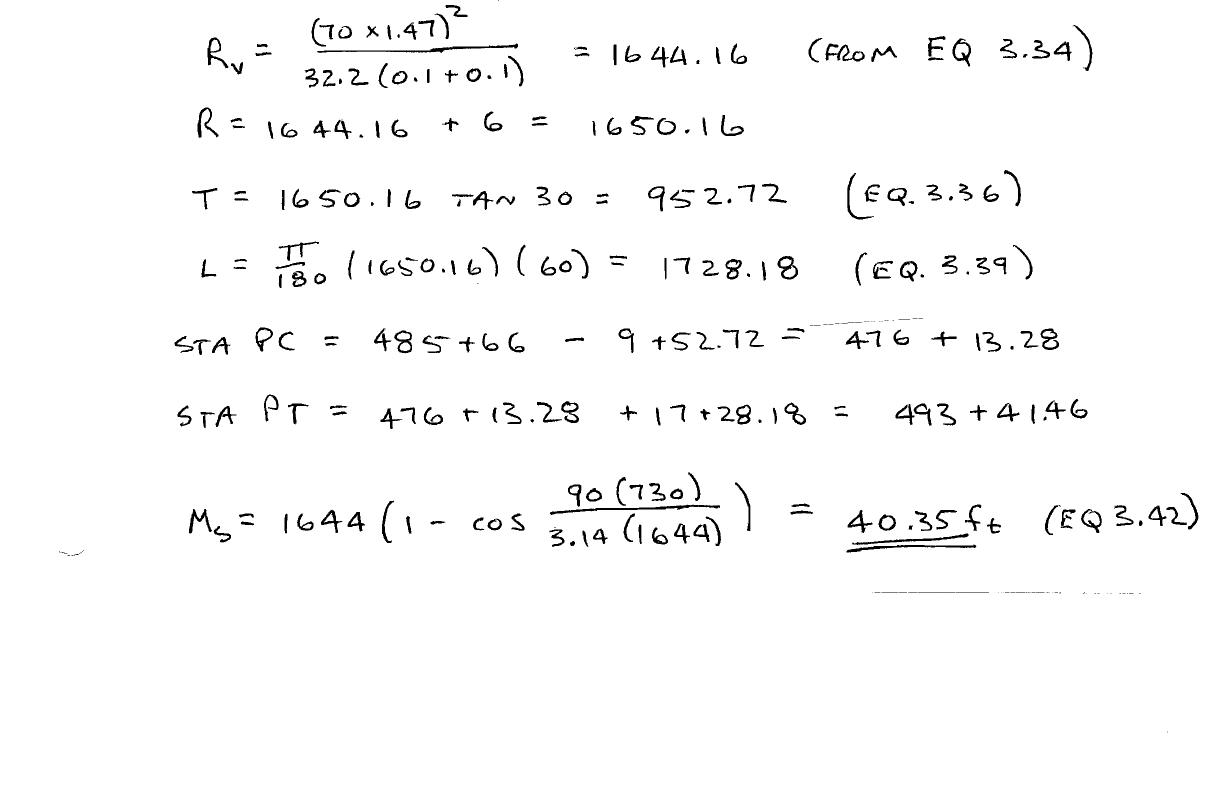
Design a horizontal alignment to connect two straight sections of highway as shown below
(The design speed is 70mi/h, superelevation is O.lOR/R and the road has two, 12-R lanes).
The
PI
is at stationing at 485+66. Determine the stationing of the
PC
and
PT
?
as well as the
distance that would need to be cleared to provide adequate stopping distance
(M,).
30
points
F~IL
70
~tf
h
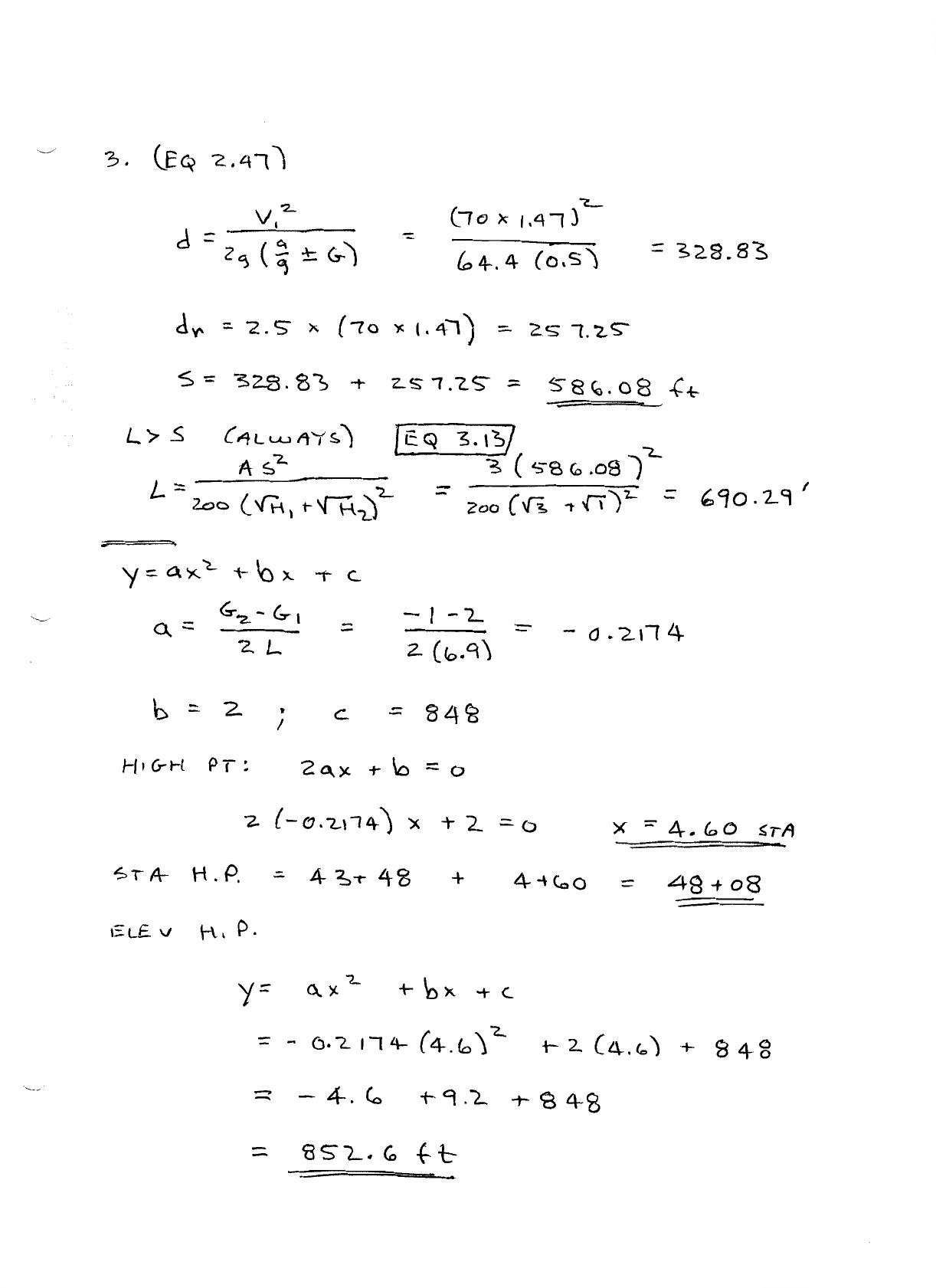
3. A crest curve has been designed20 connect a +2% initial grade and a -1 final grade for a new
vehicle that has a 3R drivers eye height and the curve was designed to avoid an object that is
1R high. Standard practical stopping distance design was used but, unlike current design
standards, the vehicle was assumed to make a 0.5g stop, although driver reactions are
assumed to be the same as current highway design standards. If the
PVC
of the curve is at
elevation 848R and station 43+48, what is the station and elevation of the highpoint of the
curve?
)-IIG~-~
Pr:
24%
+\D
=O
Common Mid-Term Mistakes
Problem
1
In calculatingh must use V!2
Must us correct p’s (Table 2.4), maximum for ABS, slide for non ABS
Problem
2
Use correct
A
(clearly shown on Fig. 3.13)
Table 3.5 gives Rv, must add half the lane width on a two-lane road to
get R
Must add L to staPC to get staPT. Cannot add tangent to staPI or use
,512 as in vertical alignment
Problem
3
G
=
0
for SSD calculations (always)
Always assume L
>
S
for highway design
Units
in
y
=
ax2
+
bx
+
c
G’s in percent, L in stations,
x
in stations
OR
–
G’s in Wft, L in ft,
x
in
ft
(cannot mix these options)
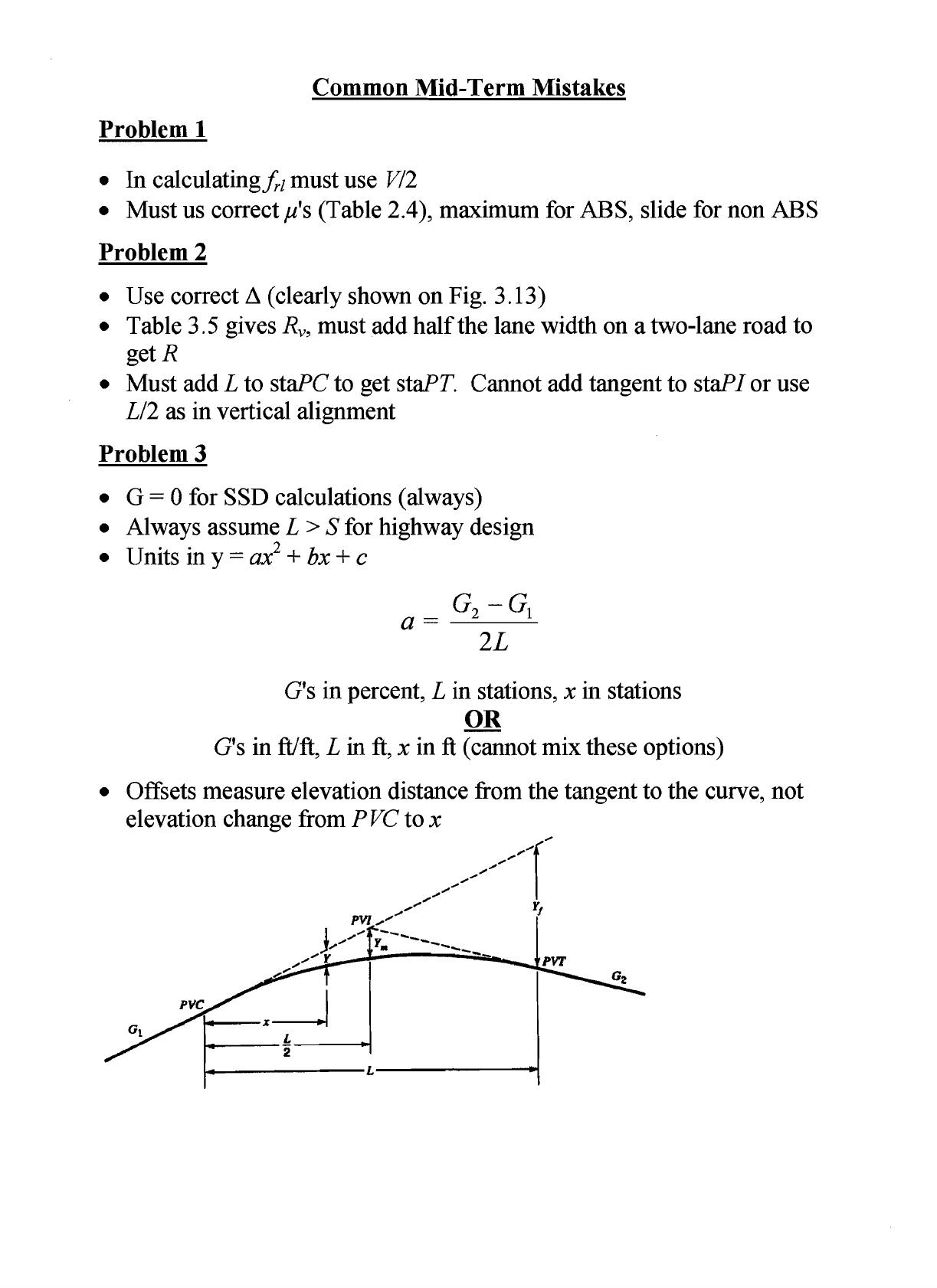
Offsets measure elevation distance fi-om the tangent to the curve, not
elevation change from
P
VC
to
x

CE 361
Mid-Term Exam
(Open Book)
Name
25 points
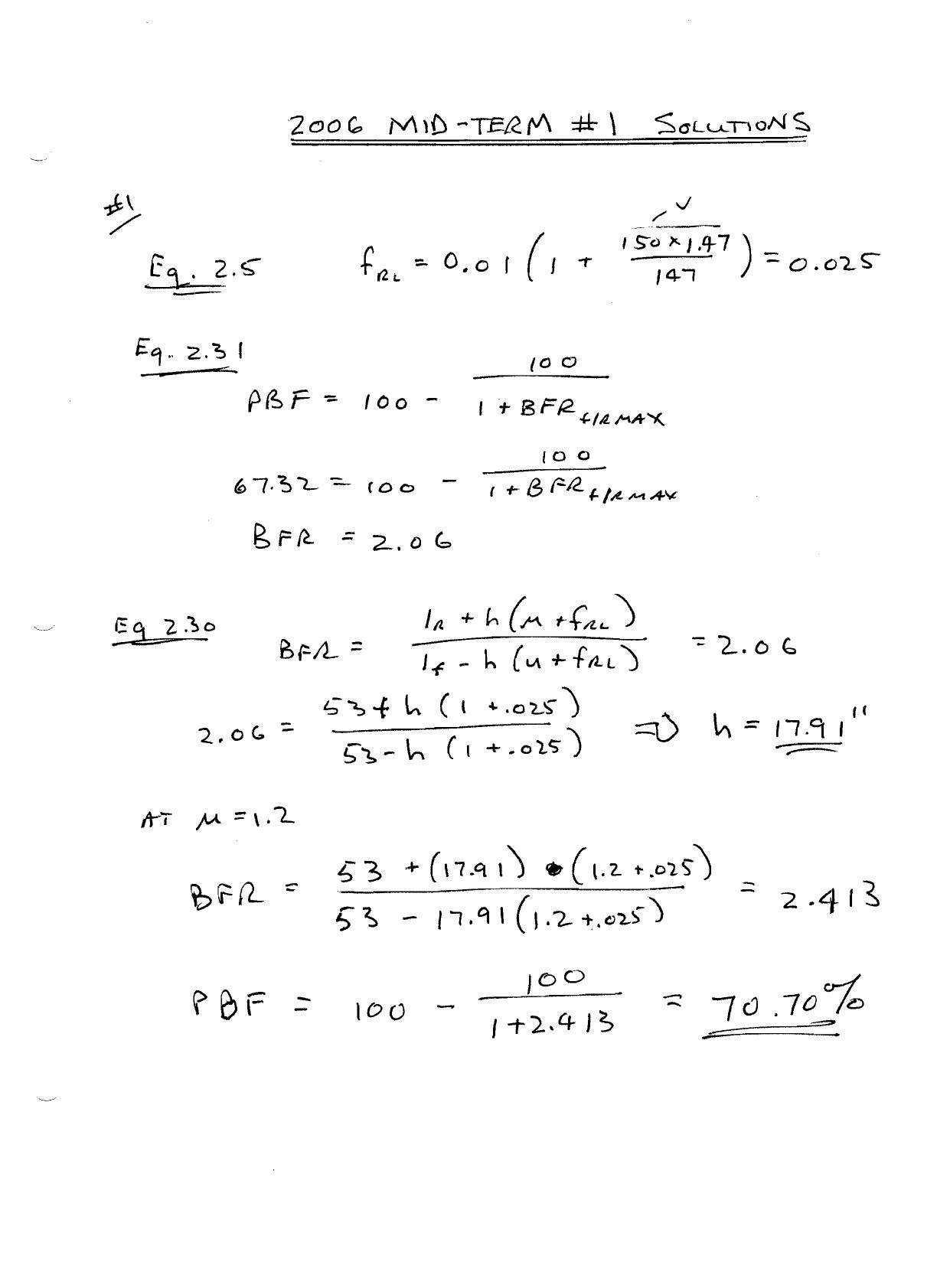
1. A race car with a 106 inch wheelbase has its weight evenly distributed between front and rear
axles. At 150mi/h, on a race track with μ = 1.0, the optimal brake force has 67.32% of the
braking force on the front brakes. A new racing tire generates μ = 1.2. At 150mi/h, what
percentage of the braking force should now be allocated to the front to achieve optimal
braking?
25 points
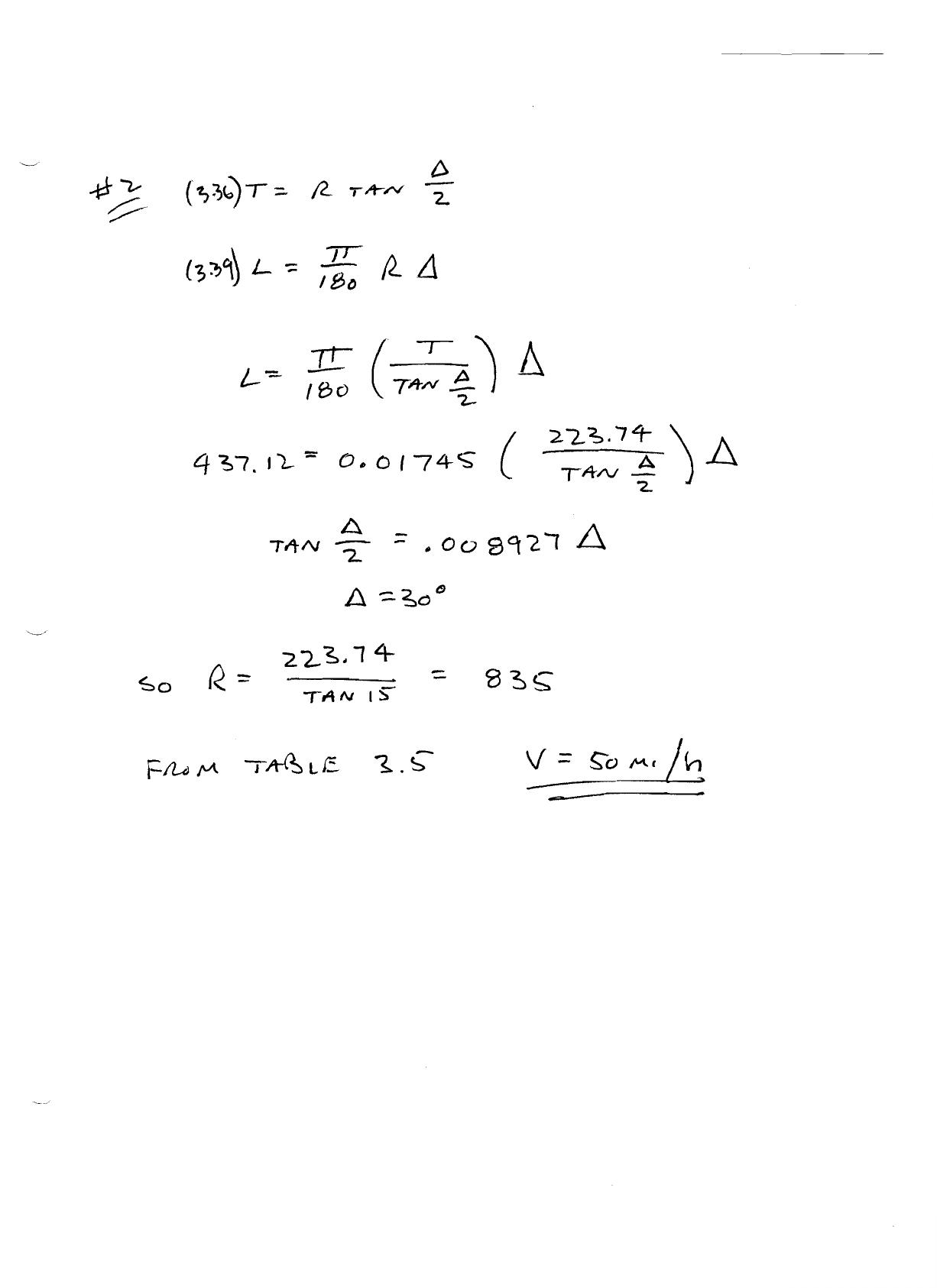
2. An exiting horizontal curve is on flat land with no sight distance restriction. Original design
drawings were lost but the survey crew determined the length of the curve to be 437.12 ft,
the tangent length to be 223.74 ft, and the superelevation to be 6%. What design speed was
used for the curve?
30 points
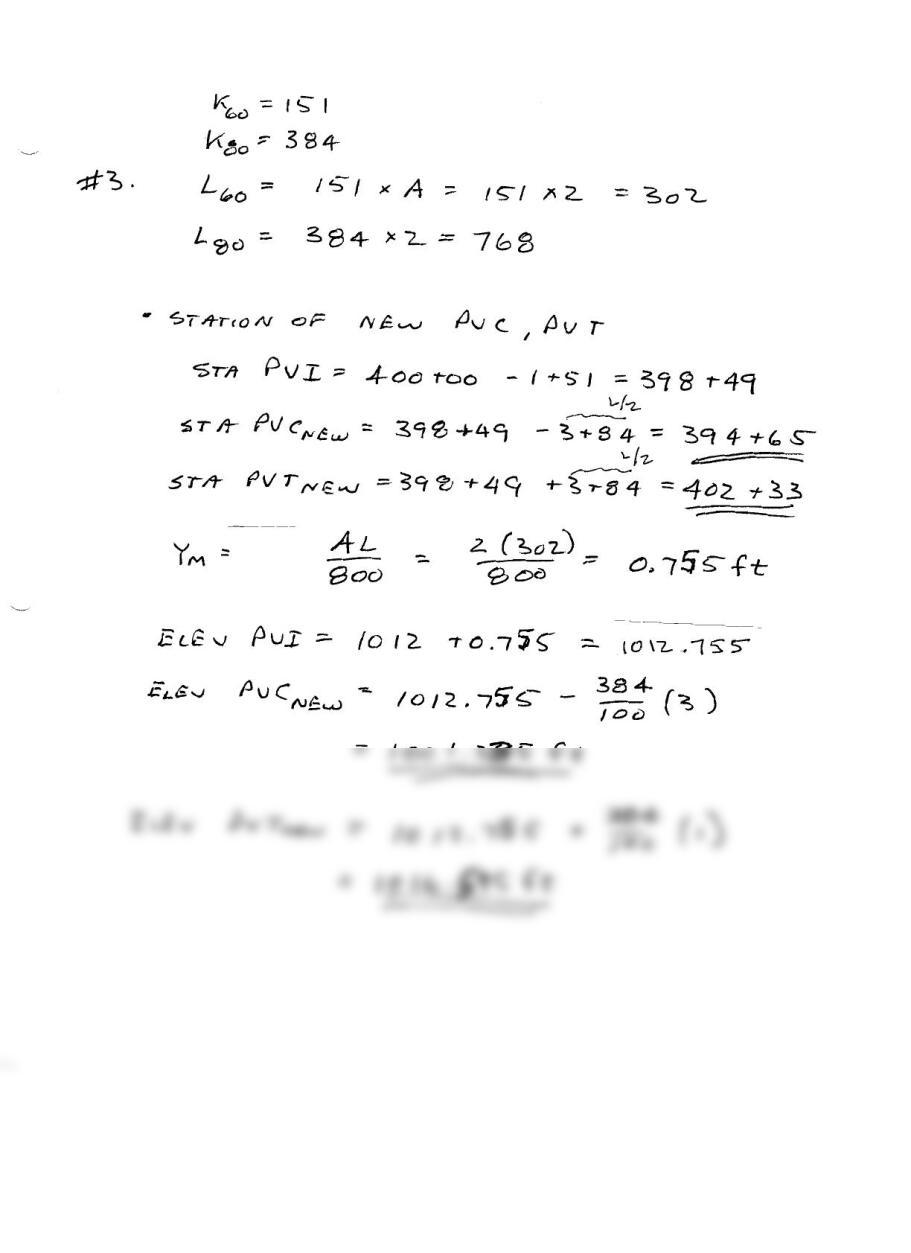
3. An existing equal tangent crest curve connects +3% and +1% grades, and is design for
60mi/h. The curve is to be reconstructed with an 80mi/h design speed. The PVI of the new
curve will remain the same as the existing curve but the PVC and PVT will change to
accommodate the new curve length. The existing curve’s PVT is at 400+00 and the elevation
of the existing curve directly below the PVI is 1012 ft. What would the station and elevation
of the new curve’s PVC and PVT be?