GPAC 2014
ASESSMENT FACTORS LEADING TO THE RISK OF FALLING INTO
MIDDLE INCOME TRAP: VIETNAM CASE STUDY
Nguyen Thi Thien Duyen, Pham Trang Nhung, Vu Thi Hong Nhung
Email: hoasencan@gmail.com, nhungptr.yec@gmail.com, hongnhung.ueb@gmail.com
ABSTRACT
Based on the economic theory of development, the research paper mentions the nature of the middle-
income-trap (MIT); evaluates the factors leading to the risk of a middle-income trap in a country and
studies specific case of Vietnam, which offers policy implications for Vietnam. Theoretical framework for
answering questions about the concepts and characteristics of middle-income trap shows the need of
consideration and evaluation the system of seven groups of elements of various aspects, which leads to
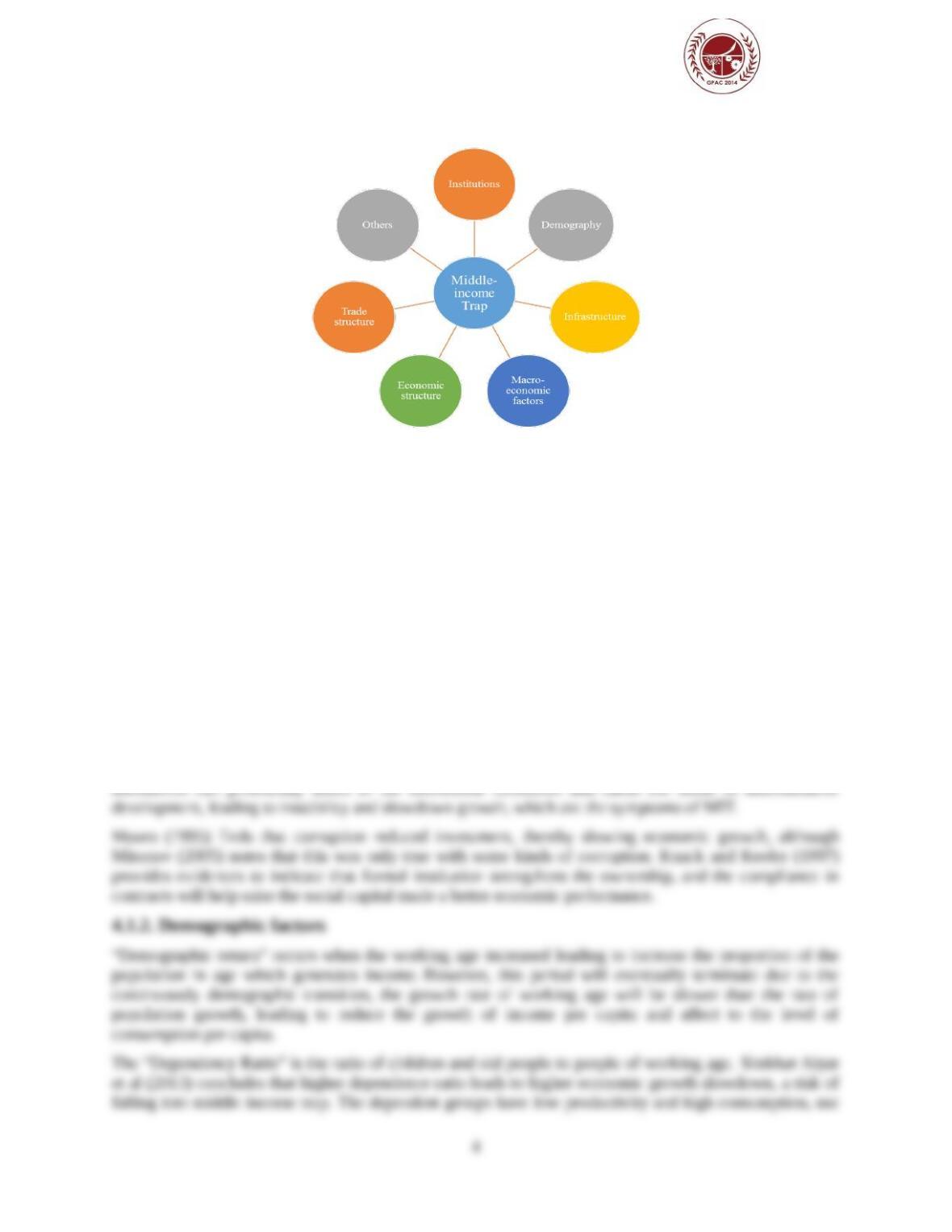
the risk of falling into middle-income trap in a country including institutions, infrastructure, demography,
economic structure, trade structure, macroeconomic factors, and other factors (geography, research and
deployment…).
The results of comparison between the factors affecting middle-income trap in the world and in Vietnam
shows that Vietnam has quite large risk suffering from middle-income trap. The research analyses seven
groups of factor as mentions in the analysis framework that leading to the risk of falling into middle-
income trap of Vietnam. Although there is no quantitative basis for concluding whether Vietnam has
fallen into middle income trap, the impacts of the above factors suggest a potential risk of middle-income
trap in Vietnam. Some concluding remarks are drawn and directions for further research are discussed in
the final section of the paper.
Keywords: middle-income trap, Vietnam, factors, geography, integration, institutions.
1. INTRODUCTION
The development process of a country usually goes through three periods from low income level to
middle-income level and ultimately high income levels. However, many countries have difficulty in the
transition from middle income level to high income such as Malaysia and the Philippines. A number of
country may be slipping from middle-income to low income level, possibly due to war or declining
commodity prices if those countries are mainly deficit. In the case of country’s growth slowdown or even
stagnate after reaching middle income levels, it is said that the country has fallen into the Middle-Income
Trap (MIT). The consequence is the reduction of growth and high pressures of aging population, the
burden of social security and other social problems that make the countries never reach high income level.
In addition, wages rise faster than productivity and the competitiveness is reduced thereby leading to the
decline of industrialization and also the disappearance of high-tech industries due to lack of skills and
technology needed.
Therefore, to determine the risk of falling into middle-income trap we must identify the factors leading to
the risk of middle-income trap in the middle income countries, thus making conclusion that whether a
nation fall middle-income trap and finally recommending appropriate policies for the economic growth.
This study analyses seven groups of factor leading to the risk of falling into middle-income trap of a
country, then studies the case of Vietnam by following seven groups of influence factors. T he result of
comparison between the factors affecting MIT in the middle income countries in the world and in
Vietnam shows that the risk of MIT in Vietnam is quite large. Examining the factors leading to the risk of
MIT will help the policymakers to build effective policies to reduce the potential risk of falling into
middle income trap in Vietnam.
1

GPAC 2014
The paper is organised as follows. Section 2 reviews literature relating to the topic. Section 3 provides
data and methodology the authors use in the reasearch. Section Section 4 reviews literature on factors that
lead to the risk falling into middle income trap of a country. Section 5 offers some implementations and
discusses the direction for future research.
2. LITERATURE REVIEW
Llanto, GM (2012) have shown that the growth of sustainable development of a nation not only bases on
the input factors but also largely depends on the development of technology. Because input factors are
limited, improving the total factor productivity (TFP) is the only way to sustain economic growth in the
long-term. Thus, assessing the factors affecting TFP also shows the impact to economic growth. The
study has shown that the improvement of appropriate economic policies, the investment in education, the
more spending to improve human capital, trade openness and the high attracting foreign direct investment
and the sustain to the macroeconomic environment significantly contributed in improving productivity
growth, labor productivity, thus promoting economic growth.
In the study of Shekhar et al (2013) mentions MIT is a special case of slow growth. The study examines
the factors affecting slow growth as the structural characteristics of the economy, infrastructure,
characteristics of labor market … by using regression method and Bayesian model Averaging expertise to
solve the risk of the model, from that, recommending policies for a country to pass MIT, especially for
Asian countries.
Maria Carnovale (2012) has developed a system of surrounding factors leading to MIT, identified cases of
low-income economies may encounter in the process of growth. In addition, the study sights data and
evidence to explain the economy can not pass from the trap and make suggestions about the important
role of capital in the transfer and establishment economic structure of the middle-income countries.
However, the study only stops at analyzing factors affecting the economy, thereby deduce the relationship
between the economy and MIT, without analyzing deeply and broadenly about the social problems affect
the personal capita income of the country. The suggestion is only the fundamental change in policy
reflected the economic development to avoid MIT, not to put specific measures in the process of
economic transformation.
In the research of “Middle-income trap is seen from the ASEAN countries,” Tran Van Tho (2013)
mentions about the MIT but it is not many documents studing the current situation in ASEAN countries,
particularly Vietnam. This article gives an analytical framework for factors deciding the development of
each period, and compares the current situation of ASEAN countries with experience of South Korea. The
article concludes that in the cases of four ASEAN countries (Malaysia, Thailand, Philippines and
Indonesia), increasing research and development (R & D), emphasizing the quality and compatibility of
human capital, creating mechanisms to formation of a dynamic private sector are necessary conditions to
avoid middle income trap. For Vietnam, the country is in a period of lower middle income, reforming
institution and policies to increase total factor productivity such as labor, capital and land is crucial to
avoid the early appearance of MIT. However, the article has not yet listed factors affectting the early
present of MIT in the ASEAN countries, conditions to exist and how to test the existence of MIT.
The previous studies only focuse on the characteristics of the nation trapped MIT, as well as compares the
economic characteristics of the nations trapped MIT to the nations escaped MIT, but not systemizes fully
factors leading to the risk of MIT in a country, thus creates space for the authors to study our research.
3. DATA AND METHODOLOGY
The research is about the factors leading to risk of MIT based on the theories of growth as well as the
findings from other studies have been published around the world. Based on World Bank’s report as well
as the findings of La Porta, Lopez-de-Silanes, Shleifer and Vishny (1997,1998), the quality of legal
2

GPAC 2014
institution of a country can affect the level of economy openness. In addition, the authors uses Solow
model to clarify the relationship between demographics and output of the economy, including National
Transfer accounts model with the life cycle theory of saving and investment refers to the demographic
and affecting of population groups depending to the demographic burden. At the same time, Solow model
also indicates that external factors such as technology and the growth rate of labor can change the speed
of sustained economic growth, raises questions about the role of investment R&D in economic
development. Regarding infrastructure factors, the authors bases on the theory of affectting of public
capital to the growth (Demetriades and Mamueas, 2000; Roller and Waverman, 2001; Calderon and
Serven, 2004; Erget, Kozluk and Sutherland, 2009 ). Neoclassical theory, Keynesian theory and monetary
theory again demonstrates the relationship between market and expectation toward equilibrium in the
short and long term. In addition, economic structure is also evidenced by the Kuznet theory (1996) about
the priorities for agricultural side of the curve, “U- backwards” in analyzing the impact of trade to
economic growth. Theory system with sub-sectors according to production systems and physical MPS
system of national accounts (SNA) are as the basis for the impacts of economic structure. International
trade not only applies the longstanding theories of growth but also is supported by the trade agreements
and the negotiables between the parties. And finally, the factual basis of other factors bases on geography,
health, human, education…
The theories are demonstrated by a series of empirical studies and surveys. The related with practical
examples as Dutch disease and financial shocks can be considered to be the model demonstrate the
influence of factors to growth.
According to these theories, the process of degradation and lagged economic growth for a long time is the
main reasons causing trapped MIT of a nation. After determining the slowdown, we need to find the
factors affecting to the deceleration of the group of countries in MIT. The basic strategy in the research
process is to determine the impact of a variety of factors likely to occur when a country undergoes a slow
growth, risk of trapping MIT in a specific period and using the probabilistic specifications. According to
the precedent customary for growth and economic development, trapping MIT are caused by a set of
expected huge factors. Like the self-growth, growth recession may be occured in the host country by its
factors or factors of other countries affecting to the process development of that national. This might be
the same as the second best policy in trade, when a policy or an orientation of this country does not have
an impact on the country‘s economy but the impact on other countries. The study please makes intrinsic
factors in a country affecting the growth process of the country. We can consider each factor, demography
can accelerate growth (reduced recession), while unfavorable demography can degrade it. Weak
institution can hinder creativity, ineffective distribution of productive resources, and reduce the business’s
profitability. The characteristics of the economic structure, external orientation,infrastructure, financial
depth, and the characteristics of the labor market can affect the risk of MIT. And macroeconomic
development as well as the shifts of terms of trade or cycles in asset prices may vary the degradation
ability of sustainable growth. Moreover, a core is no theory mentioned of the cause of the slowdown in
the different middle income level of the countries and show how it occurred. The economic theory only
showed hypotheses about the cause of the slow growth or less developing of the countries. This leads to
difficulties in passing middle-income level or towards higher income level. Since then, the research
aggregates and analyses 7 fator groups leading to risk of MIT of a country.
3
GPAC 2014
Figure 1: The factors leading to the risk of middle income trap
4. RESULT AND DISCUSSION
4.1. The factors leading to risks of middle-income trap
4.1.1. Institutions
Institutions include the rule of law, protection of property rights, individual freedom to promote
innovation of operational capacity in the industry, trade, services… In the study of Iqbal, Jong-Ilyou
(2001) by surveying 115 countries in the period 1960-1980 shows that countries with high democratic
political level, and high opening level will reach an average rate of annual growth of 2,5-3%, comparing
with 1.4% growth of the domestic undemocratic economy and closes to outsiders.
According to the empirical analysis of Durlauf, Koutellas and Tan (2008), political institutions (including
limitations in management) and macro-economic policies of the state (including public spending on
defense and education) have a negative impact to the accumulation of production’s factors- an important
factor of economic growth and productivity.
Acemoglue et al (2003) finds that good institutions and strict laws will reduce macroeconomic instability
of the economy (such as inflation, budget deficit, public debt). Besides, the weakness of political