STUDY GUIDE
Baroque Art (1600s): Italy, Spain and Northern Europe
Terms/People/Places
Definition
Visual
Example
Baroque
Tenebrism
• Shadowy
•
Rubenesque
The style of the nude women—
curvacious, enlivened and vigorous is
unique to Rubens
Self-portraiture
Reflect the artist’s deep connection to
his craft
Vanitas
Paitnings show objects that reminds us
of death.
Momento-mori
Memory of death.
history painting
The top form of painting it can be
mythology
Still-life painting
Represent inanimate objects
Camera obscura
A dark box with a pin hole that
created a reflected image on a wall, the
ancestor of the camera
Artwork
Artist
subject
conte
xt
Bernini, Ecstasy of St.
Teresa, Rome, Italy, mid-
17th century. Marble.
Italian Baroque.
St. Teresa was a nun of the Carmelite
order and one of the greatest saints of
the Spanish Counter-Reformation.
The sculpture shows the point of her
conversion when a pain is attributed
to a fire-tipped arrow of divine love
that an angel thrust repeatedly into
her heart. This made her “swoon in
delightful anguish” with a
combination of spiritual and physical
ecstasy.
Bernini’s mastery of marble
sculpture shows in the various
textures created from one block of
• Was a very
popular
sant
• She was a
nune that
went
through a
transforma
tion of
ecstasy
• About
almost
spiritual
connation
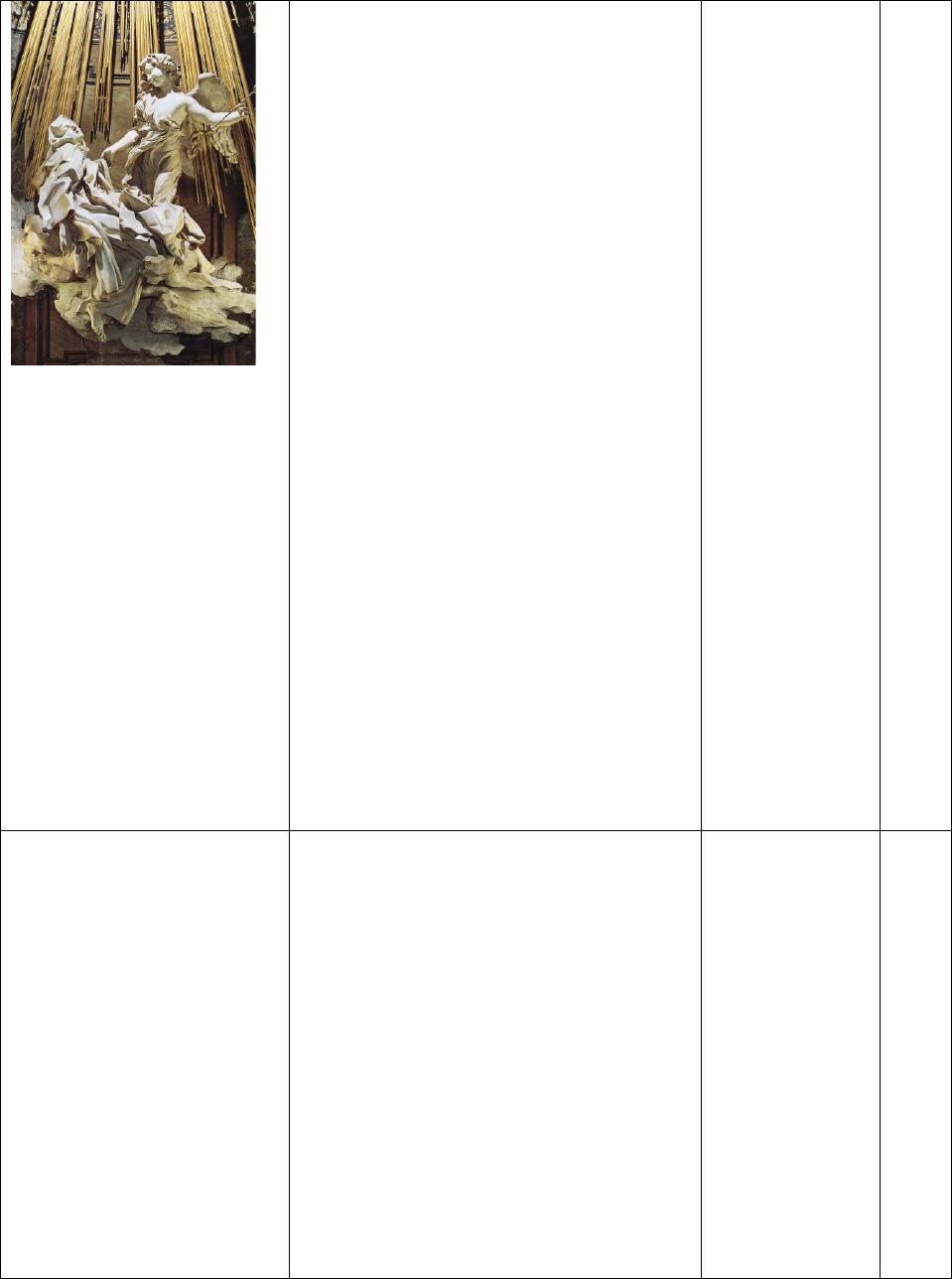
marble—clouds, robes, feathery wings.
• She looks
like she is
tried and
there is the
arrow that
would be
stab into
her heart
• Making the
emtion on
her face
• The folds in
the cloths
are very
well
rendered
its very
move, and
free flowing
• He puts
rays of
light in the
back in top
and there is
like this
cloud in the
bottom.
This
creates a
texture
Borromini, San Carlo Alle
Quattro Fontane, 1638-
1641. Italian Baroque.
• Borromini was a
contemporary, friend, and
later rival of Bernini who went
further in emphasizing a
building’s sculptural qualities.
• Church of Saint Charles at the
Four Fountains, under the care
of the Trinitarians.
• Two facades in undulating
motion, creating a
counterpoint of concave and
convex elements (antithesis of
Renaissance symmetry and
mathematical order)
• four
fountains
• there is
basically 2
facades
• ti comes
out as
being very
unbalanced
• he cerates
concave (
bends in)
and convex
( bends out)
• more
instability
visually
and
movement
• he has a lot
of
decorative/
elements
sculptors
•
Caravaggio, Calling of St.
Matthew, Late 16th
century. Oil on canvas.
Italian Baroque.
• Oil on
canvase
s
• His
painting
where
really
bed.
• He
delved
the idea
of being