Case : “Appex Corporation”
Summary
Between the periods (1988-1991) under the leadership of Shikhar Ghosh as Chief Operating Officer,
the Appex Corpration changed several structures to respond to its growth as the company is the fastest
growing high technology company in the US. Revenue grew 1600% and was expected to continue to grow
rapidly. Even each of these structural modifications has provided some improvement of operating
performance for a short period of time. However, each kind of structures have generated another problem
and inefficiencies to the company and also effect to the new product innovation, operating performance and
the growth of the firm. Consequently, the organization tend to change in organization behaviors and focus
more on individual not on whole company. Gosh always surprise by the immediacy of the impact of
structural changes: “What is striking to me is how quickly behavioral changes occur in the reaction of
structural changes” He asserted that although structural changes created some anxiety among employees,
they were necessary: “As we hire new people and the business changes, we need to change the structure to
match the people and the business changes.”
In October 1990, EDS an Information System Management own by GM, acquired Appex. As a
division of EDS, Appex had to follow EDS’s requirements, such as its financial planning system, resource
allocation system and administrative procedures. Following the acquisition, Appex’s challenge was to work
out its own divisional structure and structural changes in the context of its role as a division of larger,
bureaucratic organization.
Analyze the strengths and weakness of each structural form
To response the growth of the company Gosh has restructured the organization for several times
unfortunately, each restructuring has generated the problems rather than positives.
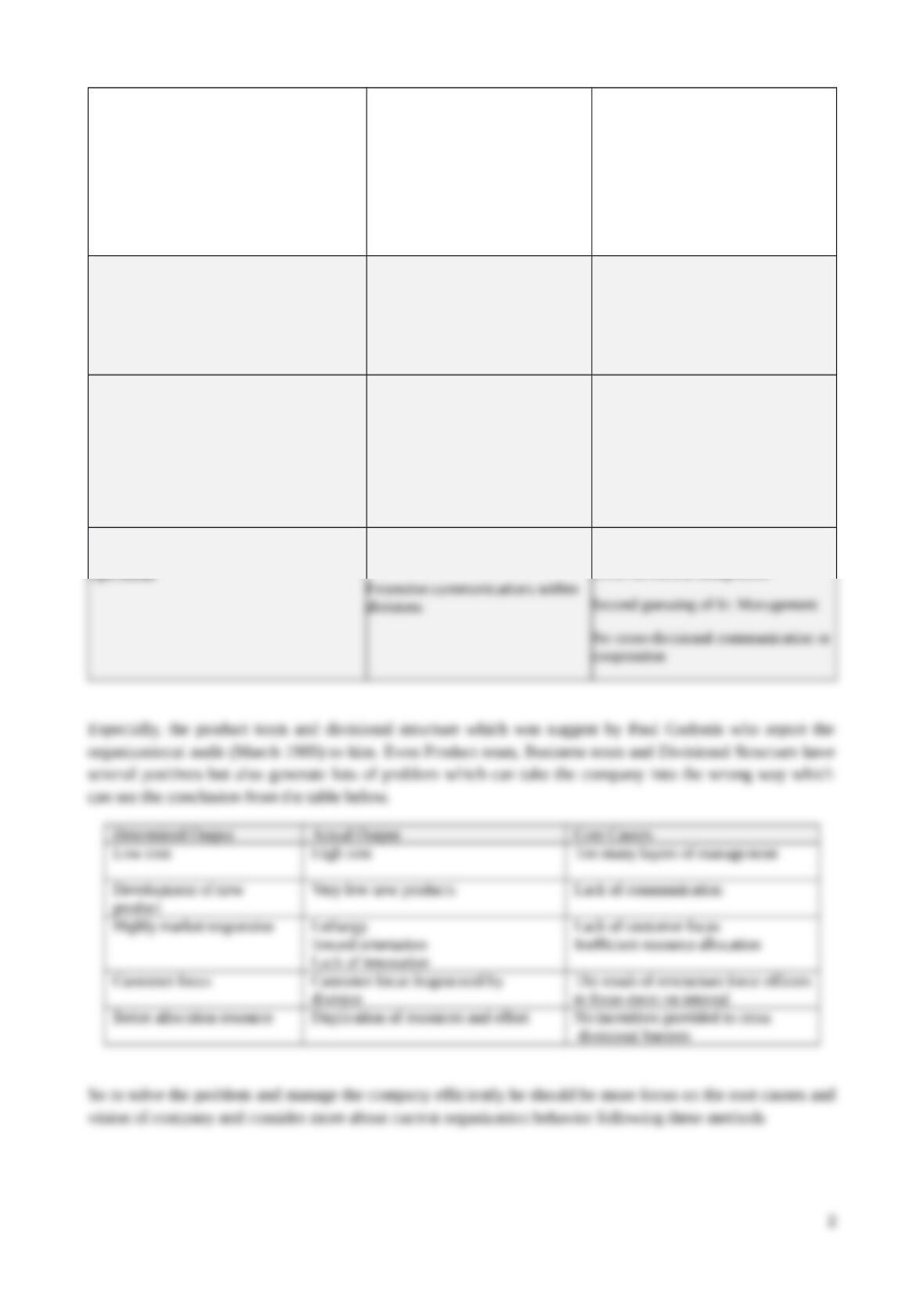
We can see the summary of structural changes of the company during 3 years controlled by Gosh from the
table below
Structure Strength Weakness
Start-Up Stage
Informal and fluid organization
Focus, committed and hard working
Close interaction with each other
Quickly response to market
No underlying planning structure,
priorities, schedules
Fire-fighting mentality
No product accountability
Unclear reporting structure
Lack of customer service responses
Circular Structure
Non-hierarchical organization
expanding out from executives to customers
Information flow continuously and
freely
Theoretically customer-based
Theoretically responsive structure
Employees could not relate
Unclear power structure
Customer became the “enemy”
Horizontal Structure
Non-hierarchical
Typical organization chart turned sideways
Impression of traditional structure Complete failure
Employees gave no response
1
Hierarchical, Functional Structure
Separation into functional teams (e.g. Sales,
Service, Operations)
Focus on task completion
Increased planning
System for assessing accountability
Extensive politics
Development of sub-functions
Polarization of teams
Reduction on cooperation
Poor skill/management matches
Addition of Product Teams
Overlay of functional representatives for
each key product
Improved planning
Application of management vs.
skill to products
No system of authority
Extensive executive decision support
No system of priorities between
products
Addition of Business Teams
Intermediaries between product teams and
corporate management
Decision making authority
Resource allocation authority
“More tail than tooth” – too many
people in overhead
Too many layers of management
Internal process focus
Loss of customer focus
Divisional Structure
Separation into three divisions, ICS, IS, and
Improved accountability, budgeting,
and planning
Resource allocations squabbles
Cross-divisional antagonism