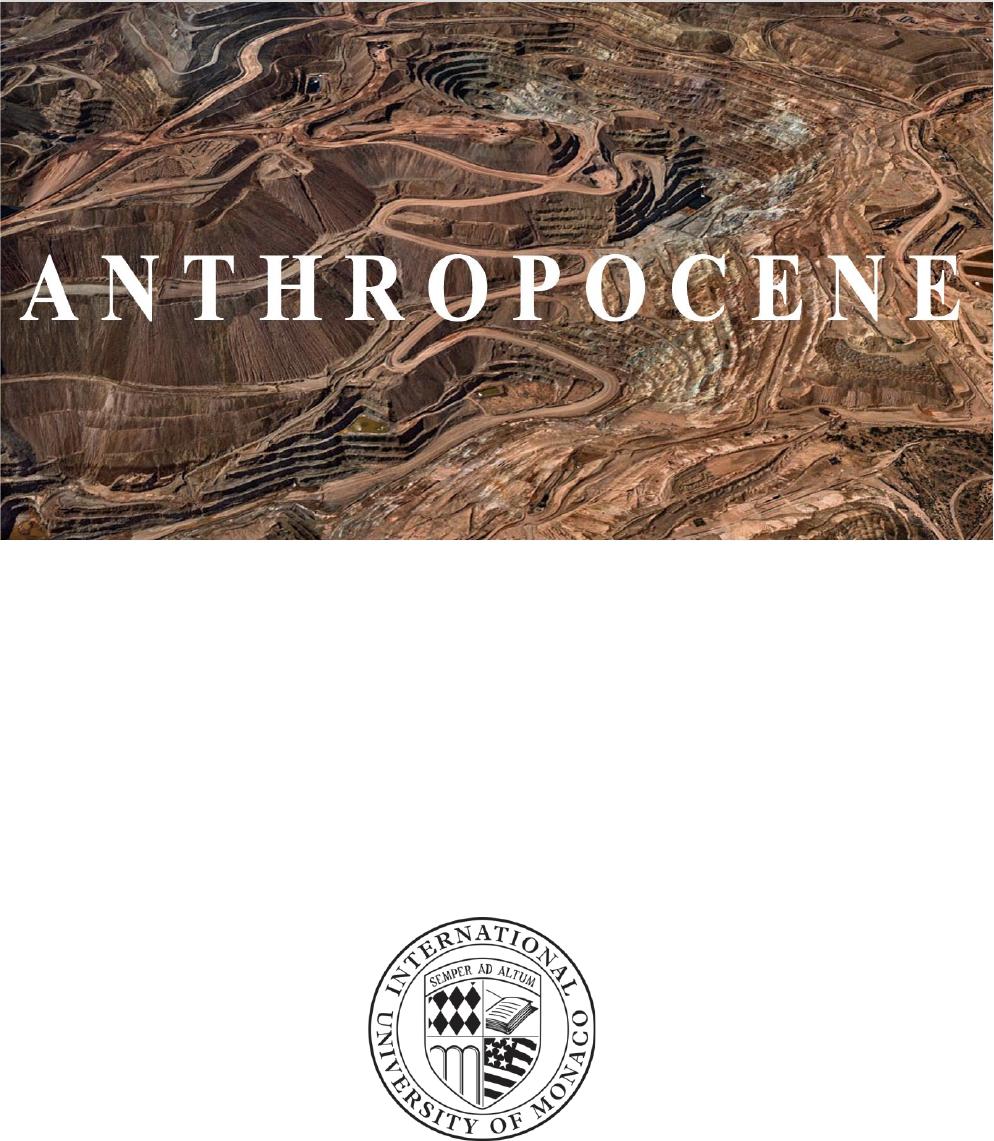
How can an ethical business have a positive
impact on the Anthropocene?
Roberta Spotorno Ethics of business
a.y. 2020-2021 Prof. H. Cristini
2
Agenda
Abstract
1. Introduction
2. Man and nature through times
2.1 Greeks
2.2 Romans, Jewish and Christians
2.3 Middle Age
2.4 Renaissance
2.5 Enlightenment
2.6 XVIIth up to XXIth century
3. The Anthropocene
3.1 Anthropocene & Corona virus
4. The ethical business and the apparent ethical business
5. Conclusion
References
3
How can an ethical business have a positive
impact on the Anthropocene?
Abstract
The Anthropocene is a phase in geological scale that in which men has brought the planet beyond his
natural limits.
Human beings are not mere participants on planet’s life, they are a dominant force: on the seas, on
landscapes, on animals that can lead a catastrophic changes on a planetary scale. There is no way to
come back: now we live in a different world.
The men is destroying is own home, driven only by a selfish behavior that is that has put a timer to
the point of no-return ever closer; the Anthropocene is a difficult idea to accept, because it requires
us to see the world differently.
Key words: Anthropocene; awareness; different; ethical;
4
How can an ethical business have a positive
impact on the Anthropocene?
1. Introduction
We live in an age that is both fascinating and terrifying.
Fascinating because never as today the planet Earth is in our hands: what will take place tomorrow,
will largely depend on what the men will or will not do today.
Fearsome, because our generation is the first to have the power to quickly destroy everything that
comes from the past irreparably, being conscious about the harm that is causing.
As all pandemics the man has been gone through, today coronavirus gave the possibility to rethink
about new values, new ways of think at the reality and especially how man can do make the difference
to reverse this disastrous course.
The idea of the pursuit of individuum, self-interests, happiness, egoism and well-being has changed
a lot during ages, this caused a continuous reshaping of cultural ethos in giving a justification for
man’s actions even more.
Ethos comes from ethics a term deriving from the ancient Greek ἔθος (êthos) that means “character”,
“behavior”, is also called moral philosophy that represents a branch of philosophy that indicates that
part of philosophy that deals with custom, that is, with human behavior. Ethics studies the
foundations that make it possible to assign a deontological status to human behaviors, or to distinguish
them into good, just, licit, concerning behaviors considered unjust, illicit, improper or bad according
to an ideal behavioral model. As a discipline, it addresses issues inherent in human morality by
defining concepts such as good and evil, right and wrong, virtue and vice, justice and crime.
This research paper is an attempt to examine how the relationship man-nature has changed during the
ages, how it has been adapted, changed until today when the man has to face his values and especially
with his actions rediscovering or reinventing some concepts of ethics, especially trying to understand
if an (real) ethical business approach can have a positive impact on Anthropocene.

5
2. Man and nature through times
Homo sapiens sapiens has been interacting with the natural world since it appeared on the face of the
Earth.
Over time and with the evolution of its cultural abilities, he has incredibly expanded its skills to
modify natural environments, but it is only for a very short time if we compare it to the period for
which it is supposed to have appeared on Earth: the human species has been rapidly and deeply
intervening on the cycles of the entire biosphere, bringing water, air, soil, light where he wanted.
Our species has not only perfected its ability to adapt in the different natural environments present on
Earth, but he has also modified the environments themselves in greater proportions than those due to
the intervention destroying a lot of living species’ habitats in a very short time.
Today there is no place in the biosphere where human intervention has not come in some way, directly
or indirectly; given that, what it is interesting the evolution of reasoning that is behind the relation
between men and nature.
2.1 Greeks
In ancient Greece, the man-environment relationship was a unitary whole, an anthropocentric vision
in which the human being is the focal center in natural reality, the only and undisputed ruler, but
nature has a double nature: it is both a locus amenus synonymous with peace, wonder, serenity but is
also horrifying, unstable, dangerous and merciless (locus horridus).
According to Plato, the world is compared to a machine in which all nature is a living organism, this
one tends towards the good, for this reason, men must do their part not obeying private interests at
the expense of others, but aspire to sobriety, controlling appetites. In his Theory of greatness man, a
human being can pursuit excellence, being virtuous and therefore in harmony with nature: it is a circle
that is destined not to break if the values such as simplicity and frugality are pursued.
A factor that deviates the man from his path is luxury: the biggest manifestation of selfishness and
self-fulfillment. The sentiments that come from luxuries such as rivalry, jealousy and enviousness, as

6
Plato forecasted, brought to the conflicts between Hellenic states, tearing down the Ancient Greek
civilization.
Another famous philosopher, Seneca was convinced that nature has generated man in a suitable
environment to meet the needs of his species and provided him with everything necessary for survival;
only the taste for the superfluous and the desire to possess have distanced man from virtue and
wisdom.
In particular, the philosopher disputes the thesis according to which man is disadvantaged by nature
compared to other animals, in comparison with he lacks natural defenses: so this starts to open a more
“justificative” way of acting towards nature, in particular towards animals.
As Plato, Seneca denunciated the luxury as the cause of men’s malaise: the happy age in which nature
regulated desires is certainly an abstraction that belongs to the utopia of the past. However if Seneca’s
thought came from old times, can be recognized very modern traits in the denunciation of a
degeneration typical of a “civilization of consumption”, in an order of ideas in which the intelligence
of man is not committed to building happiness, but to always creating new material needs.
2.2 Romans, Jewish and Christians
The eco-philosophy has ancient origins: the ancient observation of nature had strong magical-
religious components, even if did not lack scientific observation of it.
Natural calamities such as earthquakes, fires, floods, eclipses and much more, were considered
wonders to be interpreted, divine signs that were linked to the social or political events of a particular
people; nature could not be fought: magic and religion prevailed over everything, and the only way
to appease God or other supernatural entities was through rectitude and metanoia.
What divided people was again the luxury: “a pitiful creature subjected to his needs he cannot resist,
a mere slave under the yoke of his own desires” (Shaw, 1986 p.79), but then after Jesus Christ, the
“regulated” luxury (without waste), became to be more accepted with religious explanation in order
to give and help the next without reserve in name of a symbolic love.
2.3 Middle Age
The medieval man did not feel placed in front of nature, nor to be part of it: it is only a part of reality,
and not the most important, not the essential one.
Nature presents itself in the double role of dispenser of food and life, of the keeper of secret riches,
and therefore full of supernatural and symbolic signals: thus, the dark forests allude to the darkness
of sin, the snake, the fox, the wolf and the legendary animals represent a particular vice or a particular
“human” quality.
Besides, the fuel for heating and cooking food is obtained from nature, like natural medicines, with
which to treat the ailments of the body and, to a certain extent, those of the soul; and also the potions,
the filters, the poisons, which witches and sorcerers know so well, much to the fear of God-fearing
men. But one thing is certain: nature, or rather its elements (water, fire, wind, earth) are not admired,
much less venerated, in themselves, but only as reflections of the splendor, of the divine wisdom and